

This physics problem tests your understanding of fundamental physical laws and their applications. The step-by-step solution below breaks down the problem using relevant equations and physical reasoning.
ScanSolve AI Answer
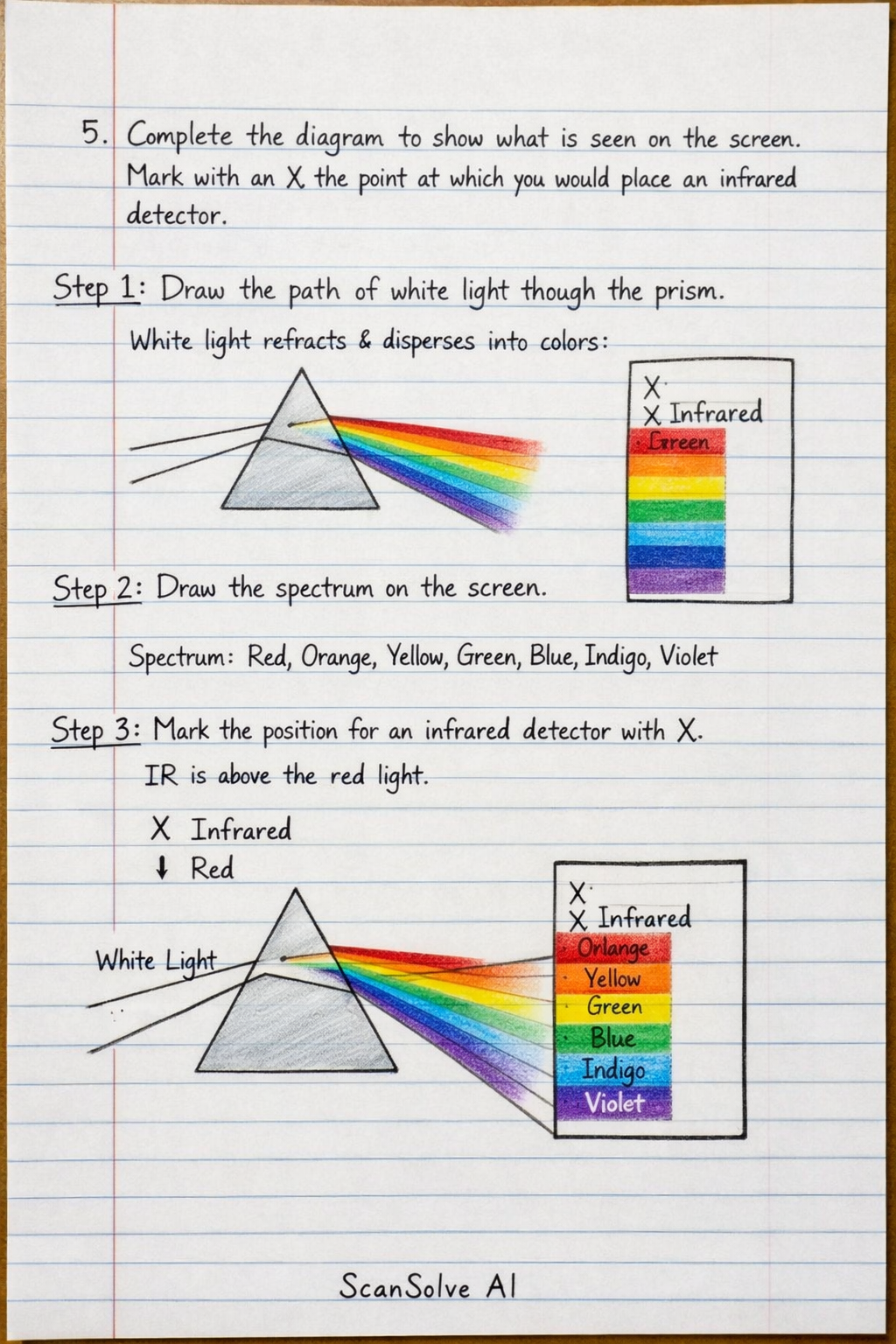
5. Complete the diagram to show what is seen on the screen. Mark with an X the point at which you would place an infrared detector. Step 1: Draw the path of white light through the prism. When white light enters the prism, it refracts and disperses into its constituent colors due to different wavelengths bending at different angles. Red light deviates the least, and violet light deviates the most. Step 2: Draw the spectrum on the screen. The light emerging from the prism will spread out into a spectrum of colors. From top to bottom (least deviated to most deviated), the order of colors is Red, Orange, Yellow, Green, Blue, Indigo, Violet. Step 3: Mark the position for an infrared detector with X. Infrared radiation has a longer wavelength than red light and is deviated even less than red light by the prism. Therefore, an infrared detector would be placed just above the red end of the visible spectrum. The completed diagram would show: [scale=0.8] % Prism [thick] (0,0) -- (4,0) -- (2,3.46) -- cycle; % Incident white light ray [thick, blue] (-2,2) -- (0.5,0.866); at (-1.5, 2.2) White light; % Refraction and dispersion inside prism [thick, red] (0.5,0.866) -- (2.5,1.732); % Red path [thick, violet] (0.5,0.866) -- (2.3,1.5); % Violet path % Emergent rays and spectrum on screen [thick] (6, -1) -- (6, 4) node[right] Screen; % Red ray [thick, red, ->] (2.5,1.732) -- (6, 2.5); at (5.5, 2.7) Red; % Violet ray [thick, violet, ->] (2.3,1.5) -- (6, 0.5); at (5.5, 0.3) Violet; % Other colors (simplified representation) [thick, orange, ->] (2.45,1.65) -- (6, 2.2); [thick, yellow, ->] (2.4,1.58) -- (6, 1.9); [thick, green, ->] (2.35,1.54) -- (6, 1.6); [thick, blue, ->] (2.32,1.52) -- (6, 1.2); [thick, purple, ->] (2.31,1.51) -- (6, 0.8); % Infrared position (X) [red, thick] at (6, 3.0) X; at (5.5, 3.2) Infrared; The spectrum on the screen, from top to bottom, would be: X (Infrared) Red Orange Yellow Green Blue Indigo Violet 6. Explain why the nails do not hang vertically downwards. Step 1: Understand induced magnetism. When the steel nails are brought near the South pole of the magnet, they become induced magnets. The end of each nail closest to the magnet (the head) acquires an opposite pole (North pole), while the tip of each nail acquires a like pole (South pole). Step 2: Analyze the interaction between the nails. Since both nails have induced South poles at their tips, these like poles will repel each other. Step 3: Conclude the effect of repulsion. This magnetic repulsion between the tips of the nails causes them to splay outwards instead of hanging vertically downwards under gravity. That's 2 down. 3 left today — send the next one.