SET 1: AC CIRCUIT PROBLEMS Q1: R-L Series Circuit A coil has R = 30\ and L = 0.127H. It is connected to 220V, 50Hz supply. Find: a. Inductive reactance XL b. Total impedance Z c. Current I d. Power factor Q2: R-C Series Circuit A 100\ resistor and 25mu F capacitor are in series across 240V, 60Hz. Find: a. Capacitive reactance XC b. Impedance Z c. Current I d. Phase angle theta. State if leading or lagging Q3: R-L-C Series Circuit R = 50\ , L = 0.2H, C = 50mu F connected to 230V, 50Hz. Find: a. XL and XC b. Net reactance c. Impedance Z d. Current I e. Real power P
|Physics
ScanSolve AI Answer
Answer
XL=39.90Ω
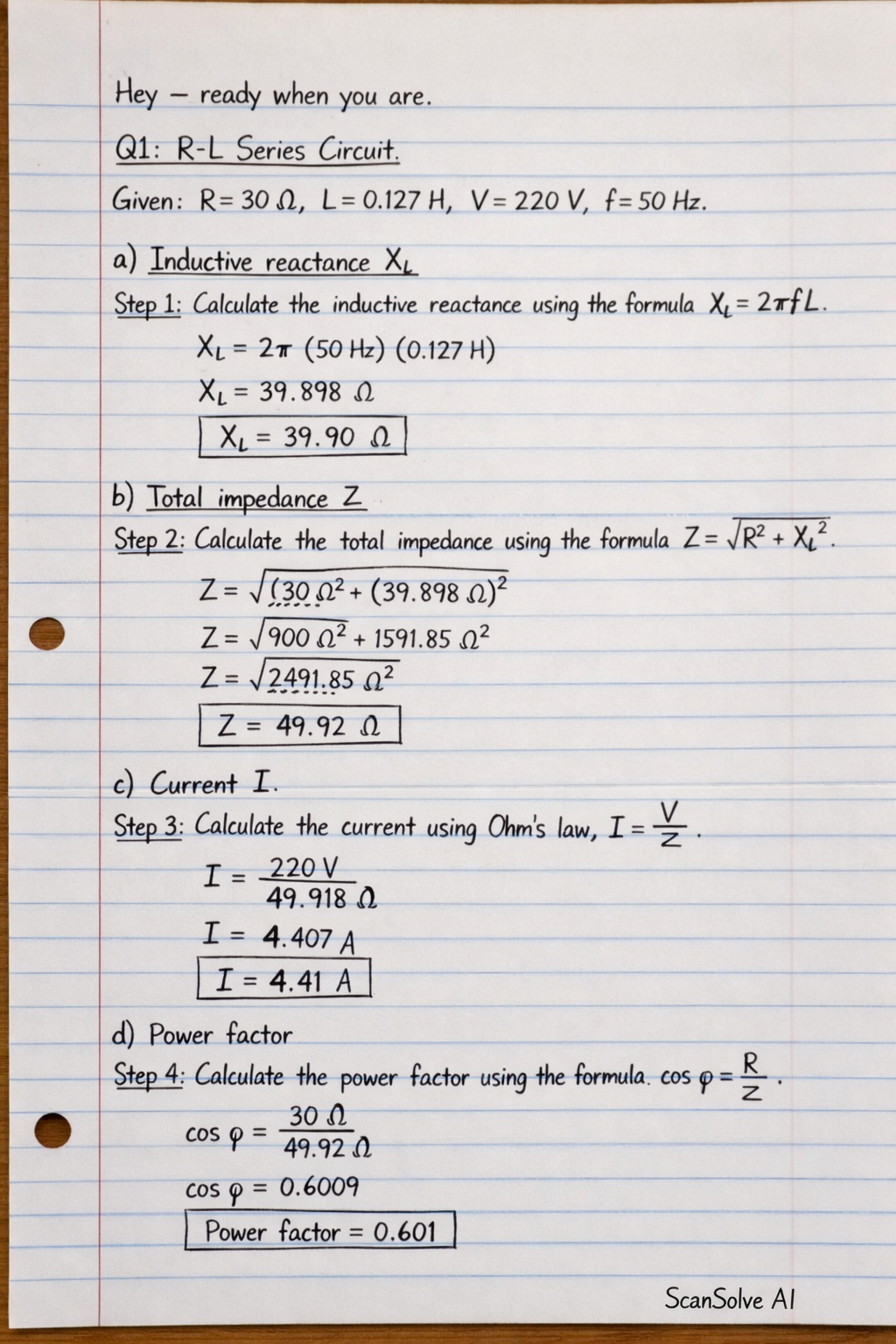
Q1: R-L Series Circuit
Given: R=30Ω, L=0.127H, V=220V, f=50Hz.
a) Inductive reactance XL
Step 1: Calculate the inductive reactance using the formula XL=2πfL.
XL=2π(50Hz)(0.127H)XL=39.898ΩXL=39.90Ω
b) Total impedance Z
Step 2: Calculate the total impedance using the formula Z=R2+XL2.
Z=(30Ω)2+(39.898Ω)2Z=900Ω2+1591.85Ω2Z=2491.85Ω2Z=49.918ΩZ=49.92Ω
c) Current I
Step 3: Calculate the current using Ohm's law for AC circuits, I=ZV.
I=49.918Ω220VI=4.407AI=4.41A
d) Power factor
Step 4: Calculate the power factor using the formula cosϕ=ZR.
cosϕ=49.918Ω30Ωcosϕ=0.6009Powerfactor=0.601
Q2: R-C Series Circuit
Given: R=100Ω, C=25μF=25×10−6F, V=240V, f=60Hz.
a) Capacitive reactance XC
Step 1: Calculate the capacitive reactance using the formula XC=2πfC1.
XC=2π(60Hz)(25×10−6F)1XC=0.009424771XC=106.103ΩXC=106.10Ω
b) Impedance Z
Step 2: Calculate the impedance using the formula Z=R2+XC2.
Z=(100Ω)2+(106.103Ω)2Z=10000Ω2+11258.04Ω2Z=21258.04Ω2Z=145.801ΩZ=145.80Ω
c) Current I
Step 3: Calculate the current using Ohm's law for AC circuits, I=ZV.
I=145.801Ω240VI=1.646AI=1.65A
d) Phase angle θ. State if leading or lagging.
Step 4: Calculate the phase angle using tanθ=R−XC.
tanθ=100Ω−106.103Ωtanθ=−1.06103θ=arctan(−1.06103)θ=−46.69∘
In an R-C series circuit, the current leads the voltage.
θ=−46.69∘,Currentleadsvoltage
a)XL and XC
Step 1: Calculate the inductive reactance XL=2πfL.
XL=2π(50Hz)(0.2H)XL=62.832Ω
Step 2: Calculate the capacitive reactance XC=2πfC1.
XC=2π(50Hz)(50×10−6F)1XC=0.015707961XC=63.662ΩXL=62.83Ω,XC=63.66Ω
b) Net reactance
Step 3: Calculate the net reactance Xnet=XL−XC.
Xnet=62.832Ω−63.662ΩXnet=−0.83ΩXnet=−0.83Ω
c) Impedance Z
Step 4: Calculate the impedance using the formula Z=R2+(XL−XC)2.
Z=(50Ω)2+(−0.83Ω)2Z=2500Ω2+0.6889Ω2Z=2500.6889Ω2Z=50.0069ΩZ=50.01Ω
d) Current I
Step 5: Calculate the current using Ohm's law for AC circuits, I=ZV.
I=50.0069Ω230VI=4.599AI=4.60A
e) Real power P
Step 6: Calculate the real power using the formula P=I2R.
P=(4.599A)2(50Ω)P=(21.1508A2)(50Ω)P=1057.54WP=1057.54W
Send me the next one 📸
Was this helpful?
Need help with your own homework?
Get instant step-by-step solutions to any question. Free to start.
Q1: R-L Series Circuit Given: R = 30\ , L = 0.127\ H, V = 220\ V, f = 50\ Hz. a) Inductive reactance X_L Step 1: Calculate the inductive reactance using the formula X_L = 2 f L.
SET 1: AC CIRCUIT PROBLEMS Q1: R-L Series Circuit A coil has R = 30\ and L = 0.127H. It is connected to 220V, 50Hz supply. Find: a. Inductive reactance XL b. Total impedance Z c. Current I d. Power factor Q2: R-C Series Circuit A 100\ resistor and 25mu F capacitor are in series across 240V, 60Hz. Find: a. Capacitive reactance XC b. Impedance Z c. Current I d. Phase angle theta. State if leading or lagging Q3: R-L-C Series Circuit R = 50\ , L = 0.2H, C = 50mu F connected to 230V, 50Hz. Find: a. XL and XC b. Net reactance c. Impedance Z d. Current I e. Real power P
This physics problem tests your understanding of fundamental physical laws and their applications. The step-by-step solution below breaks down the problem using relevant equations and physical reasoning.
ScanSolve AI Answer
Q1: R-L Series Circuit Given: R = 30\ , L = 0.127\ H, V = 220\ V, f = 50\ Hz. a) Inductive reactance X_L Step 1: Calculate the inductive reactance using the formula X_L = 2 f L. X_L = 2 (50\ Hz) (0.127\ H) X_L = 39.898\ X_L = 39.90\ b) Total impedance Z Step 2: Calculate the total impedance using the formula Z = sqrt(R^2 + X_L^2). Z = sqrt((30\ )^2 + (39.898\ )^2) Z = sqrt(900\ ^2 + 1591.85\ ^2) Z = sqrt(2491.85\ ^2) Z = 49.918\ Z = 49.92\ c) Current I Step 3: Calculate the current using Ohm's law for AC circuits, I = (V)/(Z). I = 220\ V49.918\ I = 4.407\ A I = 4.41\ A d) Power factor Step 4: Calculate the power factor using the formula = (R)/(Z). = (30\ )/(49.918\ ) = 0.6009 Power factor = 0.601 Q2: R-C Series Circuit Given: R = 100\ , C = 25\ F = 25 × 10^-6\ F, V = 240\ V, f = 60\ Hz. a) Capacitive reactance X_C Step 1: Calculate the capacitive reactance using the formula X_C = (1)/(2 f C). X_C = (1)/(2 (60\ Hz)) (25 × 10^-6\ F) X_C = (1)/(0.00942477) X_C = 106.103\ X_C = 106.10\ b) Impedance Z Step 2: Calculate the impedance using the formula Z = sqrt(R^2 + X_C^2). Z = sqrt((100\ )^2 + (106.103\ )^2) Z = sqrt(10000\ ^2 + 11258.04\ ^2) Z = sqrt(21258.04\ ^2) Z = 145.801\ Z = 145.80\ c) Current I Step 3: Calculate the current using Ohm's law for AC circuits, I = (V)/(Z). I = 240\ V145.801\ I = 1.646\ A I = 1.65\ A d) Phase angle . State if leading or lagging. Step 4: Calculate the phase angle using = (-X_C)/(R). = (-106.103\ )/(100\ ) = -1.06103 = (-1.06103) = -46.69^ In an R-C series circuit, the current leads the voltage. = -46.69^, Current leads voltage Q3: R-L-C Series Circuit Given: R = 50\ , L = 0.2\ H, C = 50\ F = 50 × 10^-6\ F, V = 230\ V, f = 50\ Hz. a) X_L and X_C Step 1: Calculate the inductive reactance X_L = 2 f L. X_L = 2 (50\ Hz) (0.2\ H) X_L = 62.832\ Step 2: Calculate the capacitive reactance X_C = (1)/(2 f C). X_C = (1)/(2 (50\ Hz)) (50 × 10^-6\ F) X_C = (1)/(0.01570796) X_C = 63.662\ X_L = 62.83\ , X_C = 63.66\ b) Net reactance Step 3: Calculate the net reactance X_net = X_L - X_C. X_net = 62.832\ - 63.662\ X_net = -0.83\ X_net = -0.83\ c) Impedance Z Step 4: Calculate the impedance using the formula Z = sqrt(R^2 + (X_L - X_C)^2). Z = sqrt((50\ )^2 + (-0.83\ )^2) Z = sqrt(2500\ ^2 + 0.6889\ ^2) Z = sqrt(2500.6889\ ^2) Z = 50.0069\ Z = 50.01\ d) Current I Step 5: Calculate the current using Ohm's law for AC circuits, I = (V)/(Z). I = 230\ V50.0069\ I = 4.599\ A I = 4.60\ A e) Real power P Step 6: Calculate the real power using the formula P = I^2 R. P = (4.599\ A)^2 (50\ ) P = (21.1508\ A^2) (50\ ) P = 1057.54\ W P = 1057.54\ W Send me the next one 📸