
This geography problem is solved step by step below, with detailed explanations to help you understand the method and arrive at the correct answer.
ScanSolve AI Answer
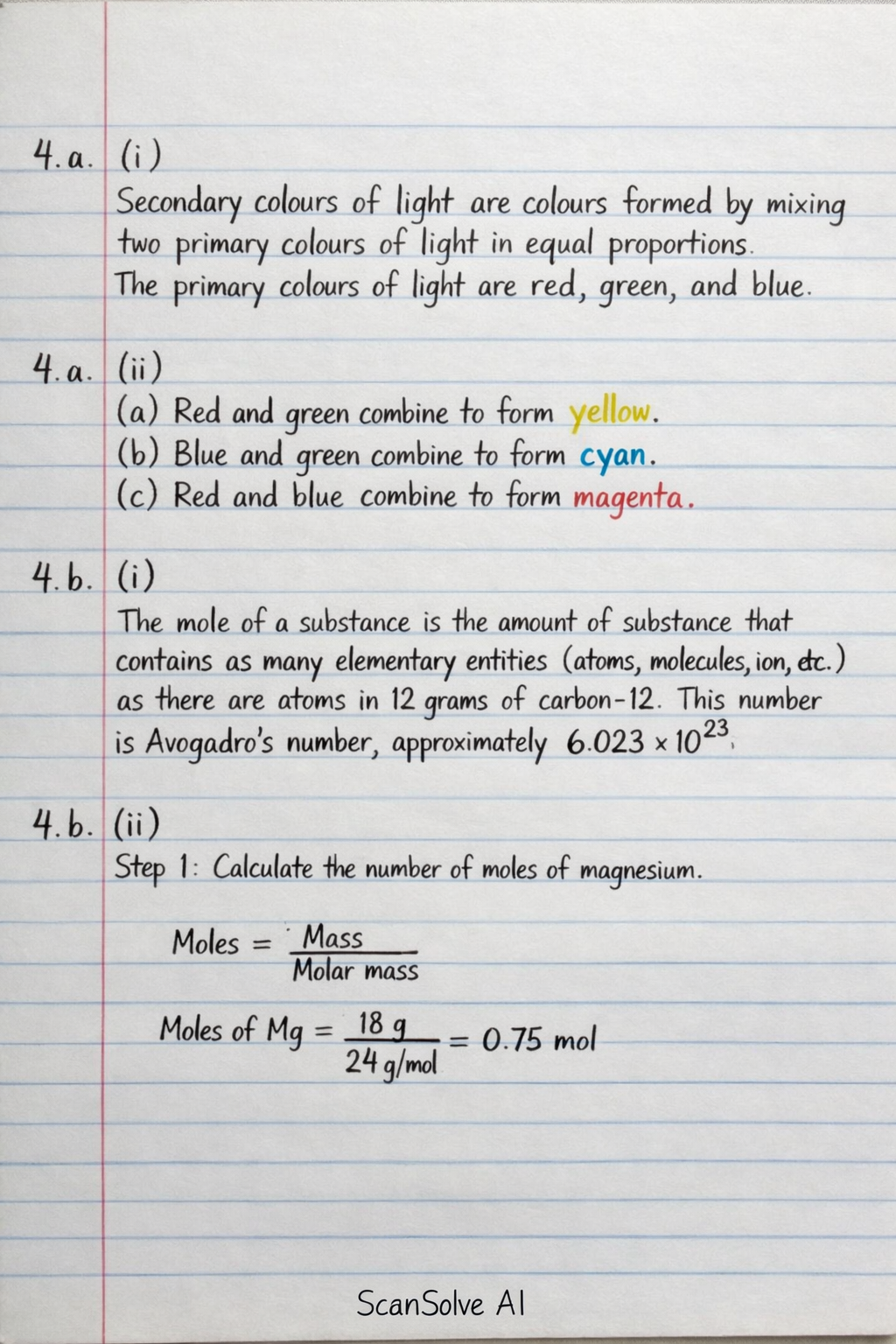
4. a. (i) Secondary colours of light are colours formed by mixing two primary colours of light in equal proportions. The primary colours of light are red, green, and blue. 4. a. (ii) (a) Red and green combine to form yellow. (b) Blue and green combine to form cyan. (c) Red and blue combine to form magenta. 4. b. (i) The mole of a substance is the amount of substance that contains as many elementary entities (atoms, molecules, ions, etc.) as there are atoms in 12 grams of carbon-12. This number is Avogadro's number, approximately 6.023 × 10^23. 4. b. (ii) Step 1: Calculate the number of moles of magnesium. Moles = MassMolar mass Moles of Mg = 18 g24 g/mol = 0.75 mol Step 2: Calculate the number of atoms. Number of atoms = Moles × Avogadro number Number of atoms = 0.75 mol × 6.023 × 10^23 atoms/mol Number of atoms = 4.51725 × 10^23 atoms The number of atoms in 18 g of magnesium metal is 4.51725 × 10^23 atoms. 4. c. (i) • Bone is a hard, rigid connective tissue that forms the skeleton, providing structural support and protection. It is highly vascularized and contains calcium salts. • Cartilage is a flexible, elastic connective tissue that is softer than bone. It provides cushioning, reduces friction in joints, and maintains the shape of certain body parts. It is avascular. 4. c. (ii) Cartilages are found in the following parts of the human body: Nose Ears Trachea (windpipe) Between vertebrae (intervertebral discs) Ends of long bones (articular cartilage) 4. d. (i) The deep litter system in poultry is a method where poultry are kept on a thick layer of absorbent material (such as wood shavings, straw, or rice hulls) that accumulates over time. This litter is allowed to build up and decompose, providing insulation and reducing the need for frequent cleaning. 4. d. (ii) Three advantages of the deep litter system are: It provides insulation, keeping the birds warm in cold weather. The decomposition of litter generates heat and produces organic fertilizer. It reduces labor costs associated with frequent cleaning and waste removal. That's 2 down. 3 left today — send the next one.