
This chemistry question involves key chemical concepts and calculations. The detailed solution below walks through each step, from identifying the reaction type to computing the final answer.
ScanSolve AI Answer
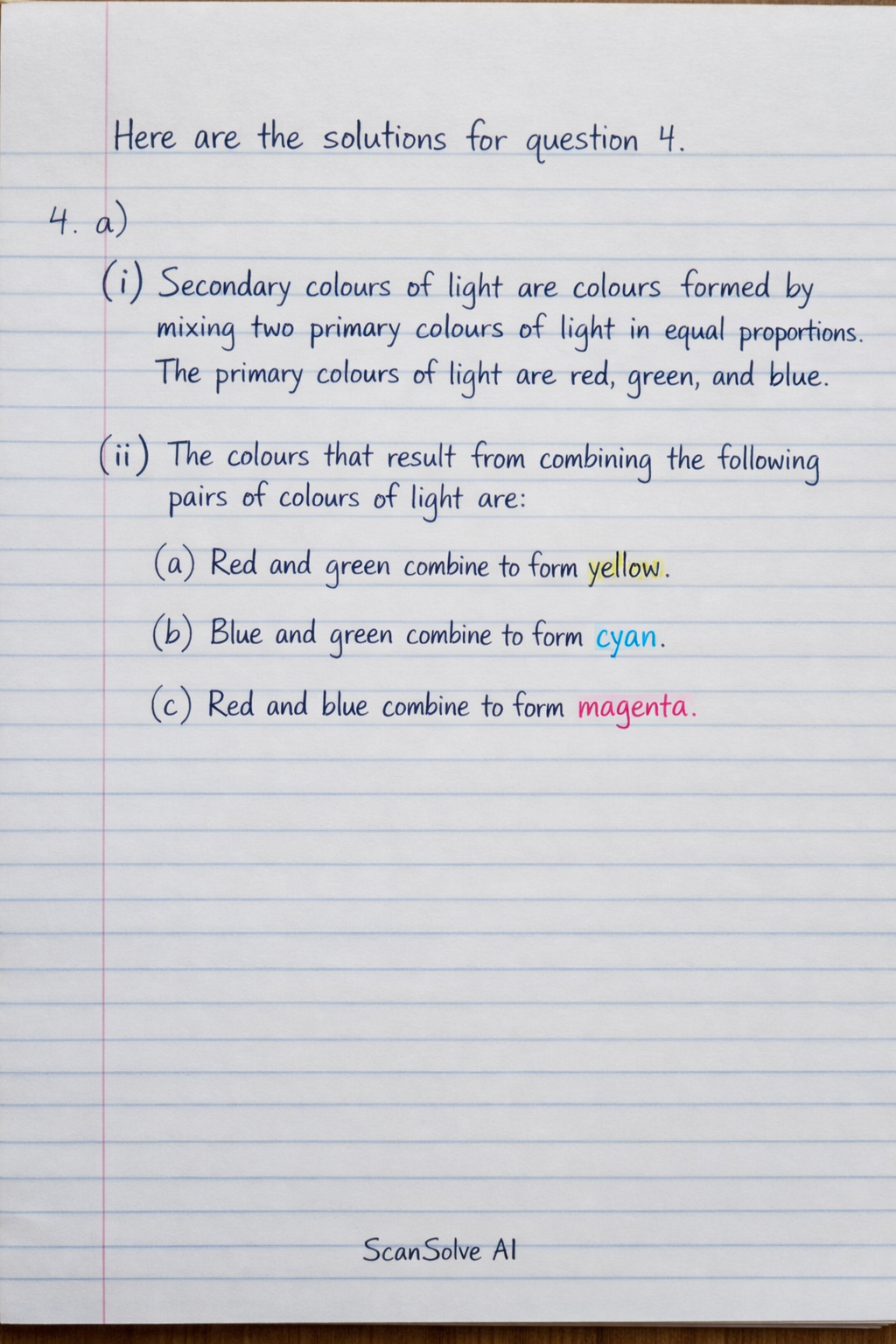
4. a) (i) Secondary colours of light* are colours formed by mixing two primary colours of light in equal proportions. The primary colours of light are red, green, and blue. (ii) The colours that result from combining the following pairs of colours of light are: (a) Red and green combine to form yellow*. (b) Blue and green combine to form cyan*. (c) Red and blue combine to form magenta*. b)* (i) The mole* of a substance is the amount of that substance which contains as many elementary entities (atoms, molecules, ions, etc.) as there are atoms in 12 grams of carbon-12. This number is known as Avogadro's number. (ii) Step 1: Calculate the number of moles of magnesium. Given: Mass of Mg = 18 g, Molar mass of Mg = 24 g/mol. Moles of Mg = MassMolar mass = 18 g24 g/mol Moles of Mg = 0.75 mol Step 2: Calculate the number of atoms using Avogadro's number. Avogadro's number = 6.023 × 10^23 atoms/mol. Number of atoms = Moles × Avogadro's number Number of atoms = 0.75 mol × 6.023 × 10^23 atoms/mol Step 3: Perform the multiplication. Number of atoms = 4.51725 × 10^23 atoms The number of atoms in 18 g of magnesium metal is 4.52 × 10^23 atoms. c)* (i) Bone is a hard, rigid, and highly vascularized connective tissue that forms the main part of the skeleton, providing structural support and protection. It is composed of a mineralized matrix (primarily calcium phosphate) and collagen fibers. Cartilage*, on the other hand, is a flexible, elastic, and avascular connective tissue that is softer than bone. It is composed of a matrix of collagen and elastic fibers embedded in a gel-like substance, providing cushioning, flexibility, and smooth surfaces for joints. (ii) Three parts of the human body where cartilages are found are: • The nose • The ears • The trachea (windpipe) d)* (i) The deep litter system* in poultry is a method of housing chickens where a thick layer of absorbent material (such as wood shavings, straw, or rice hulls) is spread on the floor of the poultry house. This litter accumulates droppings and gradually decomposes, forming a compost-like material that helps to absorb moisture, reduce odors, and provide warmth. (ii) Three advantages of the deep litter system are: • It provides insulation and warmth for the birds, especially during colder weather. • The decomposition process in the litter helps to reduce ammonia levels and suppress the growth of harmful bacteria. • It can reduce labor costs associated with frequent cleaning, as the litter is typically changed less often. 3 done, 2 left today. You're making progress.