
We read your photo as:
Explain Hydrolysis of proteins showing the formation of peptide bond.
ScanSolve AI Answer
4. Explain Hydrolysis of proteins showing the formation of peptide bond.
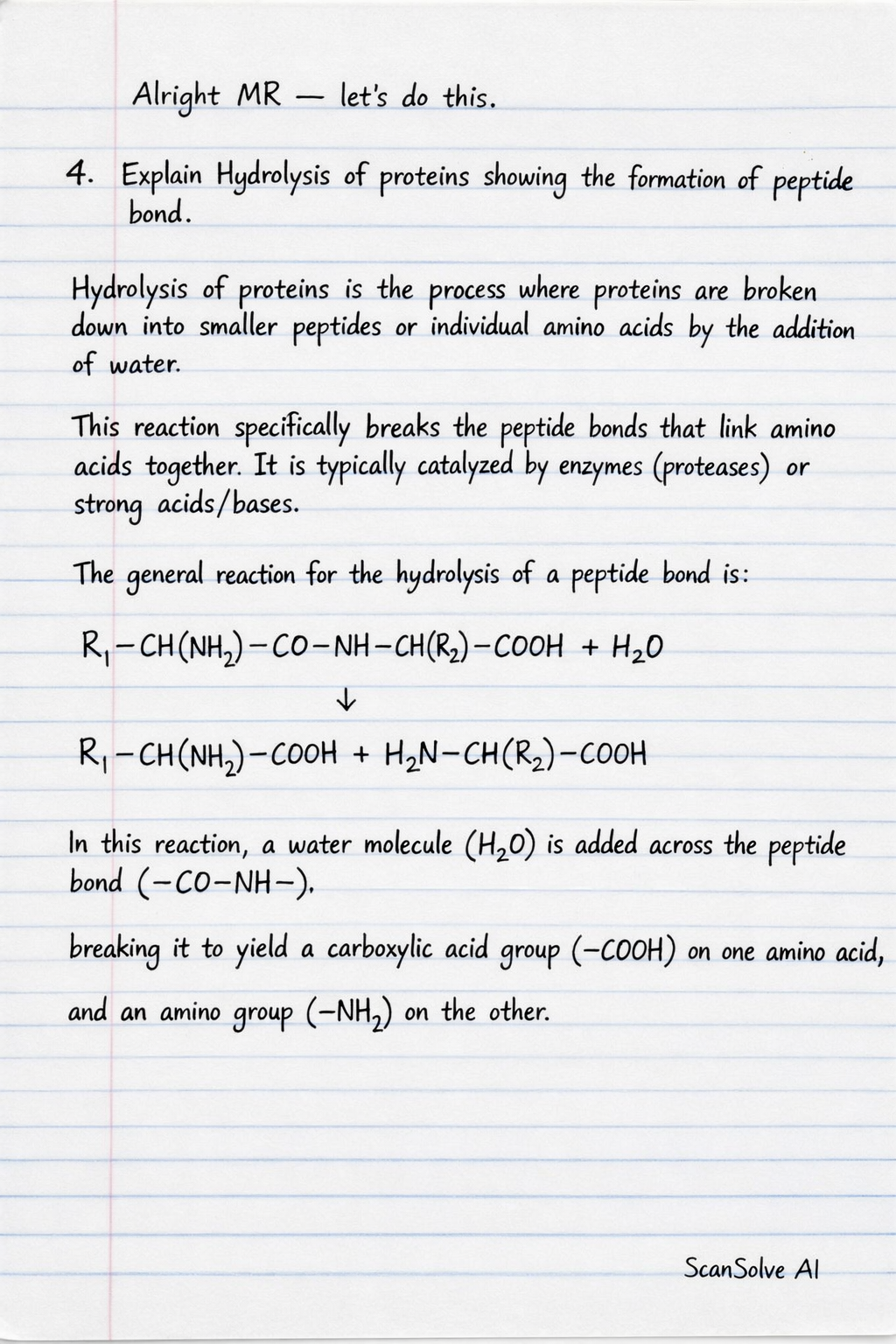
Hydrolysis of proteins is the process where proteins are broken down into smaller peptides or individual amino acids by the addition of water. This reaction specifically breaks the peptide bonds that link amino acids together. It is typically catalyzed by enzymes (proteases) or strong acids/bases.
The general reaction for the hydrolysis of a peptide bond is:
In this reaction, a water molecule () is added across the peptide bond (), breaking it to yield a carboxylic acid group () on one amino acid and an amino group () on the other.
The formation of a peptide bond is the reverse process of hydrolysis, known as dehydration synthesis or condensation reaction. It involves the reaction between the carboxyl group of one amino acid and the amino group of another amino acid, with the elimination of a water molecule. This reaction forms an amide linkage, which is the peptide bond.
The general reaction for the formation of a peptide bond between two amino acids is:
Here, the linkage is the newly formed peptide bond.
Still stuck on this one?
Ask a follow-up, and the answer starts from this question.
More Chemistry Questions
Handwritten Step-by-Step Solution
Get this as a handwritten image on WhatsApp — like a tutor wrote it for you.
Try on WhatsApp