
We read your photo as:
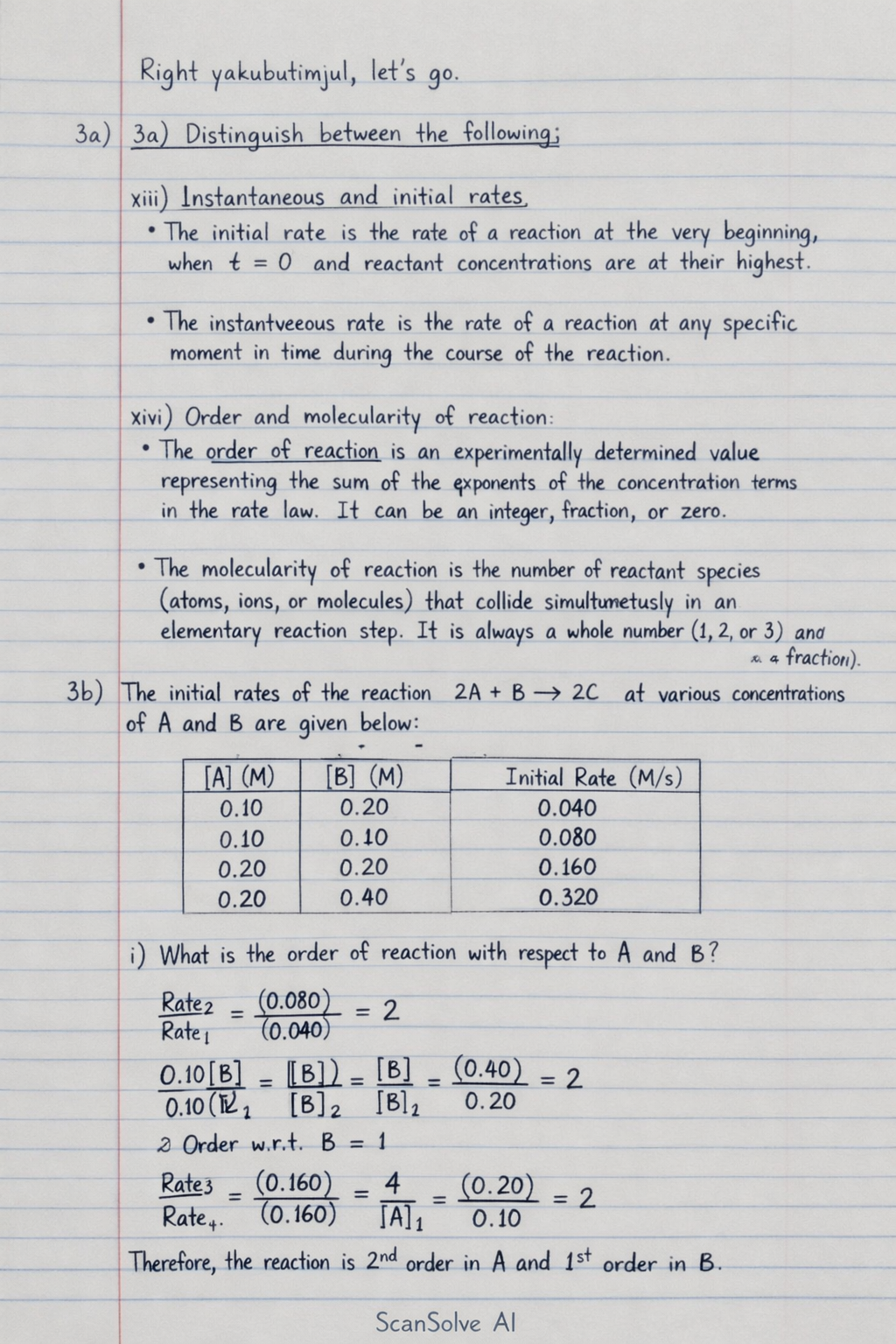
Distinguish between the following: a) Instantaneous and initial rates b) Order and molecularity of reaction
ScanSolve AI Answer
Step-by-step solution
3 steps3a) Distinguish between the following:
-
xiii) Instantaneous and initial rates
- The initial rate is the rate of a reaction at the very beginning, when time and reactant concentrations are at their highest.
- The instantaneous rate is the rate of a reaction at any specific moment in time during the course of the reaction.
-
xiv) Order and molecularity of reaction
- The order of reaction is an experimentally determined value representing the sum of the exponents of the concentration terms in the rate law. It can be an integer, fraction, or zero.
- The molecularity of reaction is the number of reactant species (atoms, ions, or molecules) that collide simultaneously in an elementary reaction step. It is always a whole number (1, 2, or 3) and cannot be zero or a fraction.
3b) The initial rates of the reaction at various concentrations of A and B are given below:
-
i) What is the order of reaction with respect to A and B?
Let the rate law be .
Determine the order with respect to A ().
Compare Experiment I and Experiment II, where $[B]$ is constant: $$ \frac{\text{Rate}_1}{\text{Rate}_2} = \frac{k[A]_1^x[B]_1^y}{k[A]_2^x[B]_2^y} $$ $$ \frac{0.20}{0.10} = \frac{k[0.02]^x[0.20]^y}{k[0.01]^x[0.20]^y} $$ $$ 2 = \left(\frac{0.02}{0.01}\right)^x $$ $$ 2 = (2)^x $$ $$ x = 1 $$ The reaction is **first order** with respect to A.Determine the order with respect to B ().
Compare Experiment II and Experiment III, where $[A]$ is constant: $$ \frac{\text{Rate}_3}{\text{Rate}_2} = \frac{k[A]_3^x[B]_3^y}{k[A]_2^x[B]_2^y} $$ $$ \frac{0.40}{0.10} = \frac{k[0.01]^x[0.40]^y}{k[0.01]^x[0.20]^y} $$ $$ 4 = \left(\frac{0.40}{0.20}\right)^y $$ $$ 4 = (2)^y $$ $$ y = 2 $$ The reaction is **second order** with respect to B.- ii) What is the overall order of reaction?
Calculate the overall order.
Overall order $= x + y = 1 + 2 = 3$. The overall order of the reaction is **third order**.3c) Match the statements given in Column I and Column II:
- (i) Catalyst alters the rate of reaction (c) By lowering the activation energy
- (ii) Molecularity (a) cannot be fraction or zero
- (iii) Second half-life of first order reaction (d) is same as the first
- (iv) Energetically favourable reactions are sometimes slow (b) proper orientation is not the only factor
- (v) Mathematical expression for rate of reaction (f) rate law
- (vi) Rate of reaction for zero order reaction is equal to (e) rate constant
- (vii) Units of rate constant for zero order reaction is same as (h) rate of a reaction
- (viii) Order of a complex reaction is determined by (g) order of slowest step
3d)
-
i) List three (3) physical parameters that can be used to monitor rate of reaction.
- Change in concentration (e.g., using spectroscopy or titration)
- Change in pressure (for gas-phase reactions)
- Change in color (if a reactant or product is colored)
-
ii) Write the Arrhenius equation and define the terms in it. The Arrhenius equation is:
Where:
- is the rate constant.
- is the Arrhenius pre-exponential factor (or frequency factor), representing the frequency of collisions with proper orientation.
- is the activation energy, the minimum energy required for a reaction to occur.
- is the ideal gas constant.
- is the absolute temperature in Kelvin.
-
iii) How does a catalyst work? A catalyst works by providing an alternative reaction pathway with a lower activation energy (). This allows a larger fraction of reactant molecules to have sufficient energy to react, thereby increasing the rate of the reaction without being consumed in the process.
-
iv) If the rate constant of a reaction is , then identify the order of the reaction. The unit of the rate constant () is . For a reaction of order , the general unit of the rate constant is . Comparing with , we see that the concentration term must be dimensionless, meaning . Therefore, . The reaction is a first-order reaction.
Still stuck on this one?
Ask a follow-up, and the answer starts from this question.
More Chemistry Questions
Handwritten Step-by-Step Solution
Get this as a handwritten image on WhatsApp — like a tutor wrote it for you.
Try on WhatsApp