
We read your photo as:
A) Order of reaction: The order of reaction with respect to a reactant is the exponent to which its concentration term is raised in the rate law. It indicates how the rate of reaction is affecte
ScanSolve AI Answer
Answers
2 partsfirst order
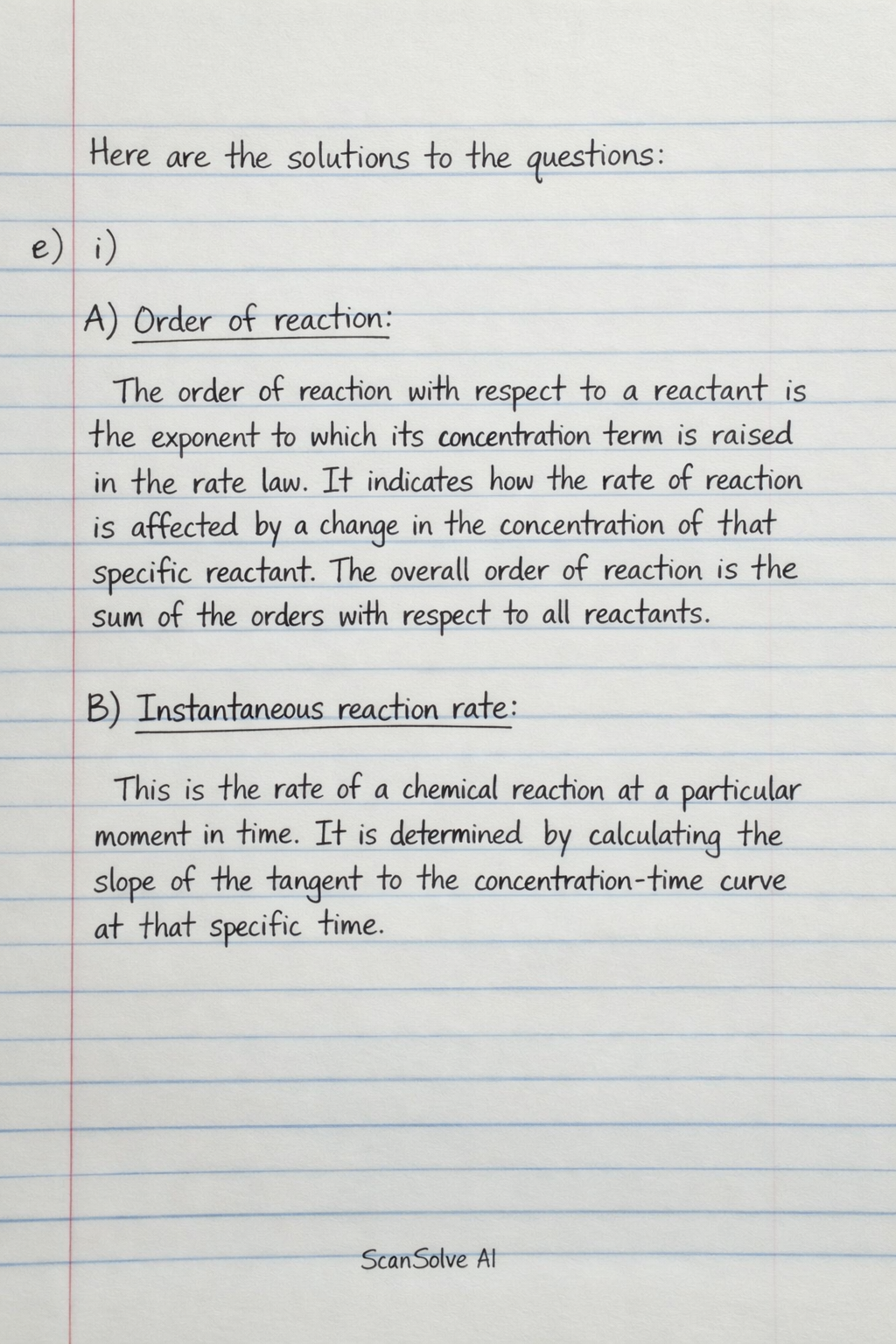
Here are the solutions to the questions:
e)
i)
A) Order of reaction: The order of reaction with respect to a reactant is the exponent to which its concentration term is raised in the rate law. It indicates how the rate of reaction is affected by a change in the concentration of that specific reactant. The overall order of reaction is the sum of the orders with respect to all reactants.
B) Instantaneous reaction rate: This is the rate of a chemical reaction at a particular moment in time. It is determined by calculating the slope of the tangent to the concentration-time curve at that specific time.
ii) Determine the half-life of the reaction:
The half-life () is the time required for the concentration of a reactant to decrease to half of its initial value.
Let's examine the data:
- From (at ) to (at ). The concentration has halved. The time taken is .
- From (at ) to (at ). The concentration has halved. The time taken is .
- From (at ), half of this is . This value is very close to at . The time taken is approximately .
Since the half-life is constant, the reaction is first order.
The half-life of the reaction is .
iii) Determine the order of the reaction with respect to A:
As observed in part (ii), the half-life of the reaction is constant and independent of the initial concentration of A. This is a characteristic property of a first-order reaction.
Therefore, the order of the reaction with respect to A is .
d) Define an acid according to Brønsted and Lowry:
According to the Brønsted-Lowry theory, an acid is a proton donor. It is a chemical species that donates a hydrogen ion () to another substance in a chemical reaction.
Try one yourself
A new problem that tests the same skill.
Still stuck on this one?
Ask a follow-up, and the answer starts from this question.
More Chemistry Questions
Handwritten Step-by-Step Solution
Get this as a handwritten image on WhatsApp — like a tutor wrote it for you.
Try on WhatsApp