
We read your photo as:
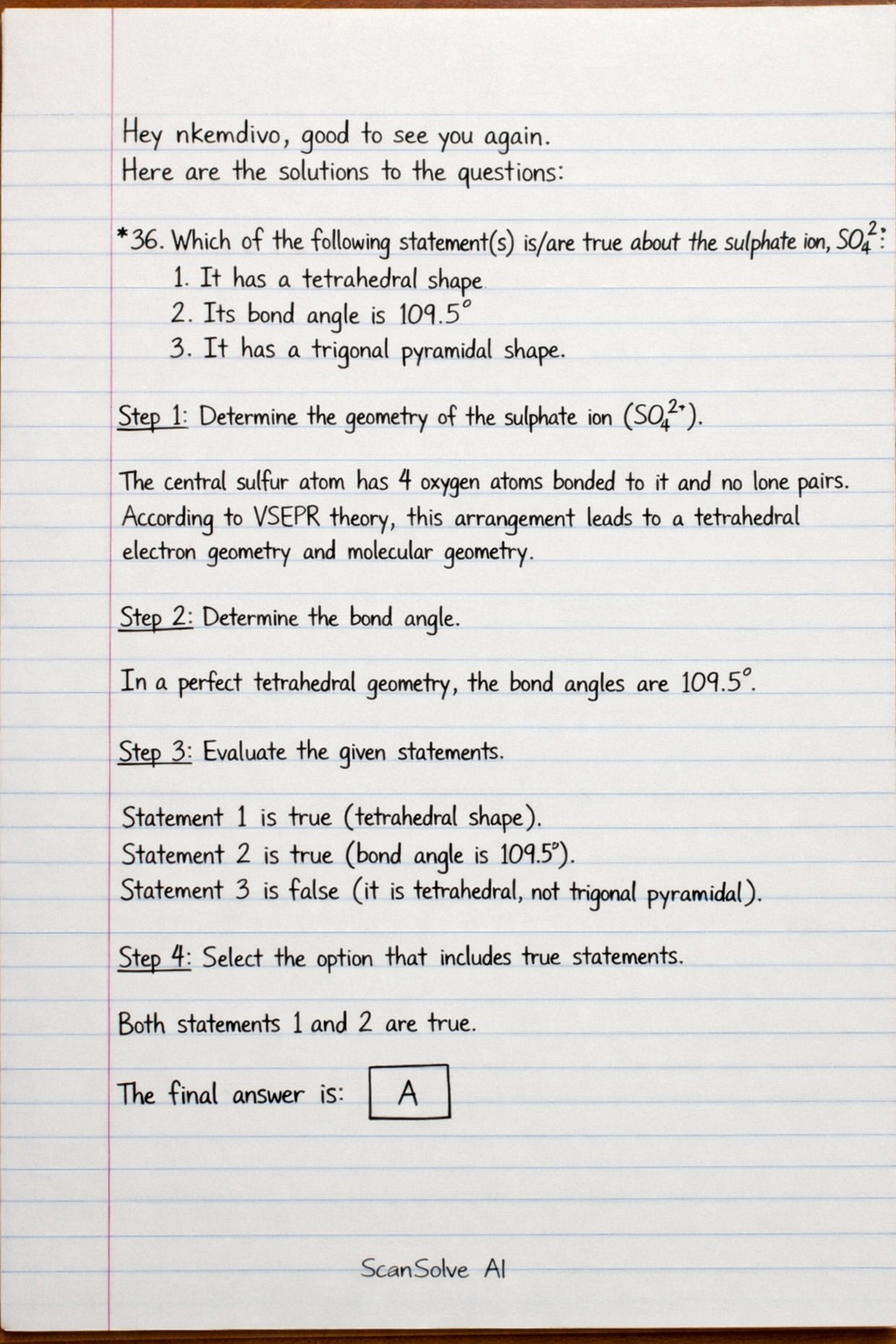
Which of the following statement(s) is/are true about the sulphate ion, SO42-? 1. It has a tetrahedral shape 2. Its bond angle is 109.5° 3. It has a trigonal pyramidal shape
ScanSolve AI Answer
Step-by-step solution
42 stepsHere are the solutions to the questions:
36. Which of the following statement(s) is/are true about the sulphate ion, ?
- It has a tetrahedral shape
- Its bond angle is
- It has a trigonal pyramidal shape
Determine the geometry of the sulphate ion ().
The central sulfur atom has 4 oxygen atoms bonded to it and no lone pairs. According to VSEPR theory, this arrangement leads to a tetrahedral electron geometry and molecular geometry.
Determine the bond angle.
In a perfect tetrahedral geometry, the bond angles are .
Evaluate the given statements.
Statement 1 is true (tetrahedral shape).
Statement 2 is true (bond angle is ).
Statement 3 is false (it is tetrahedral, not trigonal pyramidal).Select the option that includes true statements.
Both statements 1 and 2 are true.
The final answer is
37. Select the statement(s) that is/are characteristic of ideal mixtures.
- Obey Raoult's law
- Have components with similar chemical structures
- of mixing is zero
Recall the characteristics of an ideal mixture.
An ideal mixture is one where the interactions between different components are similar to the interactions between identical components.
Evaluate each statement.
- Obey Raoult's law: Ideal mixtures by definition obey Raoult's law over the entire range of concentrations.
- Have components with similar chemical structures: Components with similar chemical structures tend to have similar intermolecular forces, which is a characteristic of ideal mixtures.
- of mixing is zero: For an ideal mixture, there is no net change in enthalpy when the components are mixed, meaning .
Select the option that includes all true statements.
All three statements are characteristics of ideal mixtures.
The final answer is
38. Esters can be prepared by:
- Reaction of acid chlorides with alcohols
- Reaction of carboxylic acids with alcohols in presence of conc.
- Reaction of acid anhydrides with alcohols
Recall common methods for ester synthesis.
Esterification is the process of forming an ester.
Evaluate each method.
- Reaction of acid chlorides with alcohols: Acid chlorides react with alcohols to form esters and . This is a common and efficient method.
- Reaction of carboxylic acids with alcohols in presence of conc. : This is Fischer esterification, a classic method where a carboxylic acid reacts with an alcohol in the presence of an acid catalyst (like concentrated ) to form an ester and water.
- Reaction of acid anhydrides with alcohols: Acid anhydrides react with alcohols to form esters and a carboxylic acid. This is also a common method.
Select the option that includes all correct methods.
All three methods listed are valid ways to prepare esters.
The final answer is
39. The reactivity of group 17 (halogens) decreases down the group because:
- Atomic radius increases
- Electron affinity decreases
- Effective nuclear charge increases
Understand the trend in reactivity for halogens.
Halogens are highly reactive non-metals that tend to gain electrons. Their reactivity is related to their ability to attract electrons.
Analyze the effect of atomic radius down the group.
As you go down Group 17, the atomic radius increases because more electron shells are added. This means the outermost electrons are further from the nucleus.
Analyze the effect of electron affinity down the group.
Electron affinity generally decreases down the group because the increased atomic radius means the nucleus has less attraction for an incoming electron, making it less favorable to gain an electron.
Analyze the effect of effective nuclear charge down the group.
While the actual nuclear charge increases, the effective nuclear charge experienced by the valence electrons does not increase significantly down a group due to increased shielding from inner electrons. The ability to attract new electrons (reactivity) is more influenced by the increasing distance and shielding. A decreasing ability to attract electrons (decreasing electron affinity) leads to decreased reactivity.
Select the correct reasons for decreased reactivity.
The increased atomic radius and decreased electron affinity down the group make it harder for halogens to gain electrons, thus decreasing their reactivity.
The final answer is
40. Ethanal () and methanal () differ in their reactions with
- Iodine in solution (haloform test)
- 2,4-dinitrophenylhydrazine
- Fehling's solution
Identify the functional groups of ethanal and methanal.
Both ethanal () and methanal () are aldehydes.
Evaluate the reaction with iodine in solution (haloform test).
The haloform test (e.g., iodoform test with ) is positive for compounds containing a methyl ketone () or a secondary alcohol that can be oxidized to a methyl ketone (). Ethanal () has a methyl group attached to the carbonyl carbon, so it will give a positive haloform test. Methanal () does not have a methyl group attached to the carbonyl carbon, so it will give a negative haloform test. Thus, they differ in this reaction.
Evaluate the reaction with 2,4-dinitrophenylhydrazine (2,4-DNPH).
2,4-DNPH is a reagent used to detect the presence of carbonyl compounds (aldehydes and ketones). Both ethanal and methanal are aldehydes, so both will react with 2,4-DNPH to form an orange/yellow precipitate. They do not differ in this reaction.
Evaluate the reaction with Fehling's solution.
Fehling's solution is a mild oxidizing agent used to test for aldehydes. Both ethanal and methanal are aldehydes, and both will reduce Fehling's solution (forming a red precipitate of ). They do not differ in this reaction.
Select the option where they differ.
Ethanal and methanal differ in their reaction with iodine in solution (haloform test).
The final answer is
41. Select the hydride(s) which when dissolved in pure water will decrease the pH.
Understand what decreases pH.
A decrease in pH indicates an increase in acidity. We are looking for hydrides that act as acids in water.
Evaluate .
Ammonia () is a base. When dissolved in water, it accepts a proton to form ammonium ions () and hydroxide ions (), increasing the pH.
Evaluate .
Phosphine () is a very weak base, much weaker than ammonia. It is essentially neutral in water and does not significantly affect the pH.
Evaluate .
Hydrogen chloride () is a strong acid. When dissolved in water, it completely dissociates to form hydrogen ions () and chloride ions (), significantly decreasing the pH.
Select the hydride(s) that decrease pH.
Only will decrease the pH when dissolved in pure water.
The final answer is
42. Bromide ions are oxidised by chlorine according to the equation: . Which method can be used to monitor the rate of this reaction?
- Titrimetry
- Colorimetry
- Conductometry
Analyze the given reaction.
Reactants: Bromide ions (, colorless), Chlorine gas (, yellowish-green, but often used as aqueous solution).
Products: Bromine (, reddish-brown in solution), Chloride ions (, colorless).Evaluate Titrimetry.
Titrimetry involves determining the concentration of a substance by reacting it with a solution of known concentration. While it can be used to find concentrations at different times, it's not a continuous monitoring method and usually requires stopping the reaction or taking samples.
Evaluate Colorimetry.
Colorimetry measures the absorbance of light by a colored solution. In this reaction, (bromine) is formed, which is reddish-brown. The intensity of the color is proportional to the concentration of . Therefore, monitoring the increase in the reddish-brown color over time using a colorimeter can be used to determine the rate of reaction.
Evaluate Conductometry.
Conductometry measures the electrical conductivity of a solution. The conductivity depends on the concentration and mobility of ions. In this reaction, two ions are consumed, and two ions are produced. Since both are monovalent ions, the total number of ions in solution remains constant. The mobility of and ions are similar, so the overall conductivity change might not be significant or easily distinguishable for monitoring the reaction rate.
Select the most suitable method.
Colorimetry is the most direct and convenient method to monitor the rate of this reaction due to the formation of colored bromine.
The final answer is
43. When ethyl benzoate () is hydrolysed by excess , the products of the reaction are:
- benzoate ion
- ethanol
- phenol
Write the hydrolysis reaction of ethyl benzoate with .
Ethyl benzoate is an ester. Hydrolysis of an ester in the presence of a strong base (like ) is called saponification.
The products are sodium benzoate () and ethanol ().
Identify the products from the options.
- benzoate ion: Sodium benzoate dissociates in water to form benzoate ions () and sodium ions (). So, benzoate ion is a product.
- ethanol: Ethanol () is directly formed.
- phenol: Phenol () would be formed if the ester was phenyl benzoate, or if the benzene ring itself was involved in a different reaction, which is not the case here.
Select the correct products.
The products are benzoate ion and ethanol.
The final answer is
44. Choose the statement(s) that is/are true with respect to .
- It is the strongest among the hydrohalic acids
- It forms hydrogen bonds in the liquid state
- Its boiling point is higher than that of
Evaluate the strength of as a hydrohalic acid.
The hydrohalic acids are , , , and . Acidity generally increases down the group due to decreasing bond strength. is a weak acid, while , , and are strong acids. Therefore, statement 1 is false.
Evaluate hydrogen bonding in .
Fluorine is a highly electronegative atom, and hydrogen is directly bonded to it in . This allows for strong hydrogen bonding between molecules in the liquid state. Therefore, statement 2 is true.
Evaluate the boiling point of compared to .
Due to the strong hydrogen bonding between molecules, significantly more energy is required to overcome these intermolecular forces, resulting in a much higher boiling point for compared to (which only has weaker dipole-dipole interactions and London dispersion forces). Therefore, statement 3 is true.
Select the option that includes all true statements.
Statements 2 and 3 are true.
The final answer is
45. In an endothermic reaction,
- Heat is absorbed from the surroundings
- Energy of products is higher than energy of reactants
- is positive
Define an endothermic reaction.
An endothermic reaction is a chemical reaction that absorbs energy from its surroundings, usually in the form of heat.
Evaluate statement 1.
If heat is absorbed from the surroundings, the reaction is endothermic. This statement is true.
Evaluate statement 2.
Since energy is absorbed, the products will have more energy stored within their bonds than the reactants had. Therefore, the energy of the products is higher than the energy of the reactants. This statement is true.
Evaluate statement 3.
The change in enthalpy () for an endothermic reaction is positive because the system gains energy. This statement is true.
Select the option that includes all true statements.
All three statements are true for an endothermic reaction.
The final answer is
Still stuck on this one?
Ask a follow-up, and the answer starts from this question.
More Chemistry Questions
Handwritten Step-by-Step Solution
Get this as a handwritten image on WhatsApp — like a tutor wrote it for you.
Try on WhatsApp