

This chemistry question involves key chemical concepts and calculations. The detailed solution below walks through each step, from identifying the reaction type to computing the final answer.
ScanSolve AI Answer
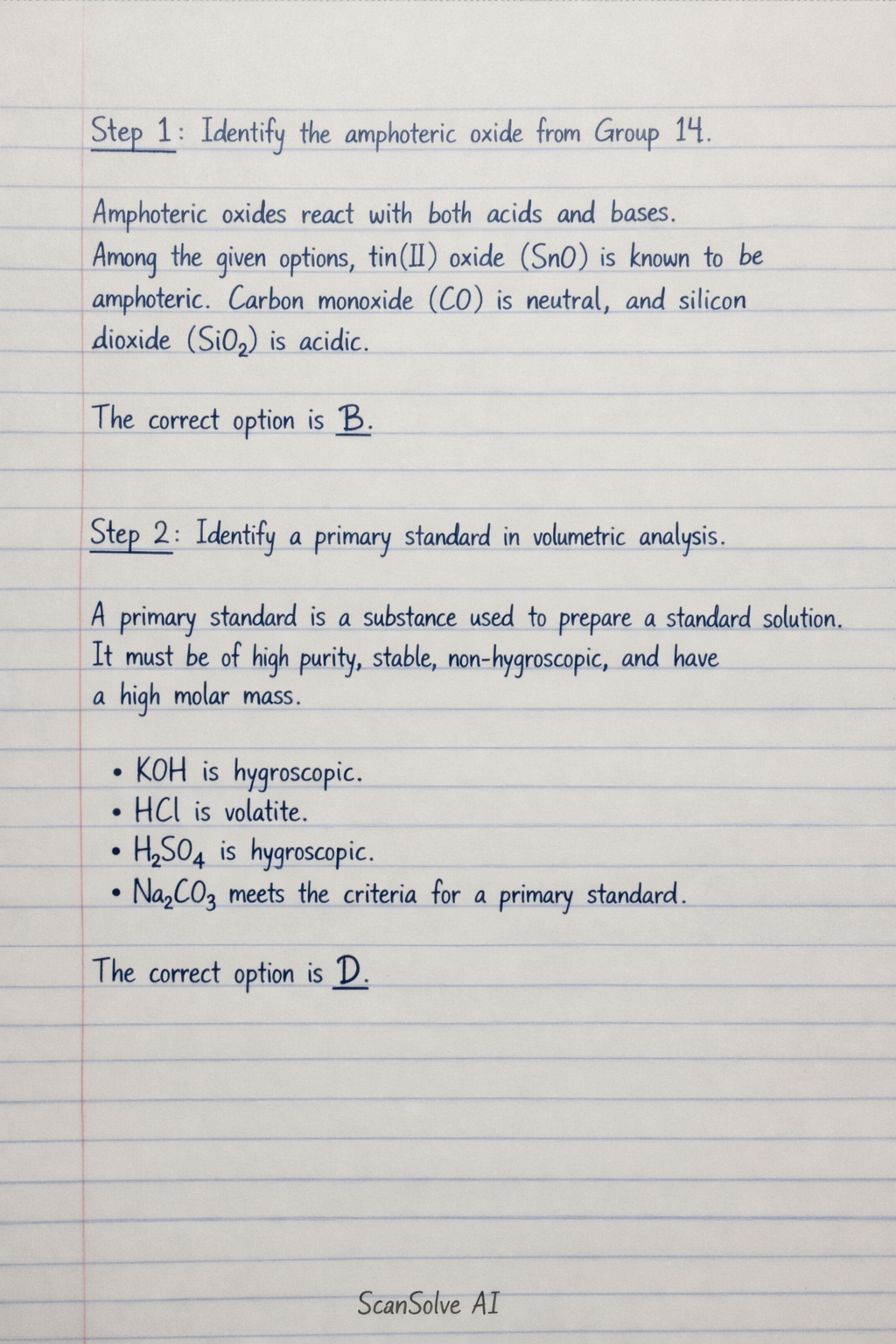
Step 1: Identify the amphoteric oxide from Group 14. Amphoteric oxides react with both acids and bases. Among the given options, tin(II) oxide (SnO) is known to be amphoteric. Carbon monoxide (CO) is neutral, and silicon dioxide (SiO_2) is acidic. The correct option is B. Step 2: Identify a primary standard in volumetric analysis. A primary standard is a substance used to prepare a standard solution. It must be of high purity, stable, non-hygroscopic, and have a high molar mass. • KOH is hygroscopic. • HCl is volatile. • H_2SO_4 is hygroscopic. • Na_2CO_3 meets the criteria for a primary standard. The correct option is D. Step 3: Identify the compound which on warming with aqueous sodium hydroxide will produce an alcohol. Warming with aqueous sodium hydroxide suggests a hydrolysis reaction. Haloalkanes undergo nucleophilic substitution with hydroxide ions to produce alcohols. • CH_3COOH (ethanoic acid) reacts with NaOH to form a salt and water. • C_2H_5OH (ethanol) is already an alcohol. • CH_2=CH_2 (ethene) undergoes addition reactions, not typically hydrolysis to an alcohol with NaOH. • CH_3CH_2Br (bromoethane) reacts with NaOH to form CH_3CH_2OH (ethanol). The correct option is D. Step 4: Calculate the mole fraction of methanol. The mole fraction of a component in a mixture is given by the moles of that component divided by the total moles of all components. Moles of methanol = 2.0 moles Moles of ethanol = 3.0 moles Total moles = 2.0 + 3.0 = 5.0 moles Mole fraction of methanol = Moles of methanolTotal moles = (2.0)/(5.0) = 0.40 The correct option is B. Step 5: Identify the type of isomerism between propanal and propanone. Propanal (CH_3CH_2CHO) is an aldehyde, and propanone (CH_3COCH_3) is a ketone. Both have the same molecular formula (C_3H_6O) but different functional groups. This is an example of functional group isomerism. The correct option is D. Step 6: Calculate the number of moles of carbonate ions (CO_3^2-) in 21.2 g of Na_2CO_3. The relative molecular mass (RMM) of Na_2CO_3 is given as 106. Moles of Na_2CO_3 = MassRMM = 21.2 g106 g/mol = 0.2 mol Since one molecule of Na_2CO_3 contains one carbonate ion (CO_3^2-), the number of moles of carbonate ions is equal to the number of moles of Na_2CO_3. Moles of CO_3^2- ions = 0.2 mol The correct option is B. Step 7: Identify particle X in the nuclear reaction. The nuclear reaction is: ^235_92U + ^1_0n ^141_56Ba + X + 3^1_0n For conservation of mass number (superscript): 235 + 1 = 141 + Mass number of X + 3 × 1 236 = 141 + Mass number of X + 3 236 = 144 + Mass number of X Mass number of X = 236 - 144 = 92 For conservation of atomic number (subscript): 92 + 0 = 56 + Atomic number of X + 3 × 0 92 = 56 + Atomic number of X Atomic number of X = 92 - 56 = 36 The element with atomic number 36 is Krypton (Kr). So, particle X is ^92_36Kr. The correct option is A. Step 8: Identify the pair of compounds that would undergo a condensation reaction. A condensation reaction involves the joining of two molecules with the elimination of a small molecule, typically water. • Ethanoic acid (a carboxylic acid) and ethanol (an alcohol) undergo esterification, which is a type of condensation reaction, to form an ester and water. The correct option is B. Step 9: Calculate the volume of 0.1 M H_2SO_4 needed to neutralize 20.0 cm^3 of 0.2 M NaOH. The balanced neutralization reaction is: H_2SO_4(aq) + 2NaOH(aq) Na_2SO_4(aq) + 2H_2O(l) From the stoichiometry, 1 mole of H_2SO_4 reacts with 2 moles of NaOH. Given: Concentration of NaOH (C_NaOH) = 0.2 M Volume of NaOH (V_NaOH) = 20.0 cm^3 = 0.020 dm^3 Concentration of H_2SO_4 (C_H_2SO_4) = 0.1 M Moles of NaOH = C_NaOH × V_NaOH = 0.2 M × 0.020 dm^3 = 0.004 mol From the reaction stoichiometry, moles of H_2SO_4 = (1)/(2) × Moles of NaOH Moles of H_2SO_4 = (1)/(2) × 0.004 mol = 0.002 mol Volume of H_2SO_4 (V_H_2SO_4) = Moles of H_2SO_4C_H_2SO_4 = 0.002 mol0.1 M = 0.020 dm^3 Converting to cm^3: 0.020 dm^3 × 1000 cm^3/dm^3 = 20.0 cm^3 The correct option is B. Step 10: Explain why ✂️ _That answer was long and got cut off. Reply continue and I'll finish it._