
We read your photo as:
PART I: OBJECTIVE (50 POINTS) Answer all the questions. Each question is followed by four options lettered A to D. Circle the letter bearing the best option or answer.
ScanSolve AI Answer
Answer
Step-by-step solution
31 stepsHere are the solutions to the math problems:
1) The numeral is 69,425,950.
The digit 4 is in the hundreds of thousands place.
The correct option is C.
2) To divide 1.68 by 1.2:
Write the division as a fraction.
Multiply the numerator and denominator by 10 to remove the decimal from the denominator.
Perform the division.
The correct option is A.
3) To find the LCM of 27, 90, and 84:
Find the prime factorization of each number.
Take the highest power of each prime factor present in any of the numbers.
Calculate the product.
The correct option is D.
4) Let the certain number be .
Set up the equation based on the given information.
Convert the percentage to a decimal and the fraction to a decimal.
Solve for .
The correct option is C.
5) For a polygon with vertices, the number of diagonals that can be drawn from a single vertex is given by the formula .
Identify the number of vertices for a pentagon.
A pentagon has vertices.
Apply the formula.
The correct option is B.
6) To simplify :
Simplify the innermost parenthesis.
Combine like terms inside the main parenthesis.
Distribute the .
Combine the constant terms.
The correct option is A.
7) To solve for in :
Distribute the numbers into the parentheses.
Combine like terms on each side of the equation.
Move terms with to one side and constants to the other.
Divide to solve for .
The correct option is B.
8) To make the subject of :
Move all terms containing to one side of the equation.
Factor out .
Divide by to isolate .
The correct option is D.
9) To factorize :
Recognize this as a difference of squares, .
Here, and .
Apply the difference of squares formula.
The correct option is A.
10) To factorize :
Look for two binomials that multiply to the given quadratic.
Since the coefficient of is 3, the factors must be of the form .
Find factors of (B and D) such that the sum of the inner and outer products equals .
Let's try :
This matches the original expression.
The correct option is A.11) To express the ratio in the simplest form:
Convert the mixed numbers to improper fractions.
Write the ratio with improper fractions.
Multiply both parts of the ratio by the common denominator, 2, to eliminate the fractions.
The correct option is B.
12) If varies directly as , the relationship is , where is the constant of proportionality.
Use the given values ( when ) to find .
Use the value of to find when .
The correct option is D.
Try one yourself
A new problem that tests the same skill.
Still stuck on this one?
Ask a follow-up, and the answer starts from this question.
More Mathematics Questions
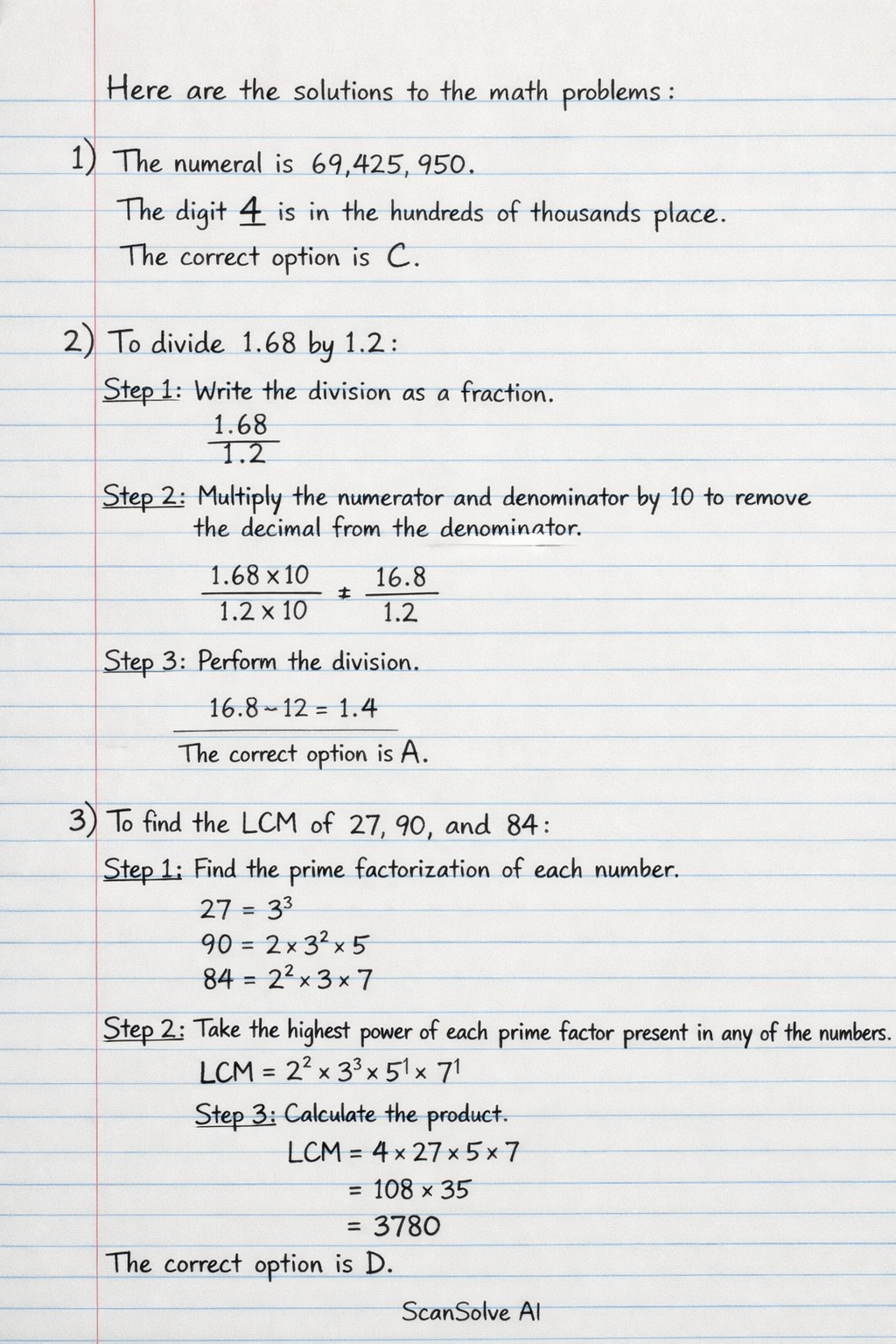
Handwritten Step-by-Step Solution
Get this as a handwritten image on WhatsApp — like a tutor wrote it for you.
Try on WhatsApp