
Differentiate between molecularity and order reaction
ScanSolve AI Answer
Answer
Molecularity and order of reaction are both concepts used to describe reaction rates, but they differ in their definition and application.
-
Molecularity refers to the number of reactant molecules that must collide simultaneously for a chemical reaction to occur. It is a theoretical concept that applies only to elementary reactions (reactions that occur in a single step). Molecularity can only be an integer value (1, 2, or 3) and cannot be zero or fractional.
-
Order of reaction, on the other hand, is an experimentally determined quantity that describes how the rate of a reaction depends on the concentration of reactants. It is the sum of the exponents of the concentration terms in the rate law. The order of reaction can be zero, integer, or fractional.
Here's a table summarizing the key differences:
| Feature | Molecularity | Order of Reaction |
|---|---|---|
| Definition | Number of colliding molecules in an elementary step | Sum of exponents in the rate law |
| Determination | Theoretical (based on reaction mechanism) | Experimental |
| Value | Integer (1, 2, or 3) | Zero, integer, or fractional |
| Applicability | Elementary reactions only | All reactions (elementary and complex) |
Still stuck on this one?
Ask a follow-up, and the answer starts from this question.
More Chemistry Questions
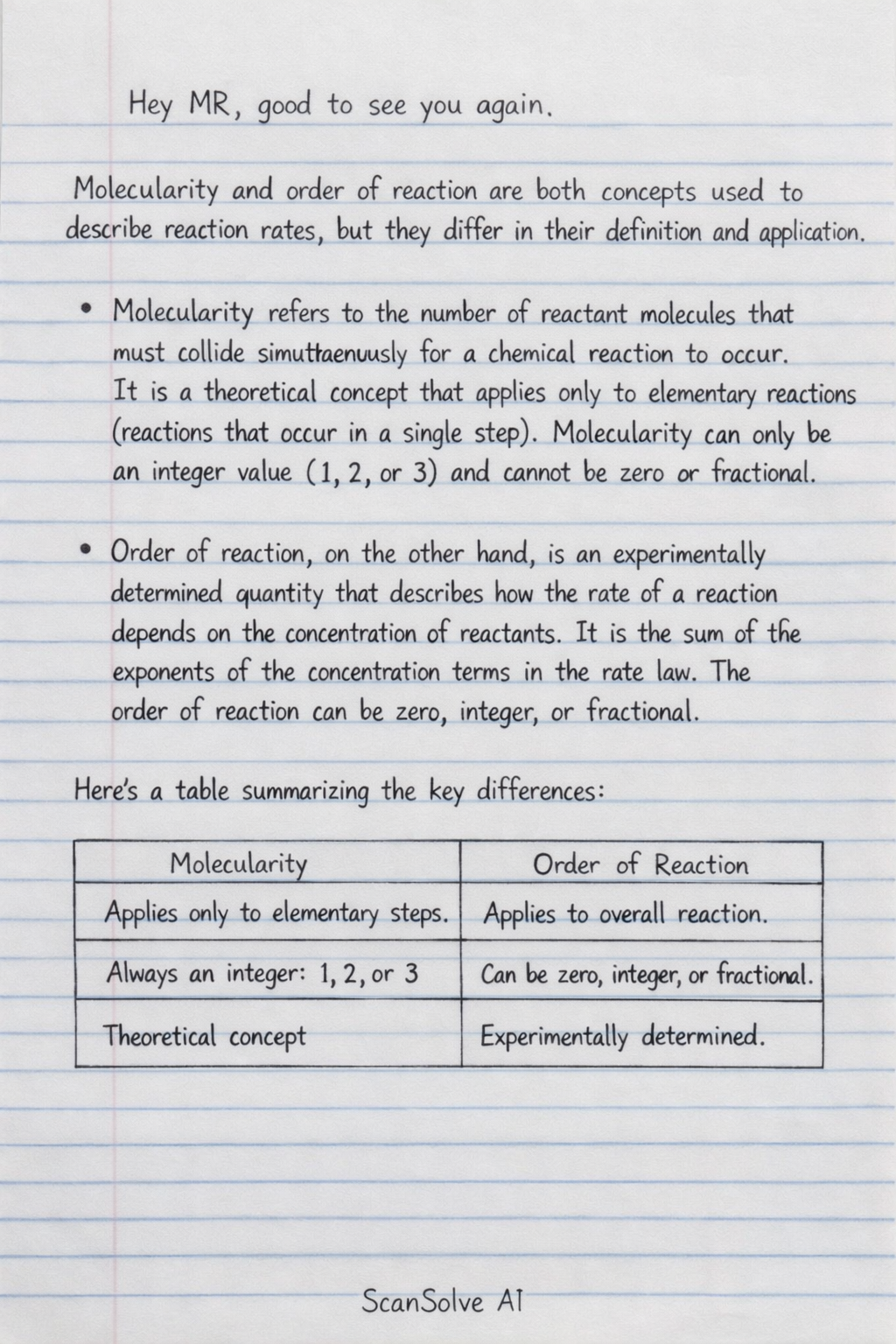
Handwritten Step-by-Step Solution
Get this as a handwritten image on WhatsApp — like a tutor wrote it for you.
Try on WhatsApp