
We read your photo as:
State FIVE properties of Transition Metals. Define the following, with (2) examples each: (i) Precious metals (ii) Base Metals. State FOUR physical properties of metals
Chemistry
ScanSolve AI Answer
Step-by-step solution
3 stepsCalculate the molar mass of NaOH.
The molar mass of sodium (Na) is approximately .
The molar mass of oxygen (O) is approximately .
The molar mass of hydrogen (H) is approximately .Calculate the number of moles of NaOH.
Given mass of NaOH = .
Calculate the molarity of the solution.
The volume of the solution is given as .
Molarity (M) is defined as moles of solute per litre of solution.The molarity of the solution is .
Was this helpful?
Still stuck on this one?
Ask a follow-up, and the answer starts from this question.
Got a different question?Ask your own question
More Chemistry Questions
QState three characteristic properties of transition metalsQDescribe the physical properties of metals, including lustre, malleability, and ductility. Include…QDescribe the electronic configurations of Sc, Ti, V, Cr, Mn, and list five general characteristics…QWhich of the following groups of elements are specially called transition metals?QList 4 examples each of metals and non-metals, and describe 4 differences between them.
Browse by topic:Inorganic Chemistry
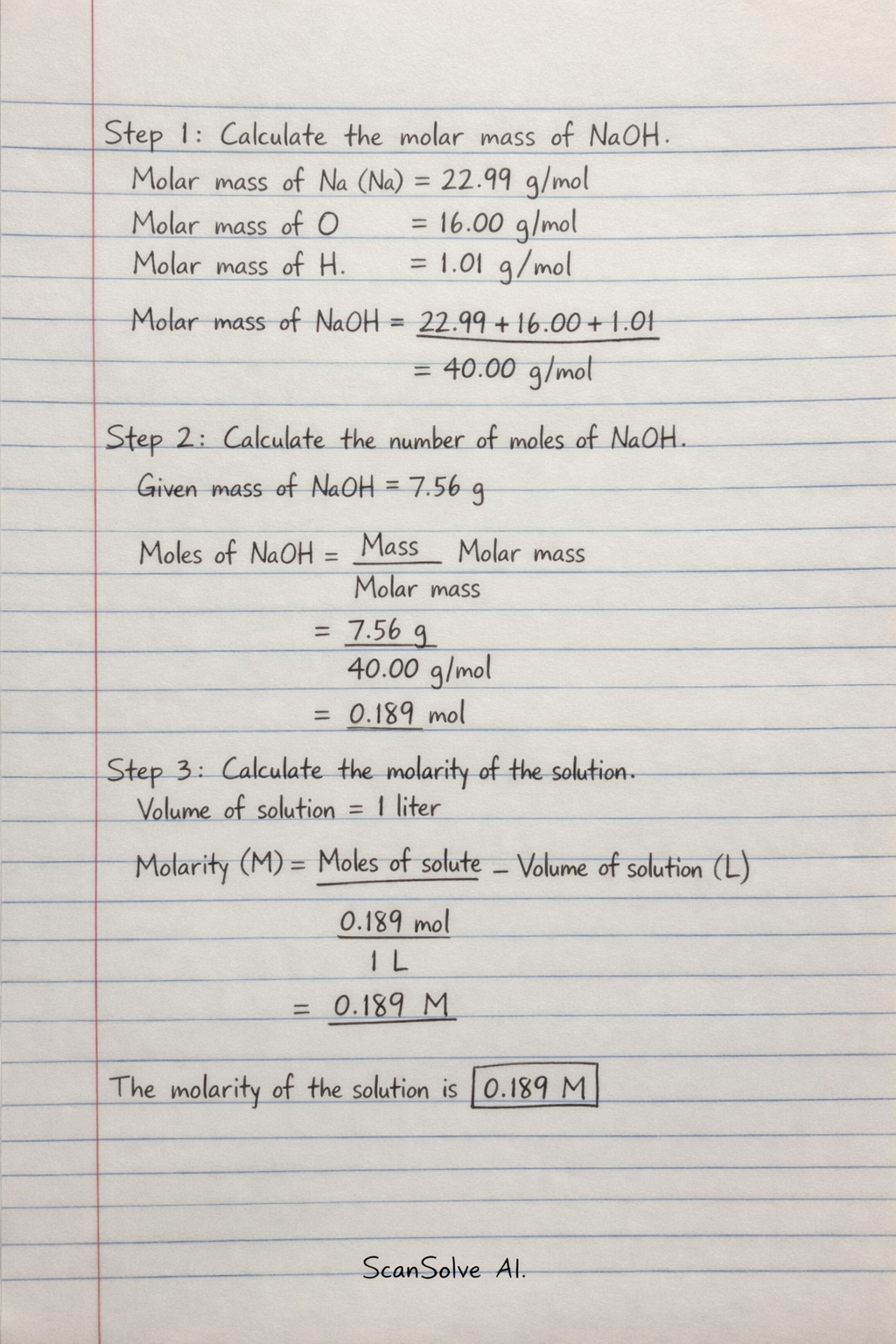
Handwritten Step-by-Step Solution
Get this as a handwritten image on WhatsApp — like a tutor wrote it for you.
Try on WhatsApp