

This chemistry question involves key chemical concepts and calculations. The detailed solution below walks through each step, from identifying the reaction type to computing the final answer.
ScanSolve AI Answer
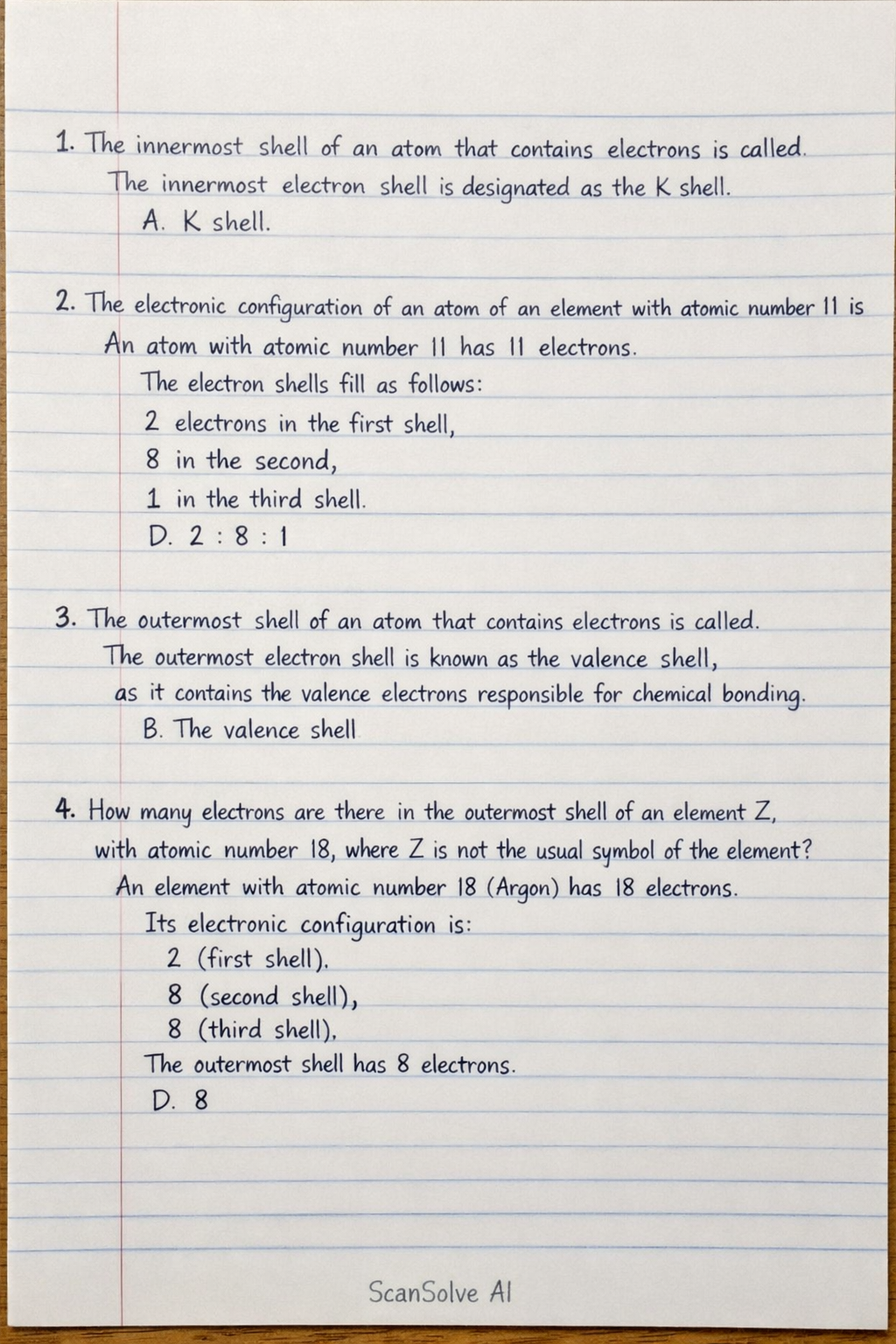
1. The innermost shell of an atom that contains electrons is called The innermost electron shell is designated as the K shell. A. K shell 2. The electronic configuration of an atom of an element with atomic number 11 is An atom with atomic number 11 has 11 electrons. The electron shells fill as follows: 2 electrons in the first shell, 8 in the second, and the remaining 1 in the third shell. D. 2:8:1 3. The outermost shell of an atom that contains electrons is called The outermost electron shell is known as the valence shell, as it contains the valence electrons responsible for chemical bonding. B. The valence shell 4. How many electrons are there in the outermost shell of an element Z, with atomic number 18, where Z is not the usual symbol of the element? An element with atomic number 18 (Argon) has 18 electrons. Its electronic configuration is 2 (first shell), 8 (second shell), 8 (third shell). The outermost shell has 8 electrons. D. 8 5. How many periods exist in the periodic table? There are 7 horizontal rows, or periods, in the standard periodic table. D. 7 6. The elements in the periodic table that lie in between group II and III are specially called The elements located between Group 2 (Alkaline Earth Metals) and Group 13 (Boron Group) are known as the transition metals (Groups 3-12). C. The transition metals 7. Atoms of elements in the same period of the periodic table have Elements in the same period have the same number of occupied electron shells. A. Equal number of electronic shells 8. Atoms of elements in the same group of the periodic table have Elements in the same group (vertical column) have the same number of valence electrons, which gives them similar chemical properties. C. Equal number of valence electrons 9. Select the odd element from the group below Beryllium (Be), Magnesium (Mg), and Barium (Ba) are all in Group 2 (Alkaline Earth Metals). Rubidium (Rb) is in Group 1 (Alkali Metals). C. Rubidium 10. In the periodic table, vertical columns are called Vertical columns in the periodic table are known as groups. C. Groups