
We read your photo as:
B) (i) What is the difference between a d-block element and a transition element? Give an example of each (ii) State and explain the variation in atomic radius across the first transition series, Scandium to Zinc (iii) Why are transition metal compounds colored?
ScanSolve AI Answer
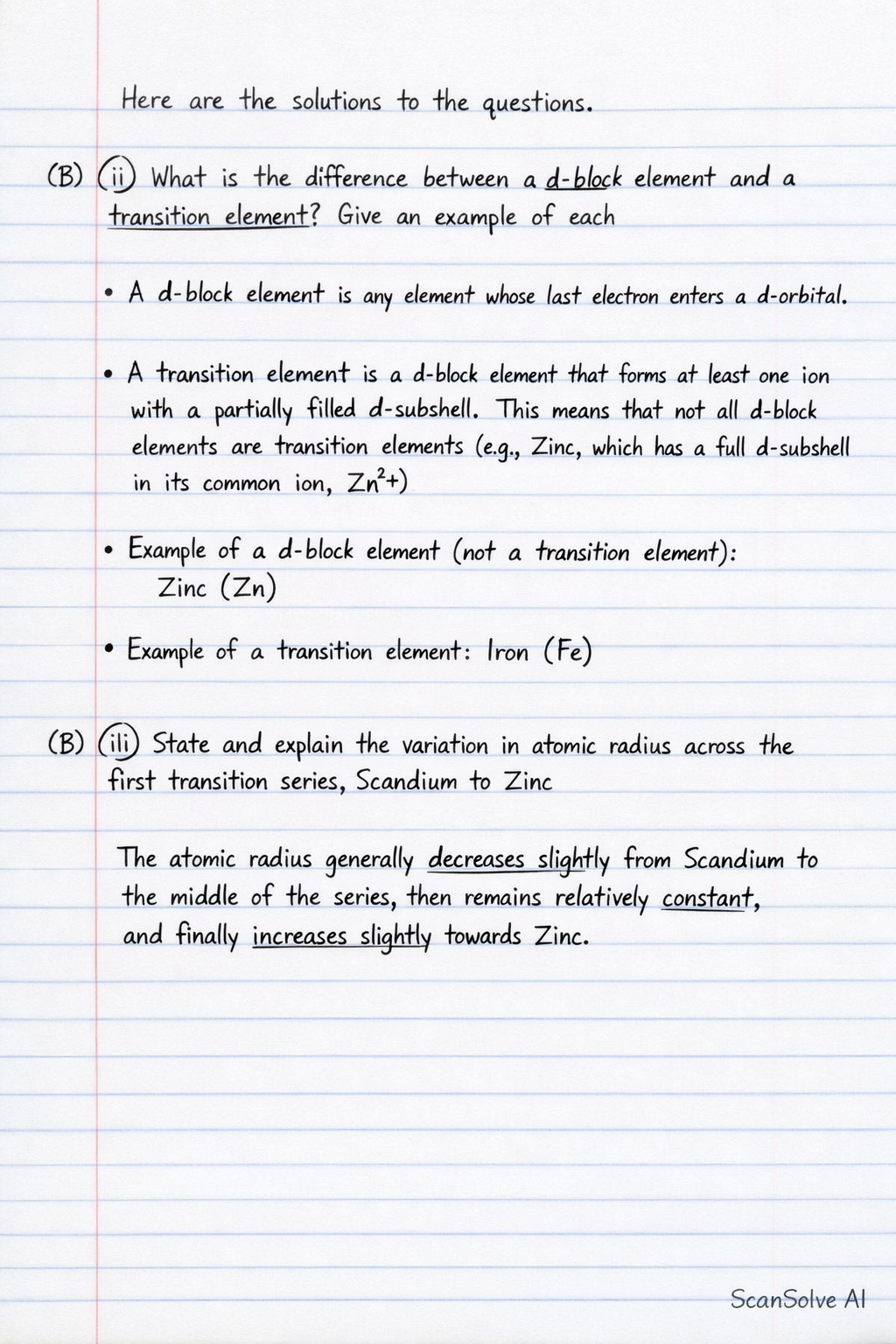
Here are the solutions to the questions.
B) (i) What is the difference between a d-block element and a transition element? Give an example of each
- A d-block element is any element whose last electron enters a d-orbital.
- A transition element is a d-block element that forms at least one ion with a partially filled d-subshell. This means that not all d-block elements are transition elements (e.g., Zinc, which has a full d-subshell in its common ion, ).
- Example of a d-block element (not a transition element): Zinc (Zn)
- Example of a transition element: Iron (Fe)
B) (ii) State and explain the variation in atomic radius across the first transition series, Scandium to Zinc
The atomic radius generally decreases slightly from Scandium to the middle of the series, then remains relatively constant, and finally increases slightly towards Zinc.
- Explanation: As you move across the series, the nuclear charge increases due to more protons. Electrons are added to the inner subshell. Initially, the increasing nuclear charge has a stronger pull on the outer electrons, causing a decrease in radius. Towards the middle, the increased shielding effect from the electrons starts to balance the increased nuclear charge, leading to a relatively constant radius. At the end of the series, increased electron-electron repulsion among the filled orbitals can cause a slight increase in radius.
B) (iii) Why are transition metal compounds colored?
Transition metal compounds are colored due to d-d electronic transitions. In the presence of ligands, the d-orbitals of the metal ion split into different energy levels. When white light shines on the compound, electrons absorb specific wavelengths of light to jump from a lower energy d-orbital to a higher energy d-orbital. The remaining, unabsorbed wavelengths are transmitted or reflected, which our eyes perceive as the complementary color.
Still stuck on this one?
Ask a follow-up, and the answer starts from this question.
More Chemistry Questions
Handwritten Step-by-Step Solution
Get this as a handwritten image on WhatsApp — like a tutor wrote it for you.
Try on WhatsApp