
We read your photo as:
The halogens are the elements in group VII of the periodic table. (c) (i) Complete the table by giving the colour of each element. (ii) Account for the change in physical state for the elements. (d) (
ScanSolve AI Answer
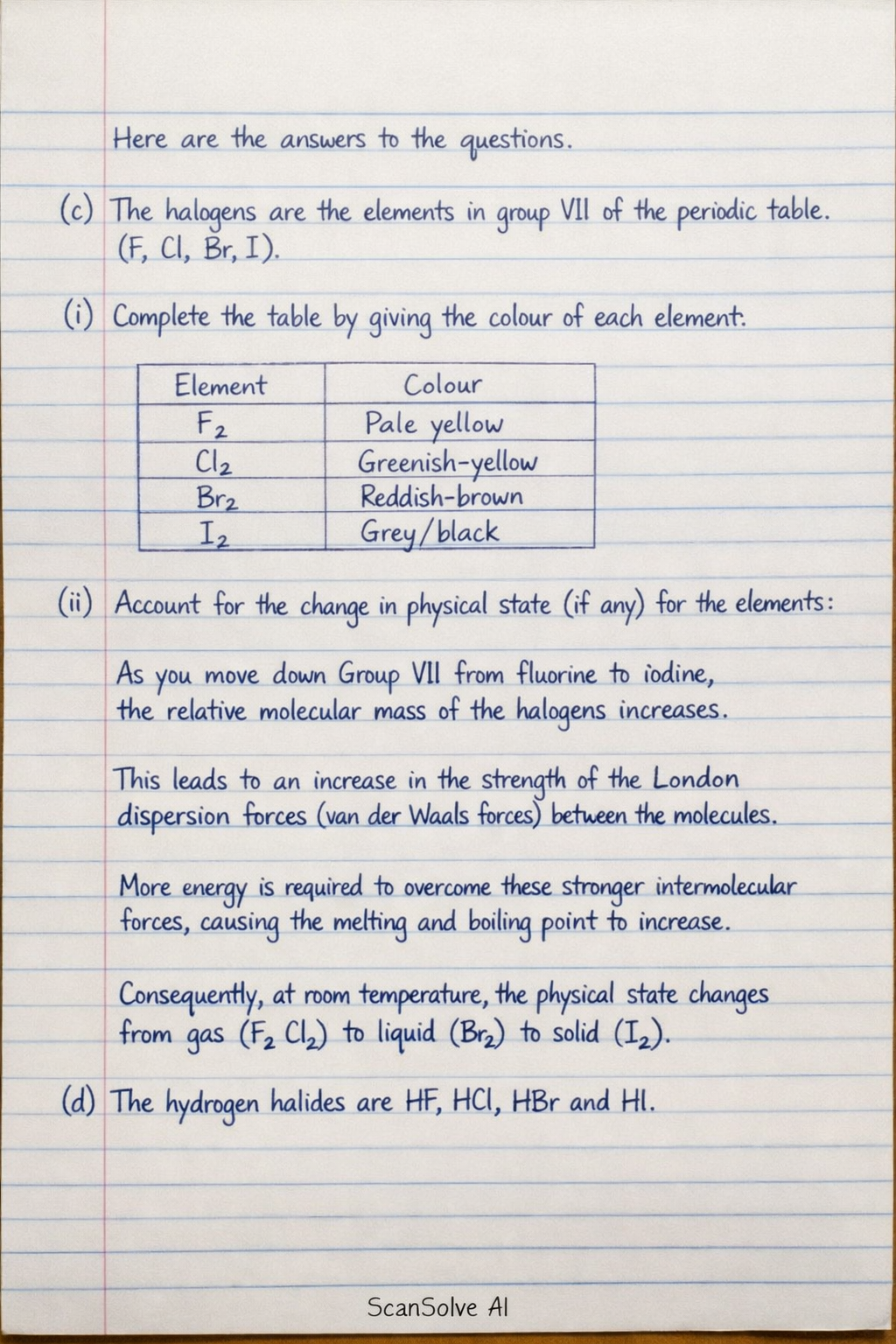
Here are the answers to the questions.
(c) The halogens are the elements in group VII of the periodic table (F, Cl, Br, I)
(i) Complete the table by giving the colour of each element.
| Element | Colour |
|---|---|
| F₂ | Pale yellow |
| Cl₂ | Greenish-yellow |
| Br₂ | Reddish-brown |
| I₂ | Grey/black |
(ii) Account for the change in physical state (if any) for the elements
As you move down Group VII from fluorine to iodine, the relative molecular mass of the halogens increases. This leads to an increase in the strength of the London dispersion forces (van der Waals forces) between the molecules. More energy is required to overcome these stronger intermolecular forces, causing the melting and boiling points to increase. Consequently, at room temperature, the physical state changes from gas (F₂, Cl₂) to liquid (Br₂) to solid (I₂).
(d) The hydrogen halides are HF, HCl, HBr and HI.
(i) In the space provided sketch a graph of boiling point against relative molecular mass for the halides
A sketch of the graph would show the following:
- The x-axis represents the relative molecular mass (or the atomic number of the halogen).
- The y-axis represents the boiling point.
- The boiling points for HCl, HBr, and HI would show an increasing trend as their relative molecular mass increases.
- The boiling point for HF would be significantly higher than that of HCl, HBr, and HI, appearing as an anomaly at the beginning of the series.
(ii) Explain the shape of the graph.
The general trend of increasing boiling points from HCl to HBr to HI is due to the increase in London dispersion forces. As the relative molecular mass and the number of electrons increase down the group, the electron clouds become more polarizable, leading to stronger instantaneous dipole-induced dipole interactions between molecules, which require more energy to overcome.
However, HF exhibits an anomalously high boiling point compared to the other hydrogen halides. This is because fluorine is highly electronegative, and the small size of the hydrogen atom allows for the formation of strong hydrogen bonds between HF molecules. These hydrogen bonds are much stronger intermolecular forces than the London dispersion forces and dipole-dipole forces present in HCl, HBr, and HI, thus requiring significantly more energy to break during boiling.
Still stuck on this one?
Ask a follow-up, and the answer starts from this question.
More Chemistry Questions
Handwritten Step-by-Step Solution
Get this as a handwritten image on WhatsApp — like a tutor wrote it for you.
Try on WhatsApp