
We read your photo as:
Explain the following observations regarding d-block elements: a) Why is Scandium a d-block element but not a transition element? b) Why is Zn2+ ion colourless? c) Define a chelating ligand with an ex
ScanSolve AI Answer
a) i) Scandium is considered a d-block element because its differentiating electron (the last electron added) enters the d-subshell. It is not considered a transition element because its common ion, , has an empty d-subshell (). A transition element must form at least one ion with a partially filled d-subshell.
a) ii) is not coloured because its electronic configuration is . The d-subshell is completely filled, meaning there are no empty d-orbitals for d-d electronic transitions to occur. Without these transitions, no visible light is absorbed, and thus the ion appears colourless.
a) iii) A chelating ligand is a ligand that can form two or more coordinate bonds to a single central metal ion, forming a ring structure. Oxalate () is a chelating ligand because it has two oxygen atoms, each capable of donating a lone pair of electrons to the metal ion, thus forming two coordinate bonds and a stable five-membered ring.
a) iv) A simple observable change is that a pale green solution of iron(II) sulfate () turns yellowish-brown when exposed to air over time. This is due to the oxidation of to by atmospheric oxygen, indicating that is more stable.
a) v) The complex exhibits linkage isomerism.
a) vi) The structures of the isomers are:
- Pentaamminenitrocobalt(III) ion: The ligand is bonded to cobalt through the nitrogen atom.
& \text{NH}_3 \\
\text{H}_3\text{N} & | & \text{NH}_3 \\
& \text{Co} & \\
\text{H}_3\text{N} & | & \text{NH}_3 \\
& \text{NO}_2
\end{bmatrix}^{2+}$$
• Pentaamminenitritocobalt(III) ion: The ligand is bonded to cobalt through an oxygen atom.
b) i) A. First ionization energy is the minimum energy required to remove one mole of electrons from one mole of gaseous atoms in their ground state to form one mole of gaseous ions with a +1 charge.
b) i) B. Second electron affinity is the energy change when one mole of electrons is added to one mole of gaseous singly negatively charged ions to form one mole of gaseous doubly negatively charged ions.
b) ii) The equation for the first ionization energy of chlorine is:
b) iii) Group V elements have a half-filled p-subshell (), which is a relatively stable electronic configuration. Removing an electron from this stable arrangement requires a significant amount of energy. Group VI elements, on the other hand, have an configuration. The fourth electron in the p-subshell is paired with another electron in the same orbital, leading to electron-electron repulsion. This repulsion makes it easier to remove one of these paired electrons, thus lowering the first ionization energy compared to Group V elements in the same period.
c) i) The elements in Group I and II on the periodic table are called s-block elements because their differentiating electron (the last electron added to the atom) occupies the outermost s-orbital. Group I elements have an configuration, and Group II elements have an configuration.
c) ii) A. The atomic radii of Group I elements are larger than the corresponding Group II elements in the same period because, as you move across a period from Group I to Group II, the nuclear charge (number of protons) increases. While the number of electron shells remains the same, the increased nuclear charge exerts a stronger pull on the valence electrons, drawing them closer to the nucleus and resulting in a smaller atomic radius for Group II elements.
Still stuck on this one?
Ask a follow-up, and the answer starts from this question.
More Chemistry Questions
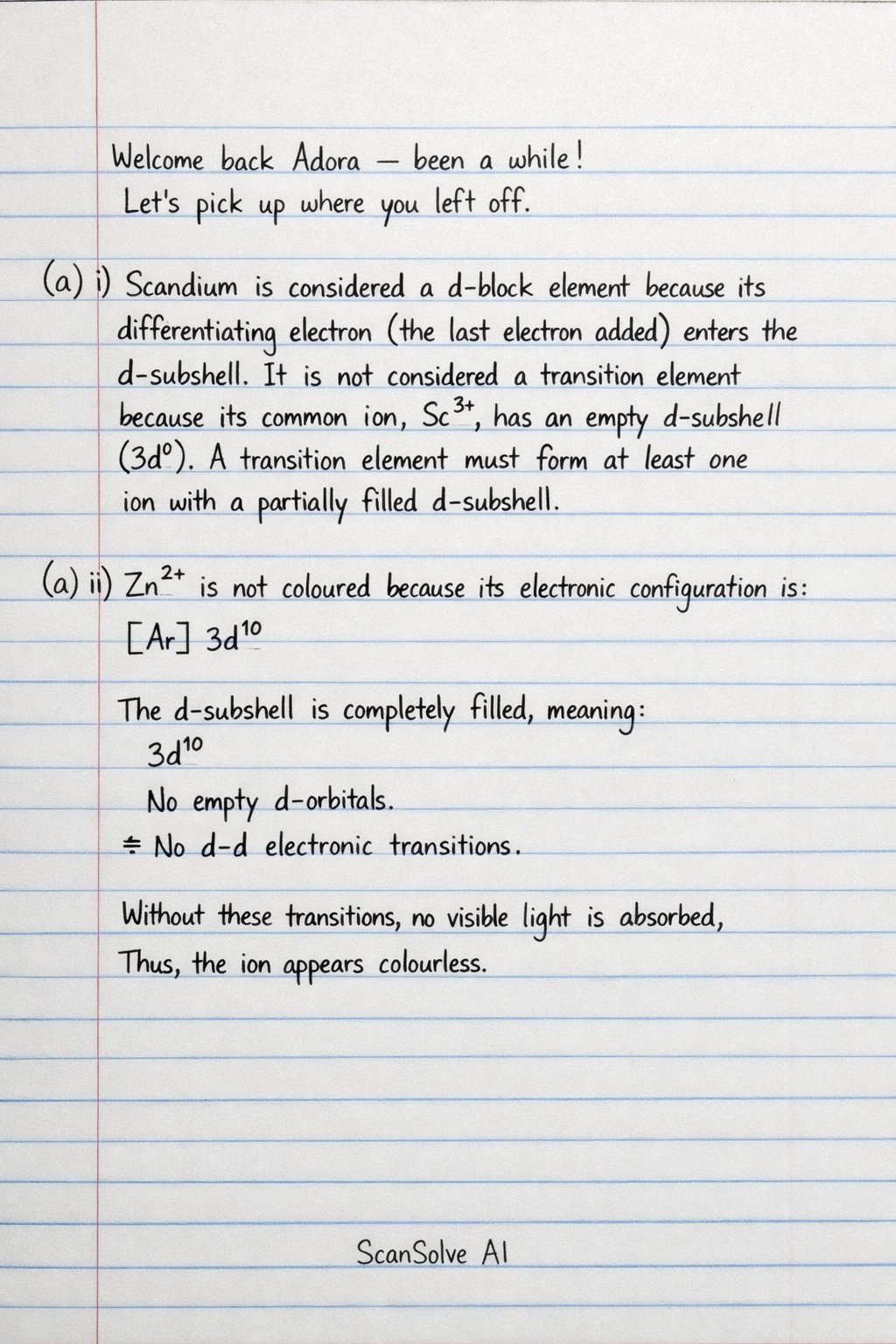
Handwritten Step-by-Step Solution
Get this as a handwritten image on WhatsApp — like a tutor wrote it for you.
Try on WhatsApp