
📚 WASSCE 2026 | INTEGRATED SCIENCE ➖➖➖➖➖➖➖➖➖➖ QUESTION 1 With the aid of a genetic diagram, explain how two parents with normal skin colour can produce an albino child. State the genotype of: (i) a carrier parent; (ii) an albino child. [5 marks] The nuclide of chlorine is represented as ³⁵₁₇Cl. State the number of: (i) protons; (ii) neutrons; (iii) electrons in a neutral atom. What are isotopes? Give one use of a radioactive isotope in medicine. [5 marks] Define kinetic energy. An athlete of mass 60 kg runs at a velocity of 8 m/s. Calculate the kinetic energy of the athlete. State two factors that affect the kinetic energy of a moving object. [5 marks] Explain the term crop rotation. State two advantages of practising crop rotation on a farm in Ghana. Name two leguminous crops that fix nitrogen in the soil. [5 marks] ➖➖➖➖➖➖➖➖➖➖ QUESTION 2 State three functions of the human blood. Explain the role of: (i) haemoglobin; (ii) white blood cells; (iii) blood platelets in the body. [5 marks] Define electrolysis. In the electrolysis of dilute sulphuric acid (H₂SO₄) using platinum electrodes: (i) name the product at the cathode; (ii) name the product at the anode; (iii) write the ionic half-equation for the reaction at the anode. [5 marks] What is an electromagnet? State three uses of electromagnets in everyday life. Explain one way of increasing the strength of an electromagnet. [5 marks] Distinguish between exotic breeds and indigenous breeds of livestock. State three advantages of exotic breeds of poultry over indigenous breeds for a Ghanaian farmer. [5 marks] ➖➖➖➖➖➖➖➖➖➖ QUESTION 3 Using the food chain below, answer the questions that follow: Grass → Grasshopper → Lizard → Hawk Name the producer and the primary consumer. (ii) State the trophic level of the lizard. (iii) State two ways energy is lost between trophic levels in a food chain. (iv) Explain what would happen to the hawk population if all the lizards were removed. [5 marks] What are petrochemicals? State two uses of petrochemicals in agriculture. Name two useful products obtained from the fractional distillation of crude oil. [5 marks] State the principle of floatation. Explain why a large steel ship floats on water even though steel is denser than water. Calculate the upthrust on a block of volume 0.02 m³ fully submerged in water. [Density of water = 1000 kg/m³, g = 10 m/s²] [5 marks] Explain the term soil conservation. State two ways in which each of the following helps conserve soil: (i) planting cover crops; (ii) contour ploughing. [5 marks] ➖➖➖➖➖➖➖➖➖➖ QUESTION 4 Explain the term hormone. State the gland responsible for producing each hormone and give one function of each: (i) insulin; (ii) adrenaline; (iii) thyroxine. [5 marks] What is an alloy? Name two components of each of the following and state one use of each: (i) brass; (ii) bronze; (iii) stainless steel. [5 marks] Define wave frequency. A radio wave has a frequency of 100 MHz and travels at 3 × 10⁸ m/s. Calculate the wavelength of the wave. State two differences between transverse and longitudinal waves. [5 marks] What is a vegetable? Give two reasons why vegetables are important in the human diet. State three cultural practices involved in tomato production in Ghana. [5 marks] ➖➖➖➖➖➖➖➖➖➖ QUESTION 5 What is transpiration? State three factors that affect the rate of transpiration in plants. Give one importance of transpiration to a plant. [5 marks] Distinguish between hard water and soft water. State two methods of removing permanent hardness from water. A 250 cm³ solution contains 5.0 g of NaOH. Calculate the concentration of the solution in mol/dm³. [Na = 23, O = 16, H = 1] [5 marks] State the principle of moments. A uniform beam is balanced on a pivot at its centre. A force of 30 N acts 1.5 m to the left of the pivot. Calculate the force F needed 1.0 m to the right of the pivot to keep the beam in balance. [5 marks] Explain the term debeaking as used in poultry management. State three reasons why debeaking is carried out. Name two other routine management practices in a broiler house and give the reason for each. [5 marks] ➖➖➖➖➖➖➖➖➖➖ QUESTION 6 What is photosynthesis? Write the balanced chemical equation for photosynthesis. State three factors that affect the rate of photosynthesis. [5 marks] Explain the term rate of chemical reaction. State four factors that affect the rate of a chemical reaction. Briefly explain how temperature affects reaction rate using collision theory. [5 marks] What is static electricity? State two ways static electricity can be produced. Give two practical applications and two dangers of static electricity, stating one precaution for each danger. [5 marks] Distinguish between green manure and farmyard manure. State three ways in which organic matter improves soil fertility. [5 marks] ➖➖➖➖➖➖➖➖➖➖ QUESTION 7 Define excretion and distinguish it from egestion. Name the excretory organ responsible for removing: (i) urea; (ii) carbon dioxide; (iii) bile pigments. State two consequences of kidney failure in humans. [5 marks] State the law of conservation of mass. When 6.0 g of carbon is completely burned in excess oxygen, carbon dioxide is produced. (i) Write the balanced equation. (ii) Calculate the mass of CO₂ produced. [C = 12, O = 16] [5 marks] https://whatsapp.com/channel/0029VbCaje835fLuwzBUkg1H An immersion heater is rated 220 V, 850 W. (i) Calculate the current flowing through the heater. (ii) If it operates for 5 minutes, calculate the total electrical energy supplied in joules. (iii) State two safety precautions when using an immersion heater. [5 marks] What are ecto-parasites? Name three ecto-parasites that commonly infest goats in West Africa. State two harmful effects of ecto-parasites on farm animals and give one method of controlling them. [5 marks] ➖➖➖➖➖➖➖➖➖➖➖➖➖➖➖➖➖➖➖➖
ScanSolve AI Answer
Step-by-step solution
4 stepsHere's the solution for Question 1 (a):
Part a· 4 steps
Albinism is a recessive genetic condition. For two parents with normal skin colour to produce an albino child, both parents must be heterozygous carriers for the albinism allele.
Let:
- = allele for normal skin colour (dominant)
- = allele for albinism (recessive)
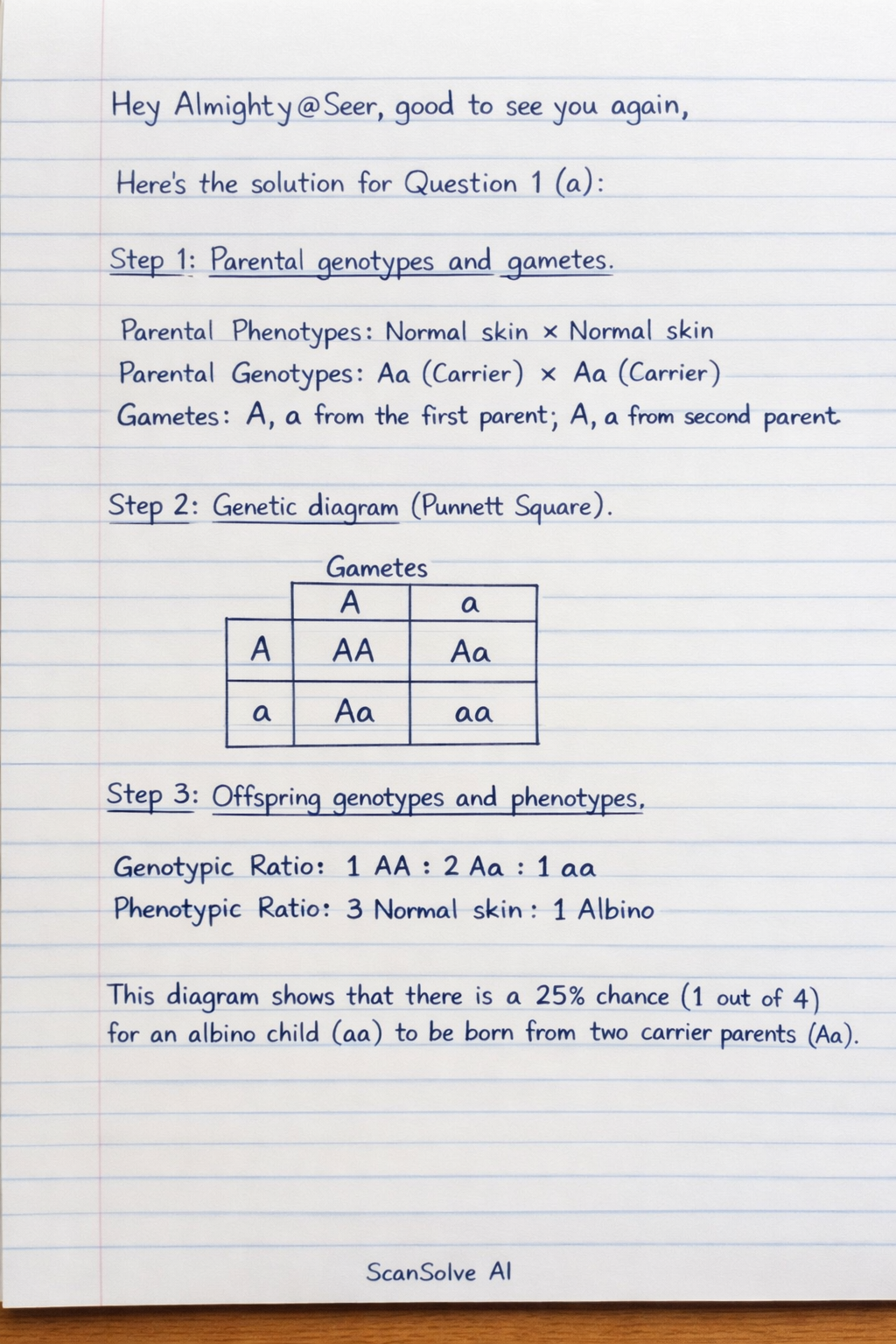
Parental genotypes and gametes.
Parental Phenotypes: Normal skin Normal skin
Parental Genotypes: (Carrier) (Carrier)
Gametes: , from the first parent; , from the second parentGenetic diagram (Punnett Square).
Offspring genotypes and phenotypes.
Genotypic Ratio:
Phenotypic Ratio: 3 Normal skin : 1 AlbinoThis diagram shows that there is a chance (1 out of 4) for an albino child () to be born from two carrier parents ().
State the genotypes.
Part a(i)
The genotype of a carrier parent is .
Part a(ii)
The genotype of an albino child is .
Still stuck on this one?
Ask a follow-up, and the answer starts from this question.
More Geography Questions
Handwritten Step-by-Step Solution
Get this as a handwritten image on WhatsApp — like a tutor wrote it for you.
Try on WhatsApp