
This geography problem is solved step by step below, with detailed explanations to help you understand the method and arrive at the correct answer.
ScanSolve AI Answer
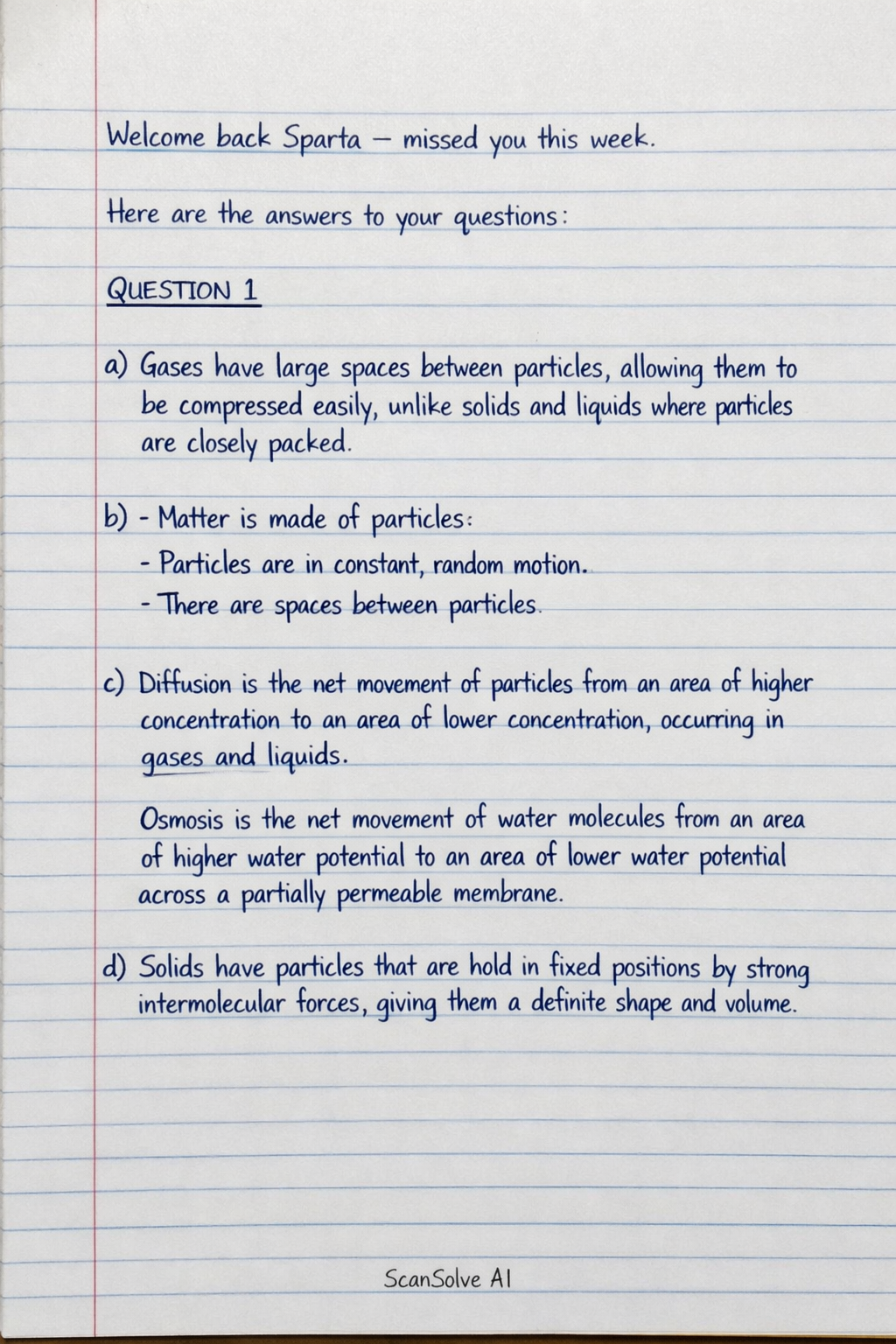
Welcome back Sparta — missed you this week. Here are the answers to your questions: QUESTION 1 a) Gases have large spaces between particles, allowing them to be compressed easily, unlike solids and liquids where particles are closely packed. b) • Matter is made of particles. • Particles are in constant, random motion. • There are spaces between particles. c) Diffusion is the net movement of particles from an area of higher concentration to an area of lower concentration, occurring in gases and liquids. Osmosis is the net movement of water molecules from an area of higher water potential to an area of lower water potential across a partially permeable membrane. d) Solids have particles that are held in fixed positions by strong intermolecular forces, giving them a definite shape and volume. QUESTION 2 a) Photosynthesis is considered an energy conversion process because it transforms light energy from the sun into chemical energy, which is stored in the bonds of glucose molecules. b) • Light intensity • Carbon dioxide concentration • Temperature • Water availability c) Chlorophyll is a green pigment found in plant cells that is responsible for absorbing light energy from the sun. This absorbed light energy is then used to power the chemical reactions of photosynthesis. d) Photosynthesis cannot occur at night because it is a light-dependent process. The initial stages of photosynthesis require sunlight to provide the energy needed to convert carbon dioxide and water into glucose and oxygen. QUESTION 3 a) To calculate acceleration, we use Newton's Second Law of Motion, F = ma. Step 1: Identify the given values. F = 20\, N m = 5\, kg Step 2: Rearrange the formula to solve for acceleration (a). a = (F)/(m) Step 3: Substitute the values and calculate. a = 20\, N5\, kg a = 4\, m/s^2 The acceleration is 4 m/s^2. b) Newton's Second Law of Motion states that the rate of change of momentum of an object is directly proportional to the applied force and occurs in the direction of the force. c) Objects in motion eventually stop if no other force acts on them due to the presence of friction and air resistance. These forces oppose the motion, causing the object to decelerate and eventually come to a halt. d) • Design of lifting machines (e.g., cranes, levers) • Development of braking systems in vehicles QUESTION 4 a) Metals are good conductors of electricity because they have a 'sea' of delocalized (free) electrons that are not bound to any particular atom. These free electrons can move easily throughout the metal lattice, carrying electrical charge. b) Conductors are materials that allow electric current to flow through them easily due to the presence of free charge carriers. Insulators are materials that resist the flow of electric current because their electrons are tightly bound to atoms and cannot move freely. c) • Wiring in homes and buildings • Components in electrical circuits (e.g., resistors, capacitors) • Heating elements in electrical appliances (e.g., toasters, kettles) d) Plastic is used for covering wires because it is an excellent electrical insulator. This prevents the electric current from escaping the wire, thereby protecting users from electric shock and preventing short circuits. QUESTION 5 a) The heart is called a double pump because it has two separate pumping systems. The right side pumps deoxygenated blood to the lungs (pulmonary circulation), and the left side pumps oxygenated blood to the rest of the body (systemic circulation). b) Deoxygenated blood from the body enters the right side of the heart, which pumps it to the lungs. In the lungs, the blood picks up oxygen and releases carbon dioxide. This oxygenated blood then returns to the left side of the heart, which pumps it out to the rest of the body. c) • Arteries carry blood away from the heart, while veins carry blood towards the heart. • Arteries have thick, muscular, elastic walls to withstand high pressure, while veins have thinner, less muscular walls. • Arteries generally carry blood under high pressure, while veins carry blood under low pressure. d) Valves are important in the circulatory system because they ensure that blood flows in only one direction. They prevent the backflow of blood, which is crucial for efficient circulation, especially in veins where blood pressure is low and gravity can cause pooling. QUESTION 6 a) Anaerobic respiration produces less energy than aerobic respiration because it occurs without oxygen, leading to an incomplete breakdown of glucose. Only a small fraction of the chemical energy stored in glucose is released, compared to the complete breakdown that occurs in aerobic respiration. b) The end products of anaerobic respiration in muscles are lactic acid and a