
SECTION B Confirmed standard Answer any FIVE questions All questions carry equal Mark's QUESTION 1: a) Name five parts of the human digestive system. b) Explain the functions of four parts of the digestive system. c) State four ways of keeping the digestive system healthy. QUESTION 2: a) What is photosynthesis? b) State four conditions necessary for photosynthesis. c) Explain four importance of photosynthesis to living organisms. You’ll often work with the core relationship here: � QUESTION 3: a) Define force. b) State four effects of force. c) Explain the difference between: i. speed and velocity ii. mass and weight A key formula to know: QUESTION 4: a) What is energy? b) State five sources of energy. c) Explain four advantages of renewable energy sources. QUESTION 5: a) What is a mixture? b) State four methods of separating mixtures. c) Explain how any two methods are carried out. QUESTION 6: a) Name four organs of the respiratory system. b) Explain the process of breathing. c) State four ways of caring for the respiratory system. QUESTION 7: a) What is electricity? b) State four materials that conduct electricity. c) Explain four safety precautions when using electricity. A very common relationship: QUESTION 8: a) Differentiate between communicable and non-communicable diseases. b) State four communicable diseases common in Ghana. c) Explain four ways of preventing these diseases.
ScanSolve AI Answer
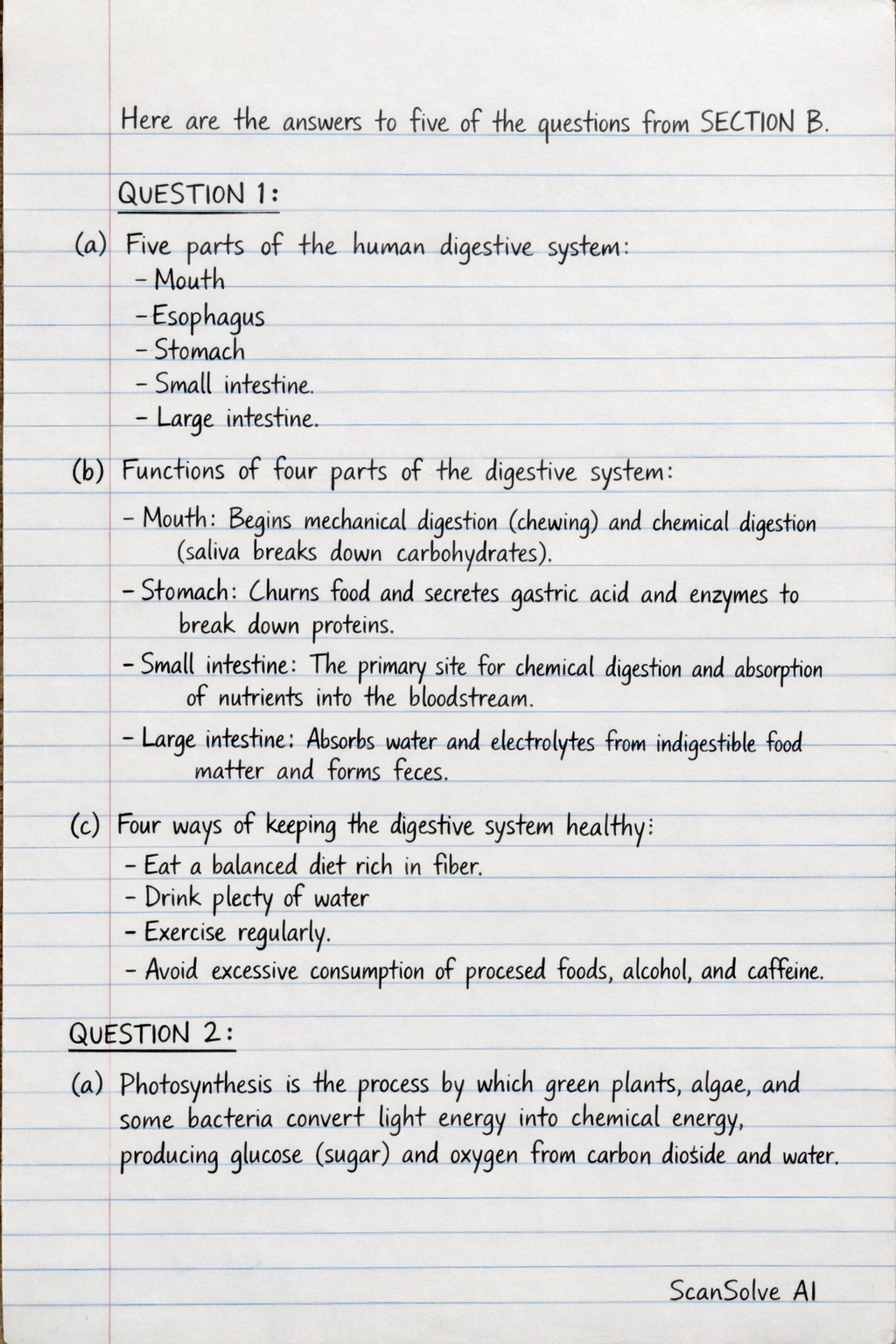
Here are the answers to five of the questions from SECTION B.
QUESTION 1:
a) Five parts of the human digestive system:
- Mouth
- Esophagus
- Stomach
- Small intestine
- Large intestine
b) Functions of four parts of the digestive system:
- Mouth: Begins mechanical digestion (chewing) and chemical digestion (saliva breaks down carbohydrates).
- Stomach: Churns food and secretes gastric acid and enzymes to break down proteins.
- Small intestine: The primary site for chemical digestion and absorption of nutrients into the bloodstream.
- Large intestine: Absorbs water and electrolytes from indigestible food matter and forms feces.
c) Four ways of keeping the digestive system healthy:
- Eat a balanced diet rich in fiber.
- Drink plenty of water.
- Exercise regularly.
- Avoid excessive consumption of processed foods, alcohol, and caffeine.
QUESTION 2:
a) Photosynthesis is the process by which green plants, algae, and some bacteria convert light energy into chemical energy, producing glucose (sugar) and oxygen from carbon dioxide and water.
b) Four conditions necessary for photosynthesis:
- Sunlight
- Carbon dioxide
- Water
- Chlorophyll
c) Four importance of photosynthesis to living organisms:
- Food production: It produces glucose, the primary source of energy for plants and, indirectly, for all other organisms in the food chain.
- Oxygen production: It releases oxygen into the atmosphere, which is essential for the respiration of most living organisms.
- Carbon dioxide regulation: It removes carbon dioxide from the atmosphere, helping to regulate Earth's climate.
- Energy source: The chemical energy stored in the glucose produced during photosynthesis is the ultimate source of energy for most life on Earth.
QUESTION 3:
a) Force is a push or a pull that can cause an object to change its state of motion (accelerate), change its direction, or change its shape.
b) Four effects of force:
- It can move a stationary object.
- It can stop a moving object.
- It can change the speed of a moving object.
- It can change the shape or size of an object.
c) Explanation of the difference between:
i. Speed and velocity:
- Speed is a scalar quantity that measures how fast an object is moving, without regard to direction.
- Velocity is a vector quantity that measures both the speed and the direction of an object's motion.
ii. Mass and weight:
- Mass is a measure of the amount of matter in an object and is constant regardless of location.
- Weight is the force of gravity acting on an object's mass and varies depending on the gravitational field.
QUESTION 4:
a) Energy is the capacity to do work or produce heat. It exists in various forms, such as kinetic, potential, thermal, electrical, chemical, and nuclear energy.
b) Five sources of energy:
- Solar energy
- Wind energy
- Fossil fuels (e.g., coal, oil, natural gas)
- Hydroelectric energy
- Geothermal energy
c) Four advantages of renewable energy sources:
- Environmental benefits: They produce little to no greenhouse gas emissions, reducing air pollution and climate change.
- Sustainability: They are naturally replenished and will not run out, unlike fossil fuels.
- Reduced reliance on imports: They can be harnessed domestically, reducing a country's dependence on foreign energy sources.
- Job creation: The renewable energy sector creates new jobs in manufacturing, installation, and maintenance.
QUESTION 5:
a) A mixture is a substance containing two or more different substances that are physically combined but not chemically bonded. Each substance retains its individual properties.
b) Four methods of separating mixtures:
- Filtration
- Evaporation
- Decantation
- Magnetism
c) Explanation of how any two methods are carried out:
- Filtration: This method is used to separate an insoluble solid from a liquid. The mixture is poured through a filter medium (like filter paper), which allows the liquid (filtrate) to pass through while retaining the solid (residue).
- Evaporation: This method is used to separate a soluble solid from a liquid. The mixture is heated, causing the liquid to turn into vapor and escape, leaving the solid behind.
Still stuck on this one?
Ask a follow-up, and the answer starts from this question.
More Geography Questions
Handwritten Step-by-Step Solution
Get this as a handwritten image on WhatsApp — like a tutor wrote it for you.
Try on WhatsApp