
GHANA WASSCE 2026 🇬🇭🇬🇭| INTEGRATED SCIENCE A 100 W heater is connected to a 240 V mains supply. Calculate: the current drawn; (ii) the resistance of the heater. b. (i) List three compounds that have electrovalent bonds. (ii) Give two characteristics of electrovalent compounds. C. (i) What is the rhesus factor? (ii) Briefly explain how the rhesus factor in humans could result in miscarriage. a. (i) Explain briefly how solar energy is used to generate electricity. (ii) State two other uses of solar energy. b. State five ways of conserving water in the home. C. (i) State three management practices that ensure high yield in maize production. (ii) Explain how two of the practices stated in (i) help to ensure high yield of maize. d. (i) State two effects of air masses on the environment. (ii) State three ways by which global warming can be reduced. a. (i) Explain why aluminium resists corrosion but iron does not. (ii) State two methods of preventing iron from rusting. b. (i) Explain the term culling as used in livestock management. (ii) State three benefits of practising culling. C. (i) Distinguish between grafting and budding. (ii) Give three reasons for grafting and budding. d. (i) State the principle of conservation of energy. (ii) State the energy transformations that occur in each of the following devices: a moving motorcycle; a television set in operation. Follow the WAEC GHANA 🇬🇭 channel on WhatsApp: a. (i) What are secondary colours of light? (ii) Name the colour that results from combining each of the following pairs of colours of light: red and green; blue and green; red and blue. b. (i) Define the mole of a substance. (ii) Calculate the number of atoms in 18 g of magnesium metal. [Mg = 24, Avogadro number = 6.023 × 10²³] C. (i) Differentiate between bone and cartilage. (ii) Name three parts of the human body where cartilages are found. d. (i) Explain the term deep litter system as used in poultry. (ii) Give three advantages of the deep litter system.
ScanSolve AI Answer
Step-by-step solution
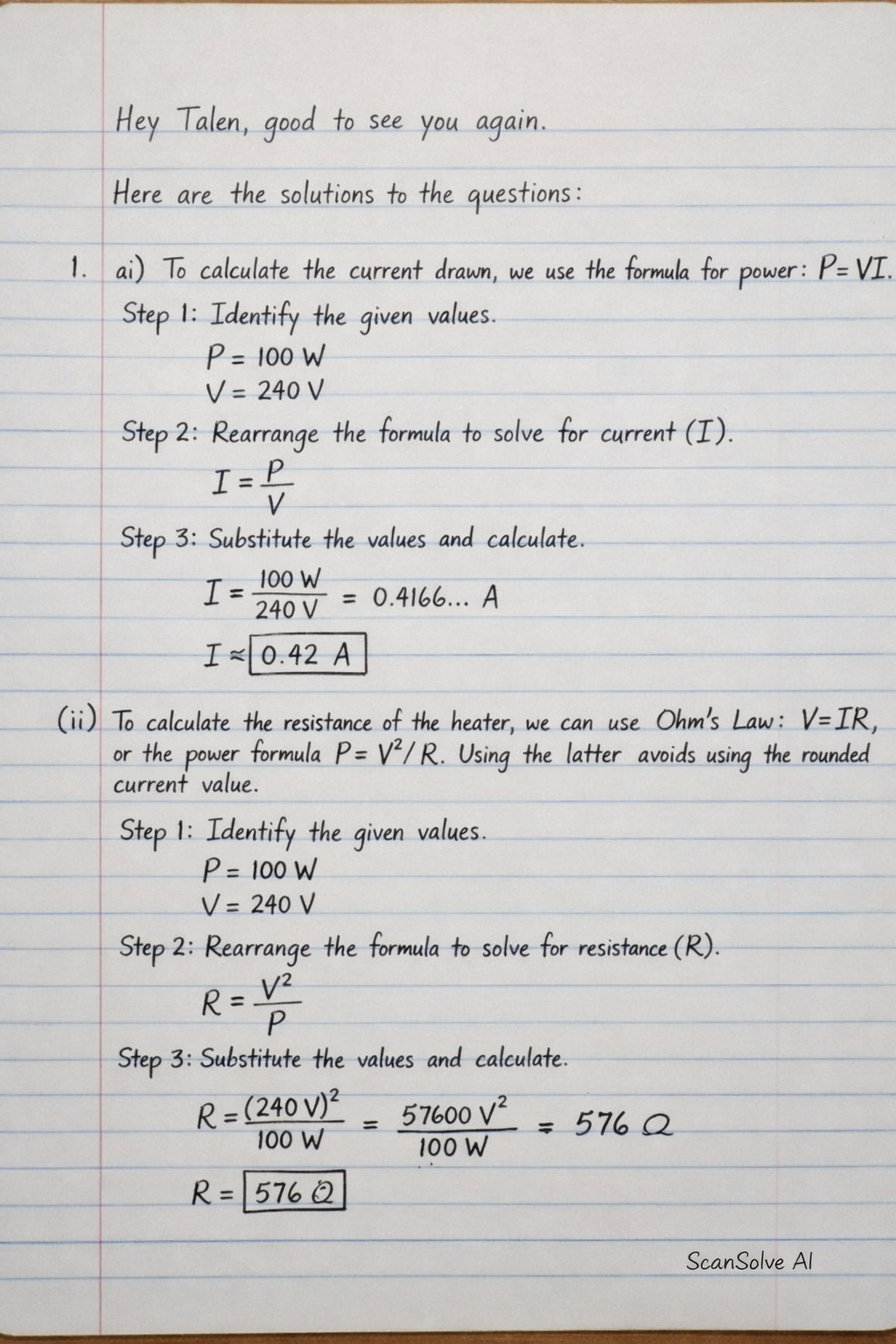
8 stepsHere are the solutions to the questions:
- a. (i) To calculate the current drawn, we use the formula for power: .
Identify the given values.
$P = 100\, \text{W}$ $V = 240\, \text{V}$Rearrange the formula to solve for current ().
$I = \frac{P}{V}$Substitute the values and calculate.
$$ I = \frac{100\, \text{W}}{240\, \text{V}} = 0.4166...\, \text{A} $$ $$ I \approx \boxed{\text{0.42 A}} $$ (ii) To calculate the resistance of the heater, we can use Ohm's Law: $V = IR$, or the power formula $P = \frac{V^2}{R}$. Using the latter avoids using the rounded current value.Identify the given values.
$P = 100\, \text{W}$ $V = 240\, \text{V}$Rearrange the formula to solve for resistance ().
$R = \frac{V^2}{P}$Substitute the values and calculate.
$$ R = \frac{(240\, \text{V})^2}{100\, \text{W}} = \frac{57600\, \text{V}^2}{100\, \text{W}} = 576\, \Omega $$ $$ R = \boxed{\text{576 } \Omega} $$ b. (i) Three compounds that have electrovalent bonds are:- Sodium chloride (NaCl)
- Magnesium oxide (MgO)
- Potassium iodide (KI)
(ii) Two characteristics of electrovalent compounds are:
- They generally have high melting and boiling points due to strong electrostatic forces between ions.
- They are typically soluble in polar solvents like water and conduct electricity when molten or dissolved in water.
c. (i) The rhesus factor (Rh factor) is a specific protein antigen found on the surface of red blood cells in some individuals. People who have this antigen are Rh-positive (Rh+), and those who do not are Rh-negative (Rh-).
(ii) The rhesus factor in humans could result in miscarriage when an Rh-negative mother carries an Rh-positive fetus. During pregnancy or childbirth, fetal blood can enter the mother's bloodstream, causing her immune system to produce antibodies against the Rh factor. In subsequent pregnancies with another Rh-positive fetus, these maternal antibodies can cross the placenta and attack the fetal red blood cells, leading to hemolytic disease of the newborn, which can cause severe anemia, brain damage, or miscarriage.
-
a. (i) Solar energy is used to generate electricity primarily through two methods:
- Photovoltaic (PV) cells: These cells, made of semiconductor materials like silicon, convert sunlight directly into electricity (direct current) through the photovoltaic effect.
- Solar thermal power plants: These plants use mirrors to concentrate sunlight to heat a fluid, which then produces steam to drive a turbine connected to a generator, producing electricity.
(ii) Two other uses of solar energy are:
- Solar water heating: Used to heat water for domestic or industrial purposes.
- Solar drying: Used to dry agricultural products like grains, fruits, and fish.
b. Five ways of conserving water in the home are:
- Taking shorter showers instead of baths.
- Turning off the tap while brushing teeth or washing dishes.
- Fixing leaky faucets and pipes promptly.
- Using water-efficient appliances (e.g., low-flow toilets, energy-efficient washing machines).
- Collecting rainwater for gardening or other non-potable uses.
c. (i) Three management practices that ensure high yield in maize production are:
- Proper land preparation (e.g., ploughing, harrowing).
- Timely planting of improved varieties.
- Appropriate fertilizer application based on soil tests.
(ii) Explanation of two practices:
- Proper land preparation: This practice ensures a fine tilth, which provides a good seedbed for uniform germination and root development. It also helps in weed control and improves soil aeration and water infiltration, all of which are crucial for healthy plant growth and high yield.
- Appropriate fertilizer application: Fertilizers supply essential nutrients (like nitrogen, phosphorus, and potassium) that maize plants need for vigorous growth, flowering, and grain formation. Applying the correct type and amount of fertilizer at the right time prevents nutrient deficiencies, leading to stronger plants and increased grain production.
d. (i) Two effects of air masses on the environment are:
- They influence weather patterns, bringing changes in temperature, humidity, and precipitation (e.g., a cold air mass can bring a drop in temperature and snow).
- They can cause extreme weather events such as heatwaves, cold snaps, or heavy rainfall, depending on their origin and characteristics.
(ii) Three ways by which global warming can be reduced are:
- Reducing the use of fossil fuels by switching to renewable energy sources like solar and wind power.
- Improving energy efficiency in homes, industries, and transportation.
- Promoting afforestation and reforestation to increase carbon dioxide absorption.
-
a. (i) Aluminium resists corrosion but iron does not because aluminium forms a thin, tough, and impermeable layer of aluminium oxide () on its surface when exposed to air. This oxide layer adheres strongly to the metal and acts as a protective barrier, preventing further oxidation. Iron, on the other hand, forms hydrated iron(III) oxide (rust), which is flaky, porous, and does not adhere tightly to the surface, allowing oxygen and water to penetrate and continue the rusting process.
(ii) Two methods of preventing iron from rusting are:
- Painting or greasing: Applying a protective coating to prevent contact with oxygen and water.
- Galvanizing: Coating iron with a layer of zinc, which acts as a sacrificial anode.
b. (i) Culling, as used in livestock management, refers to the process of removing animals from a herd or flock that are considered undesirable or unproductive. This can be due to poor health, low productivity, old age, genetic defects, or aggressive behavior.
(ii) Three benefits of practising culling are:
- Disease control: Removing sick animals prevents the spread of diseases to the rest of the herd.
- Improved herd genetics: Eliminating animals with undesirable traits allows for breeding from healthier and more productive stock.
- Increased profitability: By removing unproductive animals, resources (feed, space) are conserved for more productive ones, leading to better overall efficiency and yield.
c. (i) The distinction between grafting and budding lies in the size of the scion used:
- Grafting involves joining a scion (a shoot or twig containing several buds) from one plant onto the rootstock of another.
- Budding is a type of grafting where only a single bud (with a small piece of bark and wood) from the desired plant is inserted into the rootstock.
(ii) Three reasons for grafting and budding are:
- To propagate plants that do not root easily from cuttings or do not come true from seed.
- To combine desirable traits from two different plants, such as disease resistance from the rootstock and high fruit yield from the scion.
- To repair damaged trees by bridging wounds or to change the variety of an existing tree (topworking).
d. (i) The principle of conservation of energy states that energy cannot be created or destroyed, but it can be transformed from one form to another. The total amount of energy in an isolated system remains constant.
(ii) Energy transformations:
(a) A moving motorcycle:
Chemical energy (in fuel) Heat energy (combustion) Kinetic energy (of moving parts) Kinetic energy (of motorcycle) + Sound energy + Heat energy (friction).(b) A television set in operation:
Electrical energy Light energy + Sound energy + Heat energy. -
a. (i) Secondary colours of light are colours that are produced by mixing two primary colours of light in equal proportions. The primary colours of light are red, green, and blue.
(ii) The colour that results from combining each of the following pairs of colours of light:
(a) red and green: Yellow
(b) blue and green: Cyan
(c) red and blue: Magentab. (i) The mole of a substance is defined as the amount of substance that contains as many elementary entities (atoms, molecules, ions, etc.) as there are atoms in 12 grams of carbon-12. This number is known as Avogadro's number, approximately .
(ii) To calculate the number of atoms in 18 g of magnesium metal:
Calculate the number of moles of magnesium.
Molar mass of Mg = $24\, \text{g/mol}$ $$ \text{Moles of Mg} = \frac{\text{Mass}}{\text{Molar mass}} = \frac{18\, \text{g}}{24\, \text{g/mol}} = 0.75\, \text{mol} $$Use Avogadro's number to find the number of atoms.
Avogadro's number = $6.023 \times 10^{23}\, \text{atoms/mol}$ $$ \text{Number of atoms} = \text{Moles} \times \text{Avogadro's number} $$ $$ \text{Number of atoms} = 0.75\, \text{mol} \times 6.023 \times 10^{23}\, \text{atoms/mol} $$ $$ \text{Number of atoms} = 4.51725 \times 10^{23}\, \text{atoms} $$ $$ \text{Number of atoms} \approx \boxed{4.52 \times 10^{23}\, \text{atoms}} $$ c. (i) Differentiate between bone and cartilage:- Bone is a hard, rigid connective tissue that forms the main framework of the body, providing support and protection. It is highly vascularized and contains calcium salts.
- Cartilage is a flexible, semi-rigid connective tissue that is softer than bone. It is avascular (lacks blood vessels) and provides cushioning, reduces friction in joints, and maintains the shape of certain body parts.
(ii) Three parts of the human body where cartilages are found are:
- Ears (e.g., external ear/pinna)
- Nose (e.g., nasal septum)
- Trachea (
Still stuck on this one?
Ask a follow-up, and the answer starts from this question.
More Geography Questions
Handwritten Step-by-Step Solution
Get this as a handwritten image on WhatsApp — like a tutor wrote it for you.
Try on WhatsApp