
This geography problem is solved step by step below, with detailed explanations to help you understand the method and arrive at the correct answer.
ScanSolve AI Answer
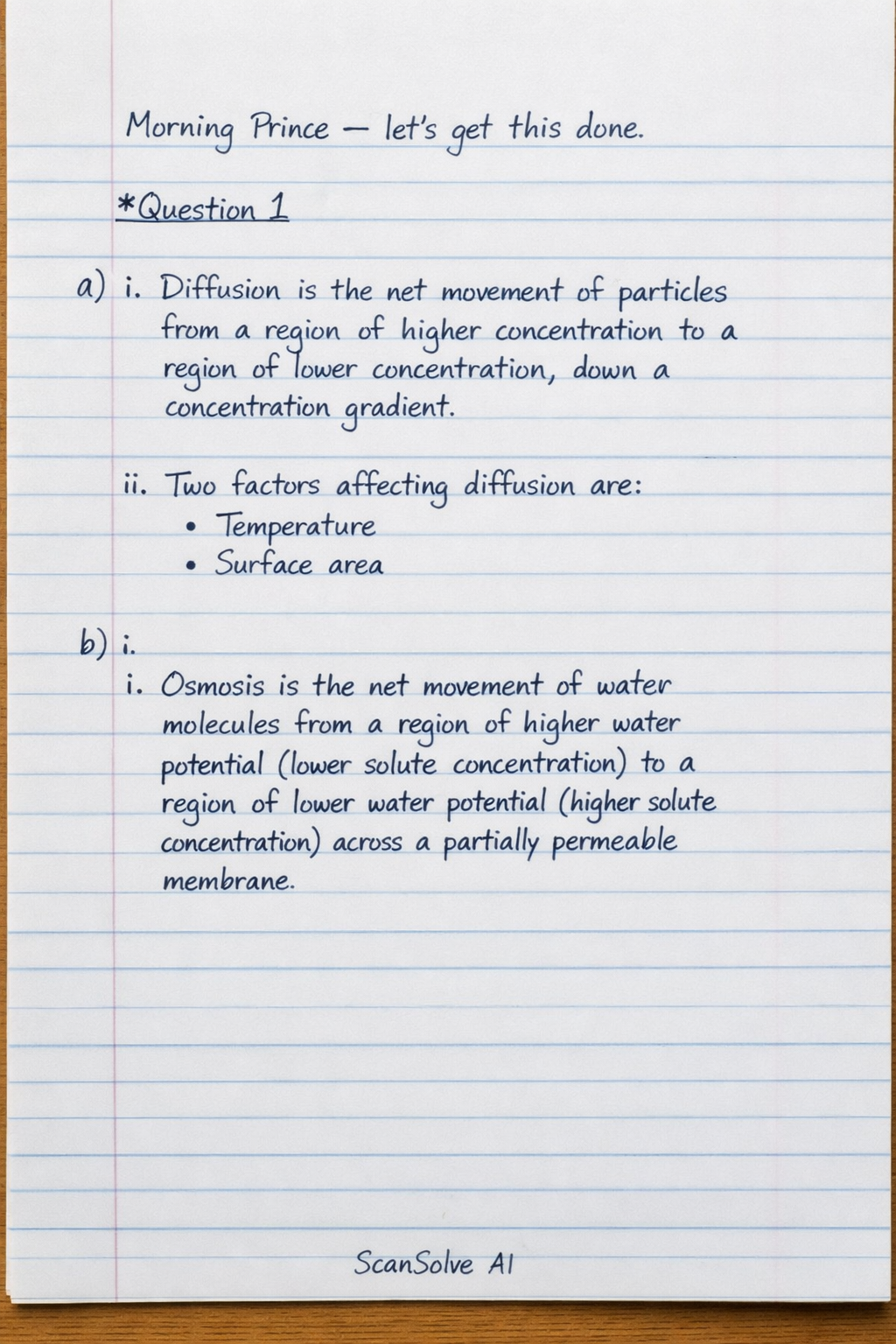
Morning Prince — let's get this done. Question 1 a) i. Diffusion is the net movement of particles from a region of higher concentration to a region of lower concentration, down a concentration gradient. ii. Two factors affecting diffusion are: • Temperature • Surface area b) i. Osmosis is the net movement of water molecules from a region of higher water potential (lower solute concentration) to a region of lower water potential (higher solute concentration) across a partially permeable membrane. ii. An experiment to demonstrate osmosis can be described as follows: 1. Peel a potato and scoop out a hollow in its center, leaving a thin base. 2. Place the potato in a beaker containing water. 3. Fill the hollow in the potato with a concentrated sugar solution and mark the initial level of the solution. 4. Leave the setup for a few hours. 5. Observe that the level of the sugar solution in the potato hollow rises, indicating that water has moved from the beaker (higher water potential) into the potato hollow (lower water potential) through the partially permeable potato cells. c) Four differences between plant and animal cells are: • Plant cells have a rigid cell wall, while animal cells do not. • Plant cells typically have a large, central vacuole, whereas animal cells have small, temporary vacuoles or none. • Plant cells contain chloroplasts for photosynthesis, while animal cells do not. • Plant cells have a fixed, regular shape, while animal cells have an irregular shape. d) Two importances of diffusion in living organisms are: • Gas exchange: Diffusion allows oxygen to move from the lungs into the blood and carbon dioxide to move from the blood into the lungs for exhalation. It also facilitates the uptake of carbon dioxide by plants for photosynthesis and the release of oxygen. • Nutrient absorption: Digested food molecules, such as glucose and amino acids, are absorbed from the small intestine into the bloodstream through diffusion. Send me the next one 📸