
PAPER 1: OBJECTIVE Answer all questions. Each question is followed by four options lettered A–D. Choose the correct option. Which of the following organelles is responsible for protein synthesis? A. Mitochondrion B. Ribosome C. Nucleus D. Chloroplast The process by which plants lose water vapor through their leaves is called A. Respiration B. Transpiration C. Photosynthesis D. Excretion Which of these is NOT a characteristic of living things? A. Growth B. Respiration C. Rusting D. Reproduction The unit of inheritance is the A. Chromosome B. Gene C. Cell D. Nucleus An example of a unicellular organism is A. Spirogyra B. Hydra C. Amoeba D. Earthworm The blood vessel that carries oxygenated blood from the lungs to the heart is the A. Pulmonary artery B. Pulmonary vein C. Aorta D. Vena cava Which of these diseases is caused by a virus? A. Malaria B. Cholera C. Measles D. Typhoid In humans, fertilization usually occurs in the A. Uterus B. Ovary C. Fallopian tube D. Vagina The part of the eye that controls the amount of light entering it is the A. Retina B. Lens C. Iris D. Cornea Which of these is a biotic component of an ecosystem? A. Soil B. Water C. Bacteria D. Temperature PAPER 2: THEORY Answer 4 questions in all: Question 1 and any other three. SECTION A a) Draw and label a diagram of a plant cell as seen under a light microscope. [6 marks] b) State three differences between a plant cell and an animal cell. [3 marks] c) List three functions of the blood in mammals. [3 marks] [Compulsory] SECTION B [Answer any three] a) Define the term photosynthesis. [2 marks] b) Write a balanced chemical equation for photosynthesis. [2 marks] c) State four factors that affect the rate of photosynthesis. [4 marks] d) How is the leaf adapted for photosynthesis? [4 marks] a) What is pollination? [2 marks] b) Differentiate between self-pollination and cross-pollination. [4 marks] c) State three agents of pollination and give one feature of flowers pollinated by each. [6 marks] a) Define ecosystem. [2 marks] b) With a labeled diagram, describe a simple food chain in a grassland habitat. [5 marks] c) Explain three effects of deforestation on an ecosystem. [3 marks] d) What is conservation? Give two reasons for conserving wildlife. [2 marks] a) List four excretory organs in mammals and one waste product removed by each. [4 marks] b) Draw the human urinary system and label six parts. [6 marks] c) State two diseases of the kidney. [2 marks] The answers
ScanSolve AI Answer
Answer
Step-by-step solution
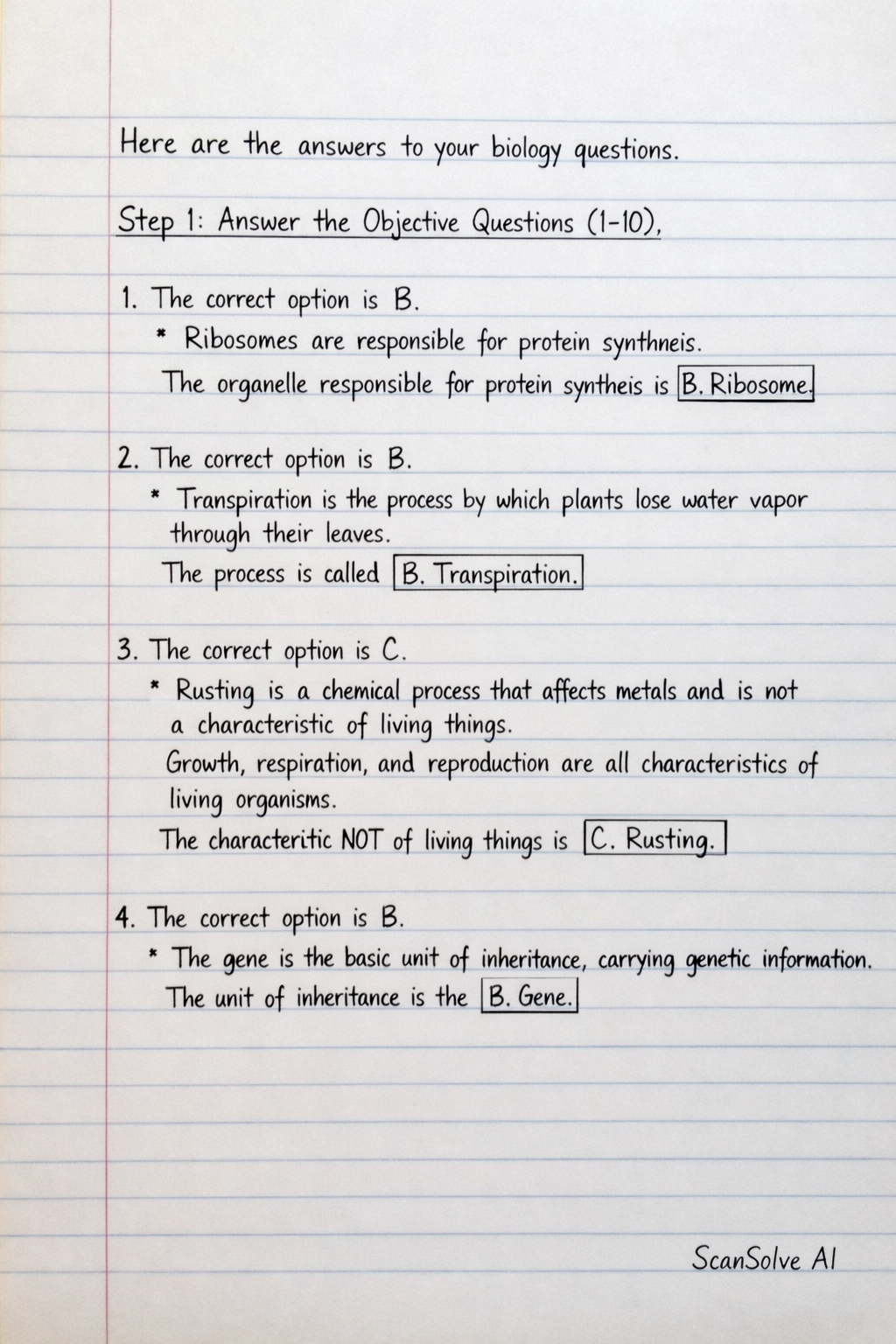
6 stepsHere are the answers to your biology questions.
Answer the Objective Questions (1-10).
-
The correct option is B.
- Ribosomes are responsible for protein synthesis. The organelle responsible for protein synthesis is .
-
The correct option is B.
- Transpiration is the process by which plants lose water vapor through their leaves. The process is called .
-
The correct option is C.
- Rusting is a chemical process that affects metals and is not a characteristic of living things. Growth, respiration, and reproduction are all characteristics of living organisms. The characteristic NOT of living things is .
-
The correct option is B.
- The gene is the basic unit of inheritance, carrying genetic information. The unit of inheritance is the .
-
The correct option is C.
- An Amoeba is a single-celled organism. Spirogyra is multicellular (filamentous algae), Hydra is multicellular, and Earthworm is multicellular. An example of a unicellular organism is .
-
The correct option is B.
- The pulmonary vein carries oxygenated blood from the lungs back to the left atrium of the heart. The blood vessel is the .
-
The correct option is C.
- Measles is caused by the measles virus. Malaria is caused by a parasite, cholera and typhoid by bacteria. The disease caused by a virus is .
-
The correct option is C.
- In humans, fertilization, the fusion of sperm and egg, typically occurs in the Fallopian tube. Fertilization usually occurs in the .
-
The correct option is C.
- The iris is the colored part of the eye that controls the size of the pupil, thereby regulating the amount of light entering the eye. The part of the eye is the .
-
The correct option is C.
- A biotic component is a living or once-living part of an ecosystem. Bacteria are living organisms. Soil, water, and temperature are abiotic (non-living) components. A biotic component of an ecosystem is .
-
Answer Theory Question 1.
a) Draw and label a diagram of a plant cell as seen under a light microscope.
Draw a diagram of a plant cell. It should be rectangular or box-like.
Label the following parts:- Cell wall (outermost layer)
- Cell membrane (just inside the cell wall)
- Cytoplasm (jelly-like substance filling the cell)
- Nucleus (large, usually spherical organelle, often near the periphery)
- Vacuole (large, central, fluid-filled sac)
- Chloroplast (oval-shaped organelles, numerous in the cytoplasm)
b) State three differences between a plant cell and an animal cell.
Here are three differences:- Plant cells have a cell wall, while animal cells do not.
- Plant cells have a large, permanent central vacuole, while animal cells have small, temporary, or no vacuoles.
- Plant cells contain chloroplasts for photosynthesis, while animal cells do not.
c) List three functions of the blood in mammals.
Here are three functions of blood:- Transport of oxygen from the lungs to body tissues.
- Transport of nutrients (e.g., glucose, amino acids) from the digestive system to cells.
- Transport of waste products (e.g., carbon dioxide, urea) to excretory organs.
- Regulation of body temperature.
- Defense against pathogens through white blood cells and antibodies.
Answer Theory Question 2.
a) Define the term photosynthesis.
Photosynthesis is the process by which green plants, algae, and some bacteria convert light energy into chemical energy, in the form of glucose, using carbon dioxide and water. Oxygen is released as a byproduct.b) Write a balanced chemical equation for photosynthesis.
The balanced chemical equation for photosynthesis is:c) State four factors that affect the rate of photosynthesis.
Here are four factors that affect the rate of photosynthesis:- Light intensity: Higher light intensity generally increases the rate up to a certain point.
- Carbon dioxide concentration: Increased concentration generally increases the rate up to a certain point.
- Temperature: Photosynthesis has an optimal temperature range; rates decrease at very low or very high temperatures.
- Water availability: Water is a reactant in photosynthesis; insufficient water can reduce the rate.
- Chlorophyll concentration: The amount of chlorophyll directly affects light absorption.
d) How is the leaf adapted for photosynthesis?
The leaf is adapted for photosynthesis in several ways:- Large surface area: To maximize light absorption.
- Thinness: Allows for rapid diffusion of gases ( and ) and light penetration to all cells.
- Presence of chlorophyll: Contained within chloroplasts in palisade and spongy mesophyll cells to absorb light energy.
- Stomata: Pores on the leaf surface that allow for gas exchange ( intake, release).
- Extensive vascular bundles (veins): To transport water to the photosynthetic cells and carry away manufactured sugars.
Answer Theory Question 3.
a) What is pollination?
Pollination is the transfer of pollen grains from the anther (male part) to the stigma (female part) of a flower.b) Differentiate between self-pollination and cross-pollination.
- Self-pollination is the transfer of pollen from the anther to the stigma of the same flower, or to another flower on the same plant.
- Cross-pollination is the transfer of pollen from the anther of a flower on one plant to the stigma of a flower on a different plant of the same species.
c) State three agents of pollination and give one feature of flowers pollinated by each.
Here are three agents of pollination and a feature of flowers pollinated by each:- Wind: Flowers are often small, dull-colored, lack nectar, have large feathery stigmas, and produce abundant, light pollen.
- Insects (e.g., bees, butterflies): Flowers are typically large, brightly colored, scented, produce nectar, and have sticky stigmas and pollen.
- Birds: Flowers are often large, brightly colored (especially red or orange), produce abundant nectar, and lack strong scent.
- Water: Flowers are often small, inconspicuous, and produce pollen that floats on water.
Answer Theory Question 4.
a) Define ecosystem.
An ecosystem is a community of living organisms (biotic components) interacting with each other and with their non-living physical environment (abiotic components) in a particular area.b) With a labeled diagram, describe a simple food chain in a grassland habitat.
Draw a simple food chain diagram showing arrows pointing from the organism being eaten to the organism that eats it.
Example:Description:
In a grassland habitat, grass (producer) converts sunlight into energy. A grasshopper (primary consumer/herbivore) feeds on the grass. A frog (secondary consumer/carnivore) then eats the grasshopper. A snake (tertiary consumer/carnivore) preys on the frog, and finally, an eagle (quaternary consumer/top carnivore) hunts and eats the snake. Each arrow indicates the flow of energy.c) Explain three effects of deforestation on an ecosystem.
Here are three effects of deforestation on an ecosystem:- Loss of biodiversity: Deforestation destroys habitats, leading to the displacement or extinction of many plant and animal species.
- Climate change: Trees absorb carbon dioxide; their removal and burning release large amounts of into the atmosphere, contributing to global warming.
- Soil erosion: Tree roots hold soil in place. Without trees, soil is easily washed away by rain or blown by wind, leading to loss of fertile topsoil.
- Disruption of water cycles: Forests play a crucial role in regulating rainfall and water retention. Deforestation can lead to reduced rainfall and increased flooding or drought.
d) What is conservation? Give two reasons for conserving wildlife.
Conservation is the protection, preservation, management, or restoration of natural environments and wildlife.
Two reasons for conserving wildlife are:- Maintaining biodiversity: To preserve the variety of life on Earth, which is essential for ecosystem stability and resilience.
- Ecological balance: Wildlife plays vital roles in ecosystems (e.g., pollination, pest control, nutrient cycling), and their loss can disrupt these balances.
- Economic benefits: Wildlife can provide resources (e.g., food, medicine, tourism) and support livelihoods.
- Ethical reasons: Many believe humans have a moral responsibility to protect other species.
Answer Theory Question 5.
a) List four excretory organs in mammals and one waste product removed by each.
Here are four excretory organs in mammals and one waste product removed by each:- Kidneys: Remove urea, excess salts, and water from the blood to form urine.
- Lungs: Remove carbon dioxide and water vapor during respiration.
- Skin: Removes excess water, salts, and a small amount of urea through sweat.
- Liver: Breaks down various toxic substances and converts ammonia into less toxic urea.
b) Draw the human urinary system and label six parts.
Draw a diagram of the human urinary system.
Label the following six parts:- Kidneys (two bean-shaped organs)
- Ureters (tubes connecting kidneys to bladder)
- Urinary bladder (sac that stores urine)
- Urethra (tube that carries urine out of the body)
- Renal artery (blood vessel supplying blood to the kidney)
- Renal vein (blood vessel carrying blood away from the kidney)
c) State two diseases of the kidney.
Here are two diseases of the kidney:- Kidney stones (renal calculi)
- Kidney failure (renal failure)
- Glomerulonephritis (inflammation of the kidney's filtering units)
- Urinary tract infections (UTIs) that affect the kidneys.
Try one yourself
A new problem that tests the same skill.
Still stuck on this one?
Ask a follow-up, and the answer starts from this question.
More Geography Questions
Handwritten Step-by-Step Solution
Get this as a handwritten image on WhatsApp — like a tutor wrote it for you.
Try on WhatsApp