
We read your photo as:
Explain latitude and its impact
ScanSolve AI Answer
Here are the explanations for the self-evaluation questions:
-
Explain latitude and its impact Latitude refers to the angular distance, measured in degrees, north or south of the Equator. It significantly impacts climate, as areas closer to the Equator (low latitudes) receive more direct sunlight and are generally warmer, while areas closer to the poles (high latitudes) receive less direct sunlight and are colder.
-
Differentiate the Northern and Southern Hemispheres with examples The Northern Hemisphere is the half of Earth north of the Equator, characterized by a larger landmass, including North America, Europe, and most of Asia. The Southern Hemisphere is the half of Earth south of the Equator, with a larger proportion of ocean and landmasses like Australia, Antarctica, and most of South America. Seasons are opposite in the two hemispheres; for example, when it is summer in the Northern Hemisphere, it is winter in the Southern Hemisphere.
Still stuck on this one?
Ask a follow-up, and the answer starts from this question.
More Geography Questions
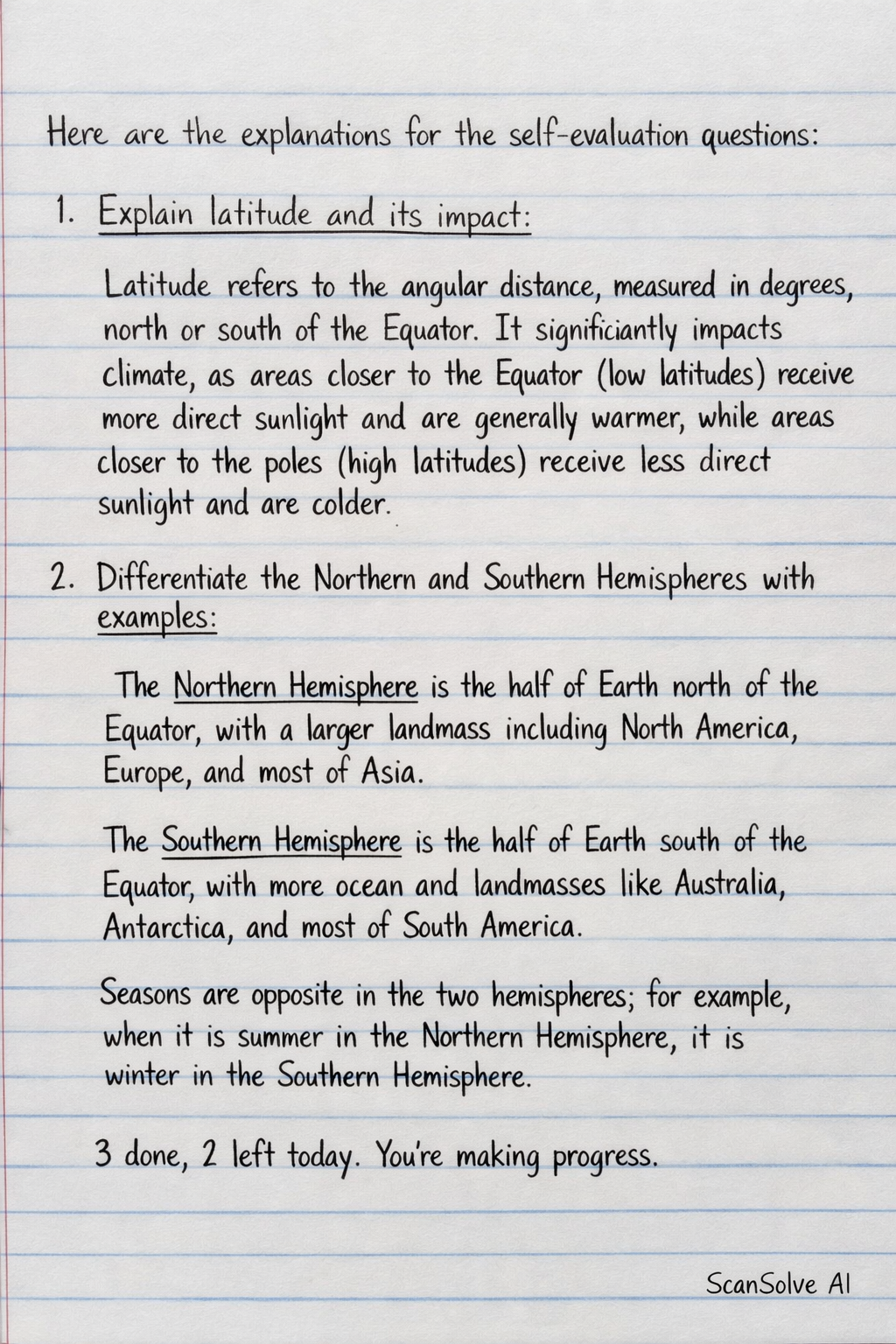
Handwritten Step-by-Step Solution
Get this as a handwritten image on WhatsApp — like a tutor wrote it for you.
Try on WhatsApp