
We read your photo as:
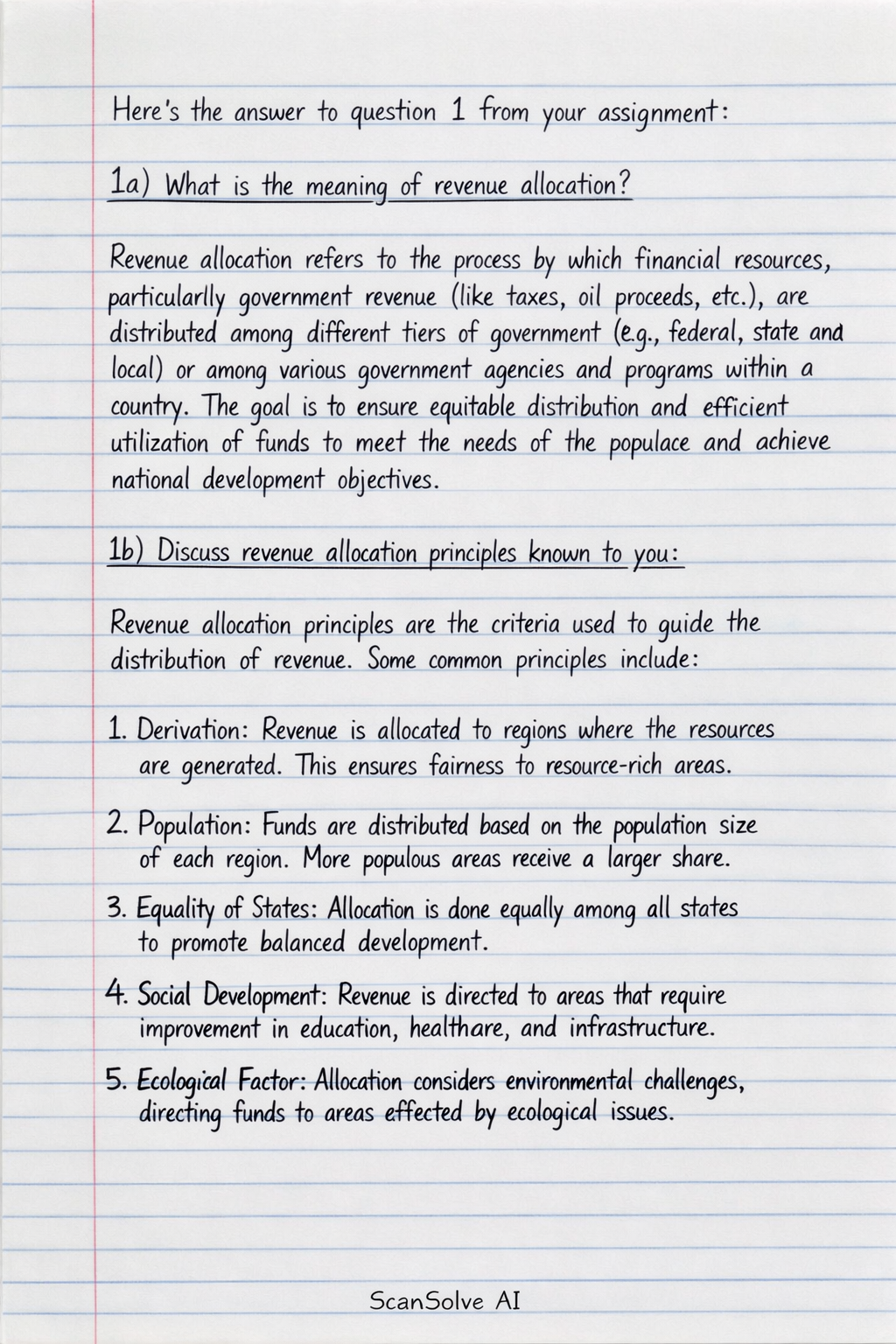
1a) What is the meaning of revenue allocation?
ScanSolve AI Answer
Here's the answer to question 1 from your assignment:
1a) What is the meaning of revenue allocation?
Revenue allocation refers to the process by which financial resources, particularly government revenue (like taxes, oil proceeds, etc.), are distributed among different tiers of government (e.g., federal, state, and local) or among various government agencies and programs within a country. The goal is to ensure equitable distribution and efficient utilization of funds to meet the needs of the populace and achieve national development objectives.
1b) Discuss revenue allocation principles known to you.
Revenue allocation principles are the criteria used to guide the distribution of revenue. Some common principles include:
- Principle of Derivation: This principle suggests that a portion of the revenue generated from a particular region or source should be returned to that region. For example, a state that produces oil might receive a higher share of oil revenue.
- Principle of Equality: This principle advocates for an equal or near-equal distribution of revenue among all units of government, regardless of their contribution to the national purse. It aims to ensure that all regions have a basic level of funding.
- Principle of Population: Revenue is distributed based on the population size of each governmental unit. The idea is that areas with more people require more resources to provide public services.
- Principle of Landmass/Geography: This principle considers the geographical size or landmass of a region, arguing that larger areas may require more funds for infrastructure development and administration.
- Principle of Social Development/Needs: This principle allocates more funds to regions that are less developed or have greater social needs (e.g., high poverty rates, low literacy rates) to help them catch up with more developed areas.
- Principle of Fiscal Capacity/Effort: This principle rewards governmental units that demonstrate greater effort in generating their own revenue or have a higher capacity to do so, encouraging fiscal responsibility.
These principles are often combined in various formulas to create a balanced and fair revenue allocation system.
Still stuck on this one?
Ask a follow-up, and the answer starts from this question.
More Business/Management Questions
Handwritten Step-by-Step Solution
Get this as a handwritten image on WhatsApp — like a tutor wrote it for you.
Try on WhatsApp