
We read your photo as:
Heat loss to the surroundings: Not all the heat energy supplied by the heat source will be absorbed by the water; some will be lost to the air or the container, affecting the accuracy of tempe
Business/Management
ScanSolve AI Answer
Here are some constraints or limitations that might be encountered during the experiment of heating water:
- Heat loss to the surroundings: Not all the heat energy supplied by the heat source will be absorbed by the water; some will be lost to the air or the container, affecting the accuracy of temperature readings.
- Accuracy of measuring instruments: The thermometer or stopwatch may not be perfectly accurate, leading to slight errors in temperature or time measurements.
- Maintaining a constant heat supply: It can be challenging to ensure that the heat source provides a perfectly constant rate of heat energy throughout the experiment, which could affect the rate of temperature increase.
Was this helpful?
Still stuck on this one?
Ask a follow-up, and the answer starts from this question.
Got a different question?Ask your own question
More Business/Management Questions
QExplain heat loss and heat gain by a thermoflaskQExplain heat loss by thermoflaskQCalculate the heat gained by the calorimeter and water, and the energy lost by the metal nut.QWhat happens to the heat supplied at points where there is no increase in temperature?QCalculate the heat gained by the calorimeter and water, given their masses, initial temperatures…
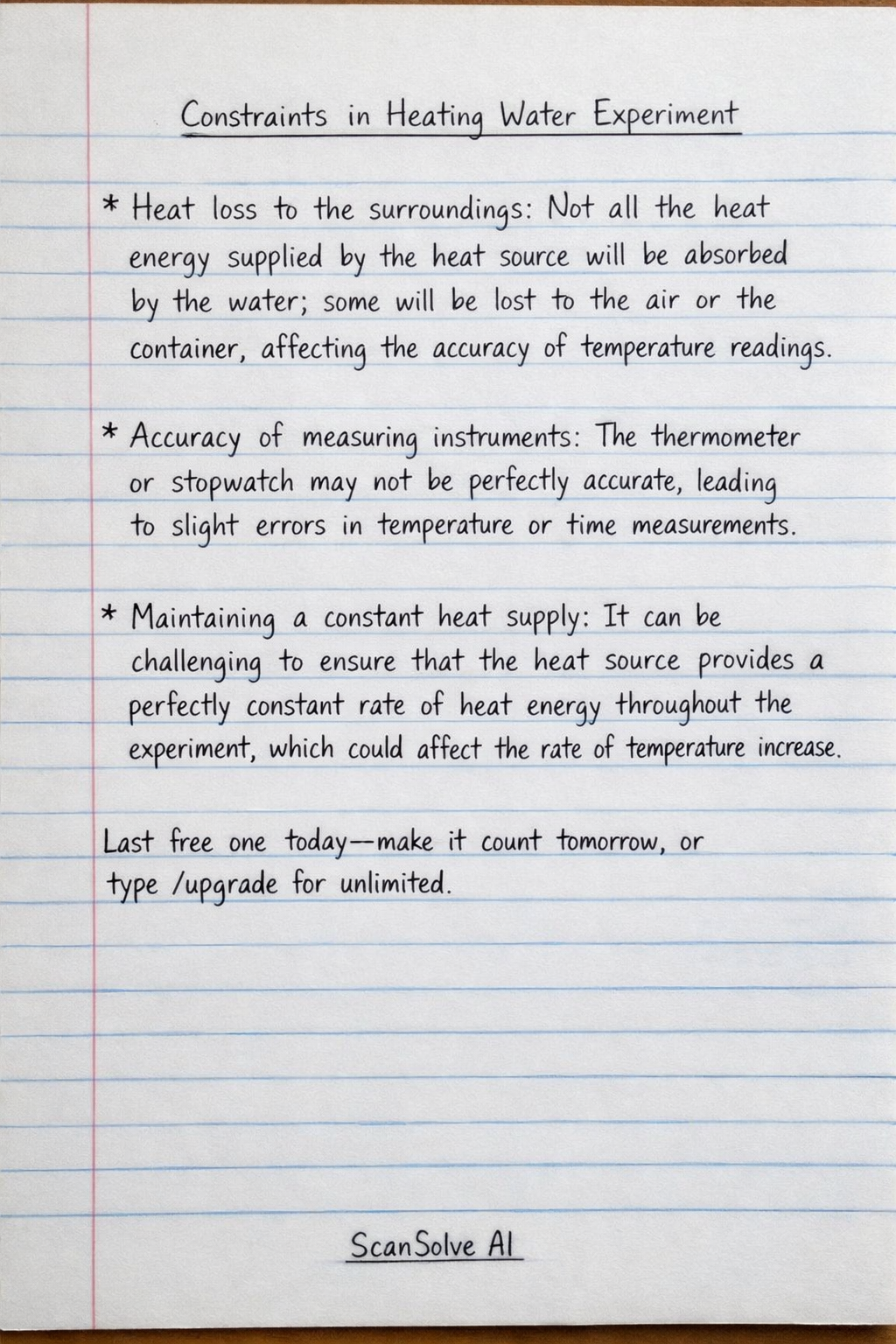
Handwritten Step-by-Step Solution
Get this as a handwritten image on WhatsApp — like a tutor wrote it for you.
Try on WhatsApp