
We read your photo as:
Calculate the heat gained by the calorimeter and water, given their masses, initial temperatures, specific heat capacities, and the final mixture temperature.
ScanSolve AI Answer
Step-by-step solution
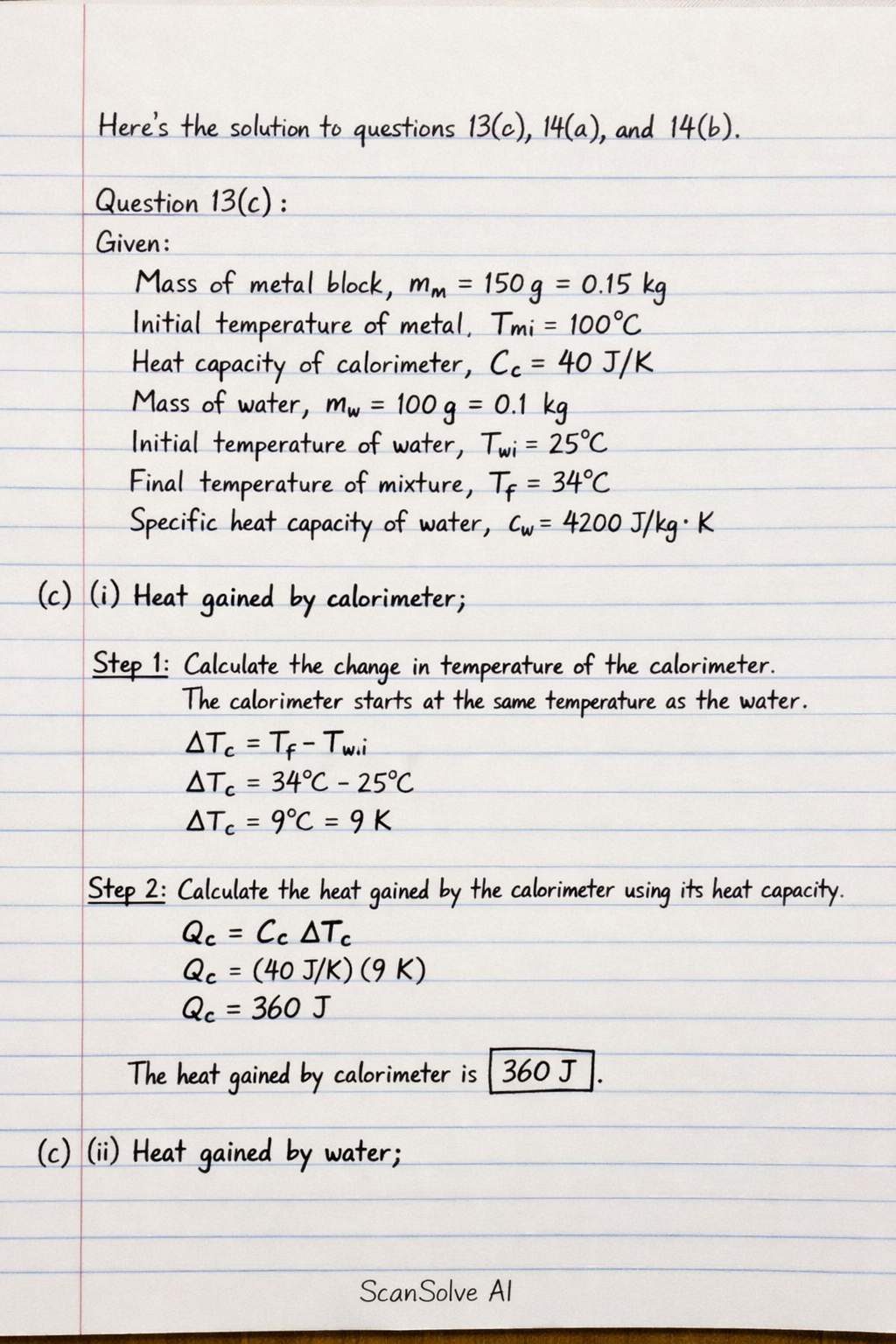
14 stepsHere's the solution to questions 13(c), 14(a), and 14(b).
Question 13(c):
Given:
Mass of metal block,
Initial temperature of metal block,
Heat capacity of calorimeter,
Mass of water,
Initial temperature of water,
Final temperature of mixture,
Specific heat capacity of water,
c) (i) Heat gained by calorimeter;
Calculate the change in temperature of the calorimeter.
The calorimeter starts at the same temperature as the water.
Calculate the heat gained by the calorimeter using its heat capacity.
The heat gained by the calorimeter is .
c) (ii) Heat gained by water;
Calculate the change in temperature of the water.
Calculate the heat gained by the water using its mass and specific heat capacity.
The heat gained by water is .
c) (iii) Heat lost by the metal block;
Apply the principle of calorimetry
Heat lost by the metal block equals the total heat gained by the water and the calorimeter.
The heat lost by the metal block is .
c) (iv) Specific heat capacity of the metal block
Calculate the change in temperature of the metal block.
Use the heat lost by the metal block to find its specific heat capacity, .
Solve for .
Rounding to one decimal place:
The specific heat capacity of the metal block is .
Question 14:
a) Distinguish between solid and liquid states of matter in terms of intermolecular forces.
In solids, intermolecular forces are very strong, holding particles in fixed positions and giving solids a definite shape and volume. In liquids, intermolecular forces are weaker than in solids, allowing particles to move past each other, giving liquids a definite volume but no definite shape.
b) In an experiment to estimate the diameter of an oil molecule, an oil drop of diameter spreads over a circular patch whose diameter is .
b) (i) Determine the volume of the oil drop
Calculate the radius of the oil drop.
Calculate the volume of the spherical oil drop.
Rounding to three significant figures:
The volume of the oil drop is .
b) (ii) Determine the area of the patch covered by the oil
Calculate the radius of the circular patch.
Calculate the area of the circular patch.
Rounding to three significant figures:
The area of the patch covered by the oil is .
b) (iii) Determine the diameter of an oil molecule (implied by the context of the experiment)
Assume the oil spreads to form a monolayer, so the thickness of the patch is the diameter of one oil molecule, .
The volume of the oil drop is equal to the volume of the cylindrical patch.
Solve for .
Rounding to three significant figures:
The diameter of an oil molecule is .
Still stuck on this one?
Ask a follow-up, and the answer starts from this question.
More Physics Questions
Handwritten Step-by-Step Solution
Get this as a handwritten image on WhatsApp — like a tutor wrote it for you.
Try on WhatsApp