
We read your photo as:
A mass of 5 kg of water is heated with a 500 W heater for 20 minutes. (i) Calculate the heat supplied. (ii) Determine the change in temperature. (iii) Explain why water is used as a cooling liquid.
ScanSolve AI Answer
Step-by-step solution
7 stepsHere are the solutions for the questions from the image:
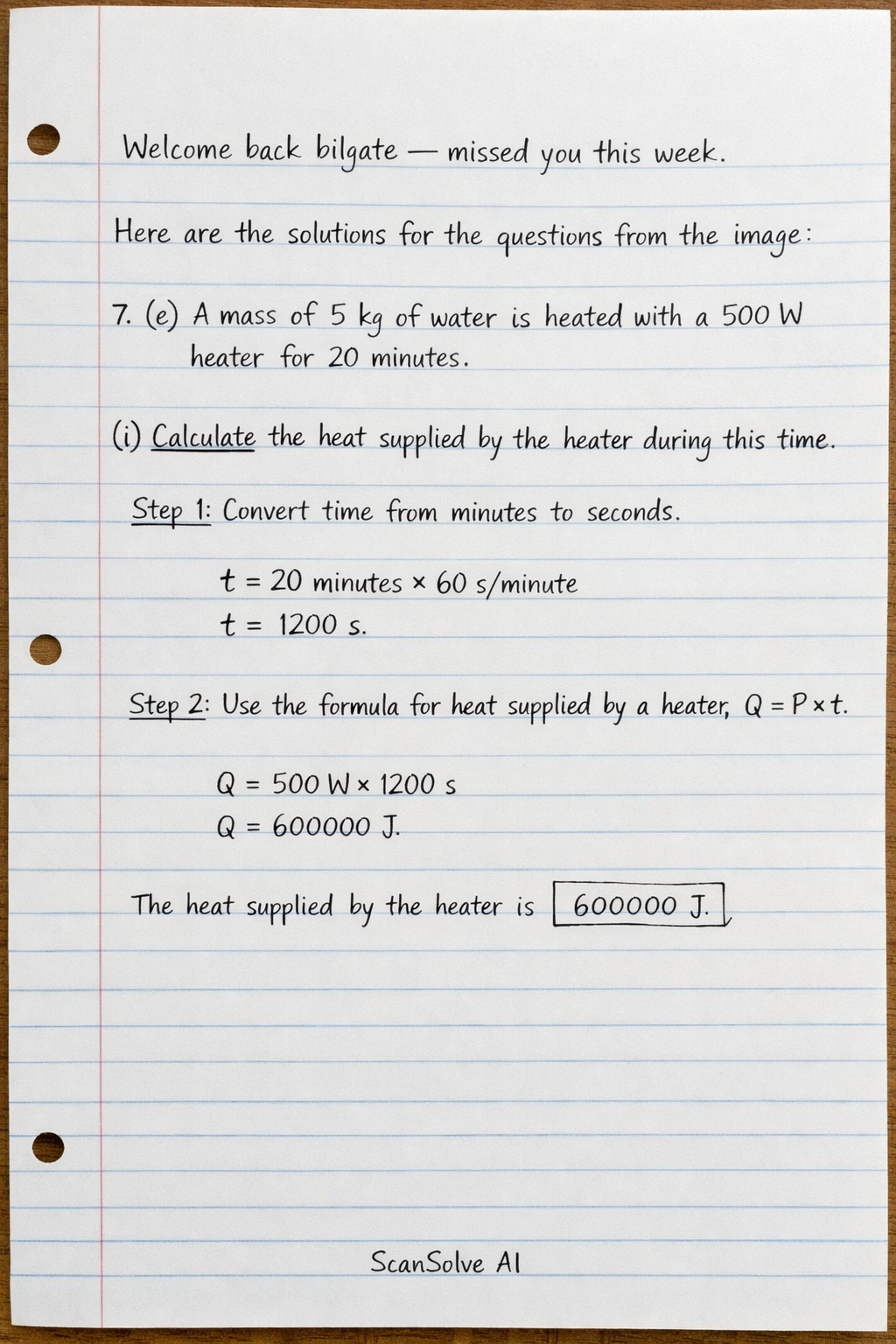
7. (e) A mass of of water is heated with a heater for .
(i) Calculate the heat supplied by the heater supplied during this time.
Convert time from minutes to seconds.
Use the formula for heat supplied by a heater, .
The heat supplied by the heater is .
(ii) Given that the specific heat capacity of water is , determine the change in temperature of the water during this time.
Use the formula for heat absorbed, .
We have (from part i), , and .
Rearrange the formula to solve for .
The change in temperature of the water is approximately .
(iii) Explain why water is often used as a cooling liquid in car radiators.
Water is often used as a cooling liquid in car radiators because it has a high specific heat capacity. This means it can absorb a large amount of heat energy from the engine without a significant rise in its own temperature, effectively cooling the engine.7. (f) A student used an un-calibrated thermometer in the laboratory to measure the temperature of a given liquid. He first put it in pure melting ice and the mercury thread was long. He then removed it and put it in steam from boiling water, the mercury thread was long. Then he puts it in the liquid and the mercury thread was long.
(i) Define temperature.
Temperature is a measure of the average kinetic energy of the particles (atoms or molecules) within a substance, indicating its degree of hotness or coldness.(ii) State two properties that make mercury suitable for use in thermometers.
- Mercury has a uniform and visible expansion over a wide range of temperatures.
- It has a high boiling point and a low freezing point, allowing it to measure a broad range of temperatures in liquid form.
- It is a good conductor of heat, allowing it to quickly respond to temperature changes. (Any two of these are suitable).
(iii) Calculate the temperature of the liquid.
Identify the given lengths and corresponding temperatures.
Length at (melting ice), .
Length at (boiling water), .
Length in the liquid, .Use the formula for calculating temperature with an un-calibrated thermometer.
Substitute the values and calculate .
The temperature of the liquid is .
Still stuck on this one?
Ask a follow-up, and the answer starts from this question.
More Physics Questions
Handwritten Step-by-Step Solution
Get this as a handwritten image on WhatsApp — like a tutor wrote it for you.
Try on WhatsApp