We read your photo as:

Calculate the profit available for sharing among partners for the first year.

Business/Management

ScanSolve AI Answer

Step-by-step solution

6 steps
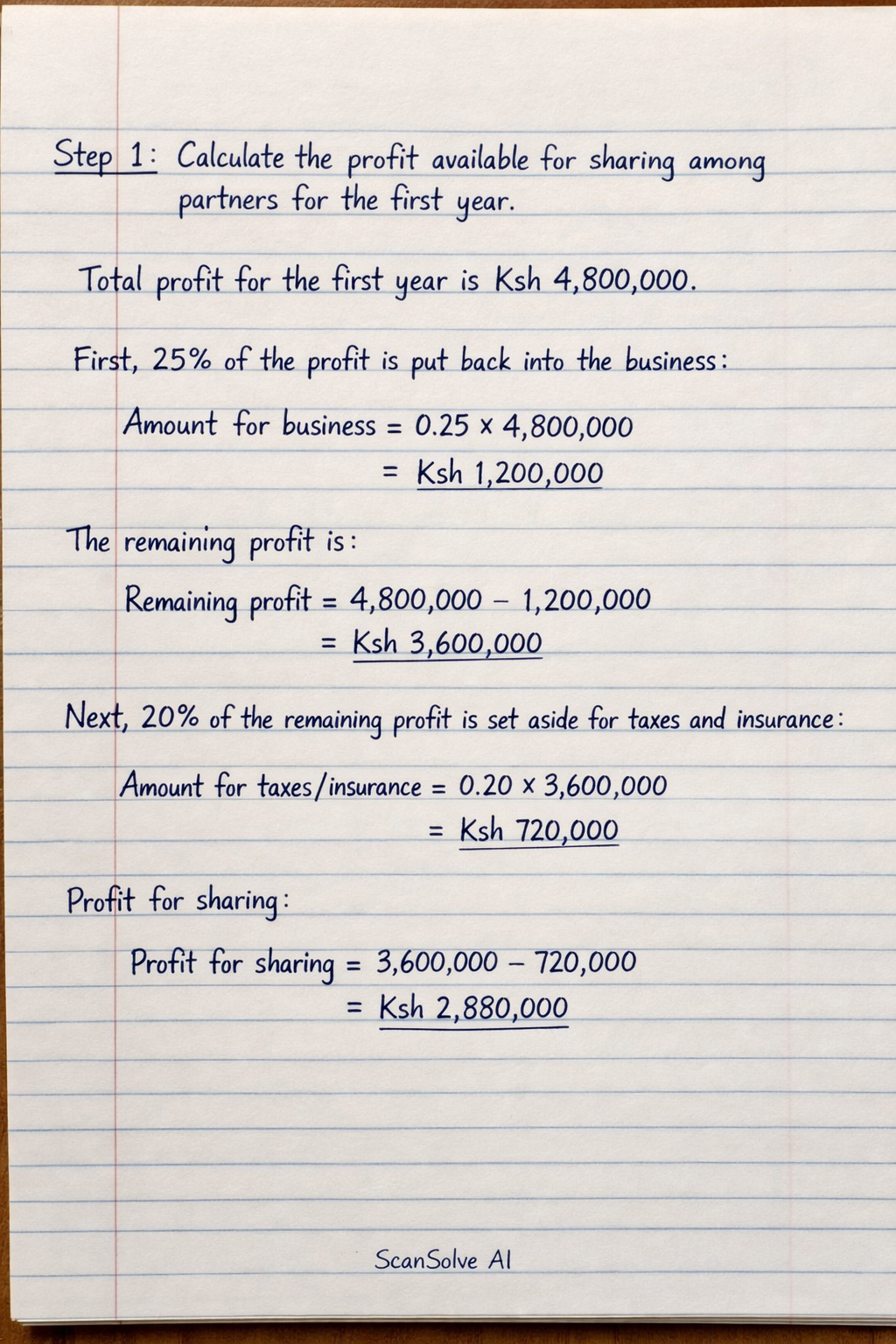
  1. Calculate the profit available for sharing among partners for the first year.

    The total profit for the first year is Ksh 4,800,000.
    First, 25% of the profit is put back into the business:

    Amount for business=0.25×4,800,000=Ksh 1,200,000\text{Amount for business} = 0.25 \times 4,800,000 = \text{Ksh } 1,200,000

    The remaining profit is:

    Remaining profit=4,800,000−1,200,000=Ksh 3,600,000\text{Remaining profit} = 4,800,000 - 1,200,000 = \text{Ksh } 3,600,000

    Next, 20% of the remaining profit is set aside for taxes and insurance:

    Amount for taxes/insurance=0.20×3,600,000=Ksh 720,000\text{Amount for taxes/insurance} = 0.20 \times 3,600,000 = \text{Ksh } 720,000

    The profit available for sharing among partners is:

    Profit for sharing=3,600,000−720,000=Ksh 2,880,000\text{Profit for sharing} = 3,600,000 - 720,000 = \text{Ksh } 2,880,000
  2. Calculate Tanui's investment (xx) for part (a)(i).

    The partners' contributions are Eliza: Ksh 90,000, Nekesa: Ksh 130,000, and Tanui: Ksh xx.
    The total contribution is 90,000+130,000+x=220,000+x90,000 + 130,000 + x = 220,000 + x.
    Tanui's share of the profit is Ksh 960,000. The profit is shared in the ratio of their contributions.

    Tanui’s shareProfit for sharing=Tanui’s contributionTotal contribution\frac{\text{Tanui's share}}{\text{Profit for sharing}} = \frac{\text{Tanui's contribution}}{\text{Total contribution}} 960,0002,880,000=x220,000+x\frac{960,000}{2,880,000} = \frac{x}{220,000 + x}

    Simplify the fraction on the left:

    13=x220,000+x\frac{1}{3} = \frac{x}{220,000 + x}

    Cross-multiply to solve for xx:

    220,000+x=3x220,000 + x = 3x 220,000=2x220,000 = 2x x=220,0002x = \frac{220,000}{2} x=Ksh 110,000x = \text{Ksh } 110,000

    a) (i) Tanui invested Ksh 110,000\boxed{\text{Ksh } 110,000}.

  3. Find the ratio of contributions for part (a)(ii).

    The contributions are Eliza: Ksh 90,000, Nekesa: Ksh 130,000, and Tanui: Ksh 110,000.
    The ratio is:

    Eliza:Nekesa:Tanui=90,000:130,000:110,000\text{Eliza} : \text{Nekesa} : \text{Tanui} = 90,000 : 130,000 : 110,000

    Divide each number by 10,000 to simplify the ratio:

    9:13:119 : 13 : 11

    a) (ii) The ratio of contributions by the three partners is 9:13:11\boxed{9:13:11}.

  4. Calculate the new contributions and new gross profit for the second year for part (b).

    Nekesa invested an additional Ksh 30,000.
    New contributions:

    • Eliza: Ksh 90,000
    • Nekesa: 130,000+30,000=Ksh 160,000130,000 + 30,000 = \text{Ksh } 160,000
    • Tanui: Ksh 110,000 New total contribution:
    90,000+160,000+110,000=Ksh 360,00090,000 + 160,000 + 110,000 = \text{Ksh } 360,000

    The gross profit increased in the ratio 6:5.

    New gross profit=65×4,800,000=6×960,000=Ksh 5,760,000\text{New gross profit} = \frac{6}{5} \times 4,800,000 = 6 \times 960,000 = \text{Ksh } 5,760,000
  5. Calculate the profit available for sharing for the second year.

    First, 25% of the new gross profit is put back into the business:

    Amount for business=0.25×5,760,000=Ksh 1,440,000\text{Amount for business} = 0.25 \times 5,760,000 = \text{Ksh } 1,440,000

    The remaining profit is:

    Remaining profit=5,760,000−1,440,000=Ksh 4,320,000\text{Remaining profit} = 5,760,000 - 1,440,000 = \text{Ksh } 4,320,000

    Next, 20% of the remaining profit is set aside for taxes and insurance:

    Amount for taxes/insurance=0.20×4,320,000=Ksh 864,000\text{Amount for taxes/insurance} = 0.20 \times 4,320,000 = \text{Ksh } 864,000

    The profit available for sharing among partners is:

    Profit for sharing=4,320,000−864,000=Ksh 3,456,000\text{Profit for sharing} = 4,320,000 - 864,000 = \text{Ksh } 3,456,000
  6. Calculate Nekesa's share of the profit at the end of the second year.

    Nekesa's contribution is Ksh 160,000. The total contribution is Ksh 360,000.

    Nekesa’s share=Nekesa’s contributionTotal contribution×Profit for sharing\text{Nekesa's share} = \frac{\text{Nekesa's contribution}}{\text{Total contribution}} \times \text{Profit for sharing} Nekesa’s share=160,000360,000×3,456,000\text{Nekesa's share} = \frac{160,000}{360,000} \times 3,456,000

    Simplify the fraction 160,000360,000=1636=49\frac{160,000}{360,000} = \frac{16}{36} = \frac{4}{9}:

    Nekesa’s share=49×3,456,000\text{Nekesa's share} = \frac{4}{9} \times 3,456,000 Nekesa’s share=4×384,000\text{Nekesa's share} = 4 \times 384,000 Nekesa’s share=Ksh 1,536,000\text{Nekesa's share} = \text{Ksh } 1,536,000

    b) Nekesa's share of the profit at the end of the second year is Ksh 1,536,000\boxed{\text{Ksh } 1,536,000}.

Was this helpful?

Still stuck on this one?

Ask a follow-up, and the answer starts from this question.

Got a different question?Ask your own question
Handwritten step-by-step solution preview

Handwritten Step-by-Step Solution

Get this as a handwritten image on WhatsApp — like a tutor wrote it for you.

Try on WhatsApp