

This biology question covers important biological concepts and processes. The step-by-step explanation below helps you understand the underlying mechanisms and reasoning.
ScanSolve AI Answer
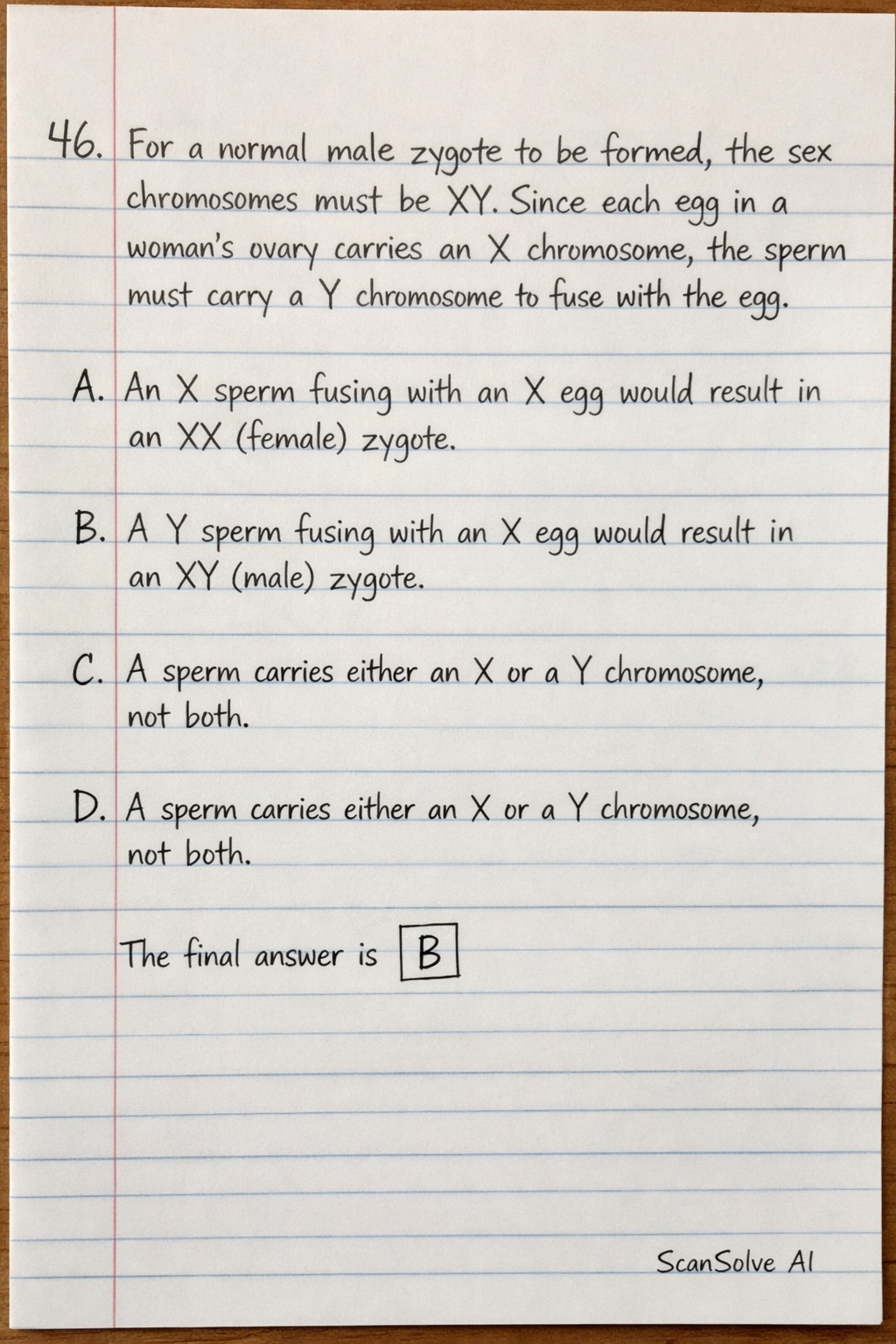
46. For a normal male zygote to be formed, the sex chromosomes must be XY. Since each egg in a woman's ovary carries an X chromosome, the sperm must carry a Y chromosome to fuse with the egg. A. An X sperm fusing with an X egg would result in an XX (female) zygote. B. A Y sperm fusing with an X egg would result in an XY (male) zygote. C. A sperm carries either an X or a Y chromosome, not both. D. A sperm carries either an X or a Y chromosome, not both. The final answer is B 47. Plants occupy the first trophic level because they are producers. Producers are organisms that can synthesize their own food, typically by converting light energy into chemical energy through photosynthesis. A. Being numerous is a characteristic, not the reason for their trophic level. B. Withstanding atmospheric conditions is an adaptation, not the reason for their trophic level. C. Their ability to convert solar energy into chemical energy defines them as producers, forming the base of the food chain. D. Having roots is a structural feature, not the reason for their trophic level. The final answer is C 48. Magnesium is a vital component of the chlorophyll molecule, which is essential for photosynthesis. A plant lacking magnesium would be unable to produce sufficient chlorophyll, leading to chlorosis (yellowing of leaves). Since magnesium is a mobile nutrient, symptoms typically appear first in older leaves as the plant moves magnesium to newer growth. A. Stunted growth can be a general symptom of nutrient deficiency, but magnesium is not primarily for cell wall synthesis. B. Yellowing of older leaves (chlorosis) is a classic symptom of magnesium deficiency due to its role in chlorophyll. C. Magnesium is not primarily involved in reproductive hormone production. D. Purple coloration is often associated with phosphorus deficiency, not magnesium. The final answer is B 49. The upward movement of water and dissolved substances (like the red dye) in the xylem vessels of a plant, against the force of gravity, is primarily driven by the transpiration pull. This pull is created by the evaporation of water from the leaves (transpiration), which generates a negative pressure potential that draws water up through the xylem. A. Osmosis in the root hairs is responsible for water uptake into the roots, not for long-distance transport up the stem. B. Active transport of minerals occurs at various points but is not the primary force for bulk water movement in the xylem. C. Translocation of sucrose in the phloem is the transport of sugars, not water in the xylem. D. Transpiration pull is the main mechanism for water movement in the xylem. The final answer is D 50. When a person exercises vigorously on a hot, humid day, the body needs to dissipate excess heat to prevent a dangerous rise in core body temperature. The primary mechanism the skin uses for this is sweating. A. Hairs standing erect (piloerection) traps air for insulation, which retains* heat, not dissipates it. B. Blood vessels near the skin surface constrict (vasoconstriction) to reduce* heat loss, which is counterproductive in hot conditions. Vasodilation would increase heat loss. C. Sweat glands secrete fluid (sweat) onto the skin surface. As this sweat evaporates, it removes latent heat from the body, causing a cooling effect. D. Shivering is a mechanism to generate* heat in cold conditions, not to cool down. The final answer is C