We read your photo as:

A) A redox reaction is a chemical reaction in which there is a change in the oxidation states of atoms involved. This involves both reduction (gain of electrons) and oxidation (loss of electrons

Business/Management

ScanSolve AI Answer

Step-by-step solution

13 steps

a) A redox reaction is a chemical reaction in which there is a change in the oxidation states of atoms involved. This involves both reduction (gain of electrons) and oxidation (loss of electrons) occurring simultaneously.

Part b(i)· 8 steps

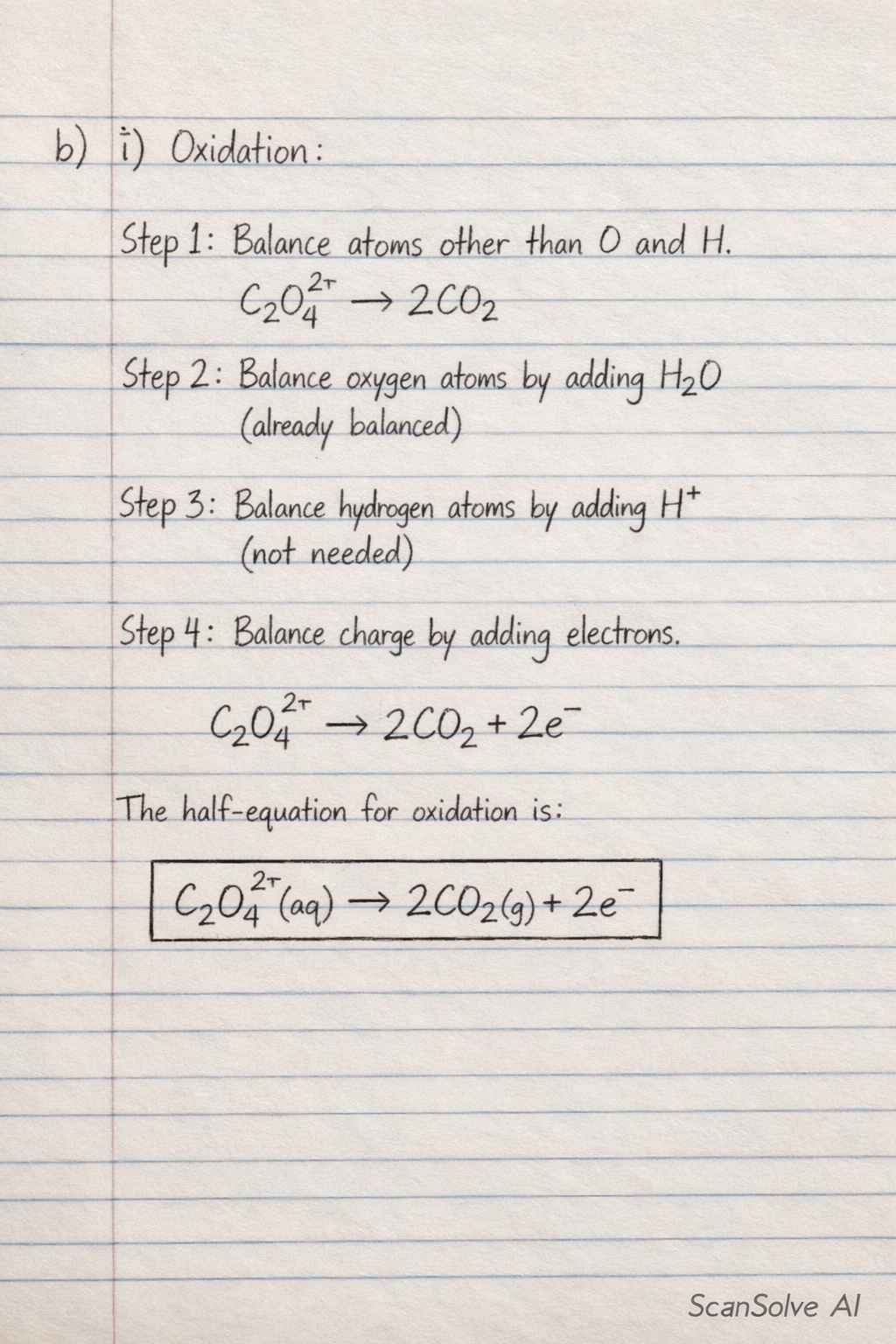
A: Oxidation:

  1. Balance atoms other than O and H.

    C2O42−→2CO2\text{C}_2\text{O}_4^{2-} \rightarrow 2\text{CO}_2
  2. Balance oxygen atoms by adding H2O\text{H}_2\text{O} (already balanced).

  3. Balance hydrogen atoms by adding H+\text{H}^{+} (not needed).

  4. Balance charge by adding electrons.

    C2O42−→2CO2+2e−\text{C}_2\text{O}_4^{2-} \rightarrow 2\text{CO}_2 + 2\text{e}^-

    The half-equation for oxidation is:

    C2O42−(aq)→2CO2(g)+2e−\boxed{\text{C}_2\text{O}_4^{2-}(\text{aq}) \rightarrow 2\text{CO}_2(\text{g}) + 2\text{e}^-}

    B: Reduction:

  5. Balance atoms other than O and H.

    MnO4−→Mn2+\text{MnO}_4^{-} \rightarrow \text{Mn}^{2+}
  6. Balance oxygen atoms by adding H2O\text{H}_2\text{O}.

    MnO4−→Mn2++4H2O\text{MnO}_4^{-} \rightarrow \text{Mn}^{2+} + 4\text{H}_2\text{O}
  7. Balance hydrogen atoms by adding H+\text{H}^{+}.

    MnO4−+8H+→Mn2++4H2O\text{MnO}_4^{-} + 8\text{H}^{+} \rightarrow \text{Mn}^{2+} + 4\text{H}_2\text{O}
  8. Balance charge by adding electrons.

    MnO4−+8H++5e−→Mn2++4H2O\text{MnO}_4^{-} + 8\text{H}^{+} + 5\text{e}^- \rightarrow \text{Mn}^{2+} + 4\text{H}_2\text{O}

    The half-equation for reduction is:

    MnO4−(aq)+8H+(aq)+5e−→Mn2+(aq)+4H2O(l)\boxed{\text{MnO}_4^{-}(\text{aq}) + 8\text{H}^{+}(\text{aq}) + 5\text{e}^- \rightarrow \text{Mn}^{2+}(\text{aq}) + 4\text{H}_2\text{O}(\text{l})}

Part b(ii)· 2 steps

Write down the overall balanced equation

  1. Multiply the half-equations to balance the electrons.

    Oxidation: $(\text{C}_2\text{O}_4^{2-} \rightarrow 2\text{CO}_2 + 2\text{e}^-) \times 5$$

    5C2O42−→10CO2+10e−5\text{C}_2\text{O}_4^{2-} \rightarrow 10\text{CO}_2 + 10\text{e}^-

    Reduction: $(\text{MnO}_4^{-} + 8\text{H}^{+} + 5\text{e}^- \rightarrow \text{Mn}^{2+} + 4\text{H}_2\text{O}) \times 2$$

    2MnO4−+16H++10e−→2Mn2++8H2O2\text{MnO}_4^{-} + 16\text{H}^{+} + 10\text{e}^- \rightarrow 2\text{Mn}^{2+} + 8\text{H}_2\text{O}
  2. Add the two balanced half-equations and cancel electrons.

    5C2O42−(aq)+2MnO4−(aq)+16H+(aq)→10CO2(g)+2Mn2+(aq)+8H2O(l)5\text{C}_2\text{O}_4^{2-}(\text{aq}) + 2\text{MnO}_4^{-}(\text{aq}) + 16\text{H}^{+}(\text{aq}) \rightarrow 10\text{CO}_2(\text{g}) + 2\text{Mn}^{2+}(\text{aq}) + 8\text{H}_2\text{O}(\text{l})

    The overall balanced equation is:

    5C2O42−(aq)+2MnO4−(aq)+16H+(aq)→10CO2(g)+2Mn2+(aq)+8H2O(l)\boxed{5\text{C}_2\text{O}_4^{2-}(\text{aq}) + 2\text{MnO}_4^{-}(\text{aq}) + 16\text{H}^{+}(\text{aq}) \rightarrow 10\text{CO}_2(\text{g}) + 2\text{Mn}^{2+}(\text{aq}) + 8\text{H}_2\text{O}(\text{l})}

Part b(iii)· 3 steps

Calculate the concentration of KMnO4\text{KMnO}_4 solution.

Given:
Volume of KMnO4\text{KMnO}_4 solution (VKMnO4V_{\text{KMnO}_4}) = 31.0 cm3=0.0310 dm331.0 \text{ cm}^3 = 0.0310 \text{ dm}^3
Volume of oxalic acid (VH2C2O4V_{\text{H}_2\text{C}_2\text{O}_4}) = 50 cm3=0.050 dm350 \text{ cm}^3 = 0.050 \text{ dm}^3
Concentration of oxalic acid (CH2C2O4C_{\text{H}_2\text{C}_2\text{O}_4}) = 0.25 M0.25 \text{ M}

  1. Calculate the moles of oxalic acid (C2O42−\text{C}_2\text{O}_4^{2-}).

    nC2O42−=CH2C2O4×VH2C2O4n_{\text{C}_2\text{O}_4^{2-}} = C_{\text{H}_2\text{C}_2\text{O}_4} \times V_{\text{H}_2\text{C}_2\text{O}_4} nC2O42−=0.25 mol/dm3×0.050 dm3=0.0125 moln_{\text{C}_2\text{O}_4^{2-}} = 0.25 \text{ mol/dm}^3 \times 0.050 \text{ dm}^3 = 0.0125 \text{ mol}
  2. Use the mole ratio from the balanced equation to find the moles of MnO4−\text{MnO}_4^{-}.

    From the balanced equation: 5C2O42−5\text{C}_2\text{O}_4^{2-} reacts with 2MnO4−2\text{MnO}_4^{-}.

    nMnO4−=nC2O42−×25n_{\text{MnO}_4^{-}} = n_{\text{C}_2\text{O}_4^{2-}} \times \frac{2}{5} nMnO4−=0.0125 mol×25=0.005 moln_{\text{MnO}_4^{-}} = 0.0125 \text{ mol} \times \frac{2}{5} = 0.005 \text{ mol}
  3. Calculate the concentration of KMnO4\text{KMnO}_4 solution (which is the concentration of MnO4−\text{MnO}_4^{-}).

    CKMnO4=nMnO4−VKMnO4C_{\text{KMnO}_4} = \frac{n_{\text{MnO}_4^{-}}}{V_{\text{KMnO}_4}} CKMnO4=0.005 mol0.0310 dm3C_{\text{KMnO}_4} = \frac{0.005 \text{ mol}}{0.0310 \text{ dm}^3} CKMnO4≈0.16129 MC_{\text{KMnO}_4} \approx 0.16129 \text{ M}

    Rounding to three significant figures:

    CKMnO4≈0.161 MC_{\text{KMnO}_4} \approx 0.161 \text{ M}

    The concentration of KMnO4\text{KMnO}_4 solution is:

    0.161 M\boxed{\text{0.161 M}}
Was this helpful?

Still stuck on this one?

Ask a follow-up, and the answer starts from this question.

Got a different question?Ask your own question
Handwritten step-by-step solution preview

Handwritten Step-by-Step Solution

Get this as a handwritten image on WhatsApp — like a tutor wrote it for you.

Try on WhatsApp