
We read your photo as:
A) Define Entrepreneurship. b) State and explain four (4) types of Entrepreneurship. c) List four (4) impor
ScanSolve AI Answer
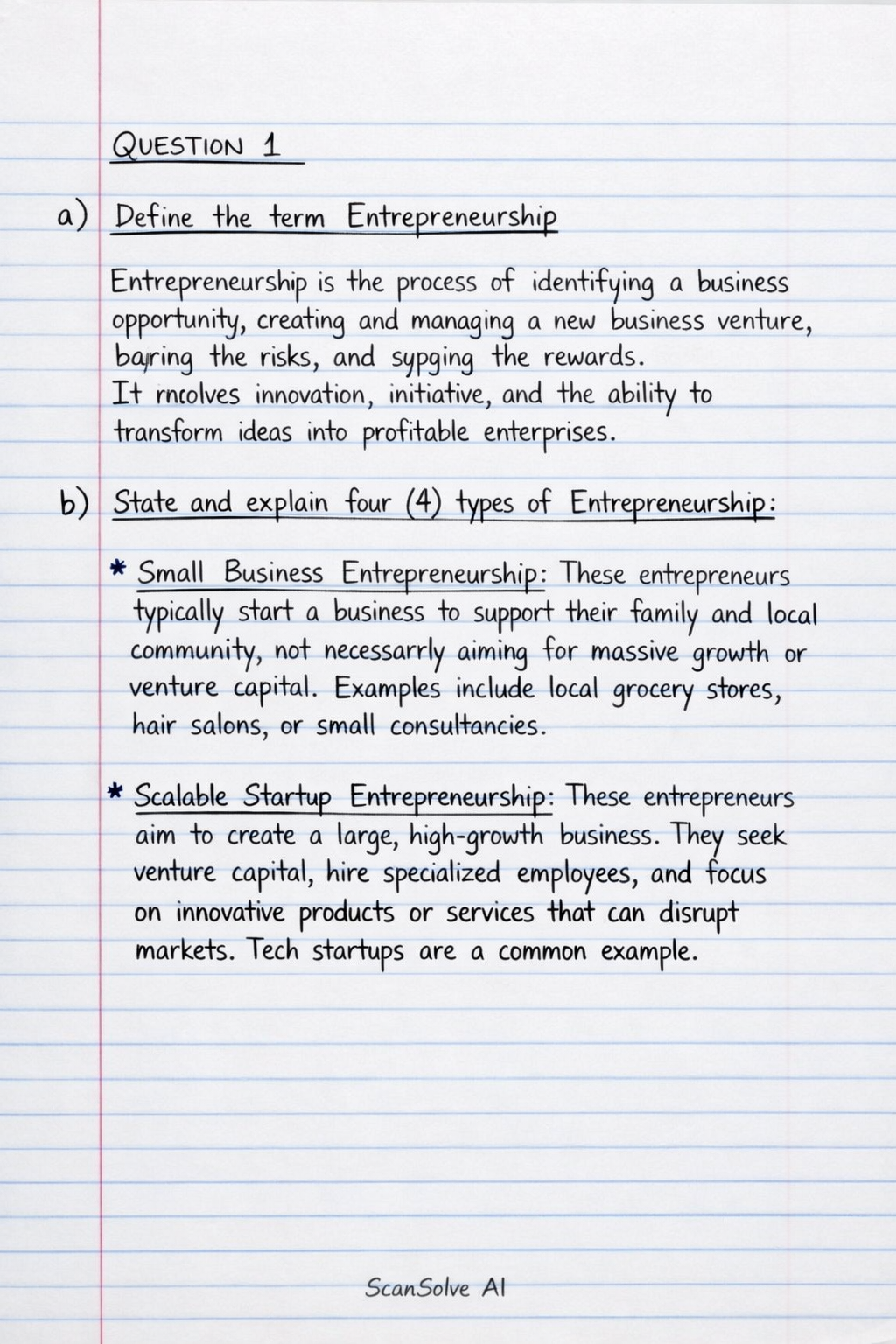
QUESTION 1
a) Define the term Entrepreneurship
Entrepreneurship is the process of identifying a business opportunity, creating and managing a new business venture, bearing the risks, and enjoying the rewards. It involves innovation, initiative, and the ability to transform ideas into profitable enterprises.
b) State and explain four (4) types of Entrepreneurship
- Small Business Entrepreneurship: These entrepreneurs typically start a business to support their family and local community, not necessarily aiming for massive growth or venture capital. Examples include local grocery stores, hair salons, or small consultancies.
- Scalable Startup Entrepreneurship: These entrepreneurs aim to create a large, high-growth business. They seek venture capital, hire specialized employees, and focus on innovative products or services that can disrupt markets. Tech startups are a common example.
- Large Company Entrepreneurship: This refers to existing large companies that innovate and launch new products or divisions to stay competitive. They leverage their existing resources and market position to introduce new ventures.
- Social Entrepreneurship: This type focuses on creating businesses that solve social or environmental problems, rather than solely maximizing profit. Their primary goal is to make a positive impact on society.
c) List four (4) importance of Entrepreneurship to Mr. Joseph
- Independence and Autonomy: Allows Mr. Joseph to be his own boss and make his own decisions, escaping poor working conditions.
- Potential for Higher Income: Offers the opportunity to earn more than his previous low salary, directly benefiting from his efforts.
- Personal Fulfillment: Provides a chance to pursue his passion and build something of his own, leading to greater job satisfaction.
- Skill Development: Forces him to learn and develop new skills in management, marketing, finance, and problem-solving.
d) (i) Outline four (4) entrepreneurial challenges he might face
- Lack of Capital/Funding: Securing sufficient funds to start and sustain the business.
- Intense Competition: Facing established businesses or new entrants in the market.
- Market Access and Customer Acquisition: Difficulty in reaching target customers and building a customer base.
- Management and Operational Skills: Lacking experience in managing all aspects of a business, from production to human resources.
d) (ii) Describe three (3) ways some of these challenges can be overcome
- Develop a Comprehensive Business Plan: A well-researched plan can help secure funding, identify market opportunities, and outline operational strategies.
- Seek Mentorship and Networking: Connecting with experienced entrepreneurs and industry experts can provide guidance, support, and valuable contacts.
- Continuous Learning and Skill Development: Attending workshops, taking courses, or reading extensively can help acquire necessary management, marketing, and financial skills.
QUESTION 2
a) What is an enterprise?
An enterprise is an organization, especially a business, that is formed for a specific purpose, such as providing goods or services, with the aim of making a profit or achieving a particular objective.
b) State and explain three (3) characteristics of an enterprise
- Risk-bearing: Every enterprise involves taking risks, as there is no guarantee of success or profit. Entrepreneurs invest time, money, and effort with the possibility of loss.
- Innovation: Enterprises often introduce new products, services, processes, or methods of organization to gain a competitive edge or meet unmet needs in the market.
- Resource Mobilization: Enterprises bring together various resources such as human capital, financial capital, physical assets, and technology to produce goods or services.
c) Describe the five (5) phases of an entrepreneurial project
- Idea Generation and Opportunity Recognition: This initial phase involves identifying potential business ideas, often by observing market gaps, solving problems, or leveraging personal skills and interests.
- Concept Development and Feasibility Study: The chosen idea is refined into a detailed business concept. A feasibility study assesses the market, technical, financial, and organizational viability of the concept to determine its potential for success.
- Resource Acquisition: This phase focuses on gathering the necessary resources, including financial capital (e.g., loans, investors), human resources (hiring staff), physical assets (equipment, premises), and intellectual property.
- Launch and Implementation: The business officially starts operations. This involves setting up legal structures, marketing the product/service, commencing production, and making the offering available to customers.
- Growth, Management, and Exit: After launch, the focus shifts to managing daily operations, achieving growth, and adapting to market changes. Eventually, the entrepreneur may choose to expand, sell the business, or transition to new ventures.
d) (i) Give three (3) major resources of an enterprise in Cameroon
- Human Resources: The workforce, including skilled and unskilled labor, management, and technical expertise.
- Financial Resources: Capital for investment, operations, and expansion, obtained from savings, loans, or investors.
- Physical/Material Resources: Tangible assets such as land, buildings, machinery, equipment, raw materials, and infrastructure.
d) (ii) Give four (4) social roles of an enterprise
- Job Creation: Enterprises provide employment opportunities, reducing unemployment and improving livelihoods.
- Community Development: They contribute to local communities through taxes, infrastructure development, and corporate social responsibility initiatives.
- Wealth Creation: Enterprises generate wealth for owners, employees, and stakeholders, contributing to the overall economic prosperity of a nation.
- Innovation and Progress: They drive innovation, leading to new products, services, and technologies that improve quality of life and societal advancement.
QUESTION 3
I - State five (5) characteristics of a good business opportunity.
- Market Demand: There is a clear and identifiable need or desire for the product or service among a significant customer base.
- Profitability: The business has the potential to generate sufficient revenue to cover costs and yield a reasonable profit margin.
- Sustainability: The business model is viable in the long term, considering resource availability, environmental impact, and market trends.
- Competitive Advantage: The business offers something unique or superior compared to competitors, such as lower costs, better quality, or innovative features.
- Feasibility: The opportunity is realistic and achievable given the available resources, skills, and market conditions.
II - State and explain the seven (7) components of a good business plan
- Executive Summary: A concise overview of the entire business plan, highlighting the company's mission, products/services, market, financial projections, and management team. It should capture the reader's attention.
- Company Description: Provides details about the business, including its legal structure, mission statement, vision, values, goals, and a brief history if applicable. It explains what the company does and its unique value proposition.
- Market Analysis: This section details the target market, including its size, demographics, needs, and purchasing habits. It also analyzes the competition, identifying their strengths, weaknesses, and market share.
- Organization and Management: Describes the organizational structure of the company, the key management team members, their roles, responsibilities, and relevant experience. It may also include an organizational chart.
- Service or Product Line: Provides a detailed description of the products or services offered, including their features, benefits, and how they meet customer needs. It may also cover intellectual property and future development plans.
- Marketing and Sales Strategy: Outlines how the business will attract and retain customers. This includes pricing strategy, promotion and advertising plans, distribution channels, and sales tactics.
- Financial Projections: Presents the financial outlook of the business, including startup costs, income statements, cash flow projections, balance sheets, and break-even analysis. It demonstrates the financial viability and potential returns.
III - Differentiate between limited and unlimited liability company
- Limited Liability Company (LLC): In a limited liability company, the personal assets of the owners (shareholders or members) are legally separate from the business's debts and obligations. If the company incurs debts or faces legal action, the owners' personal assets (like their homes or savings) are generally protected, and their liability is limited to the amount they invested in the company.
- Unlimited Liability Company: In an unlimited liability company (common in sole proprietorships and partnerships), the owners are personally responsible for all the debts and obligations of the business. If the business fails or faces legal claims, creditors can pursue the owners' personal assets to recover their money. There is no legal distinction between the owner and the business regarding financial responsibility.
Still stuck on this one?
Ask a follow-up, and the answer starts from this question.
More Business/Management Questions
Handwritten Step-by-Step Solution
Get this as a handwritten image on WhatsApp — like a tutor wrote it for you.
Try on WhatsApp