
We read your photo as:
What is pricing strategy which involves the addition of a margin to the total amount spent on production by a company?
ScanSolve AI Answer
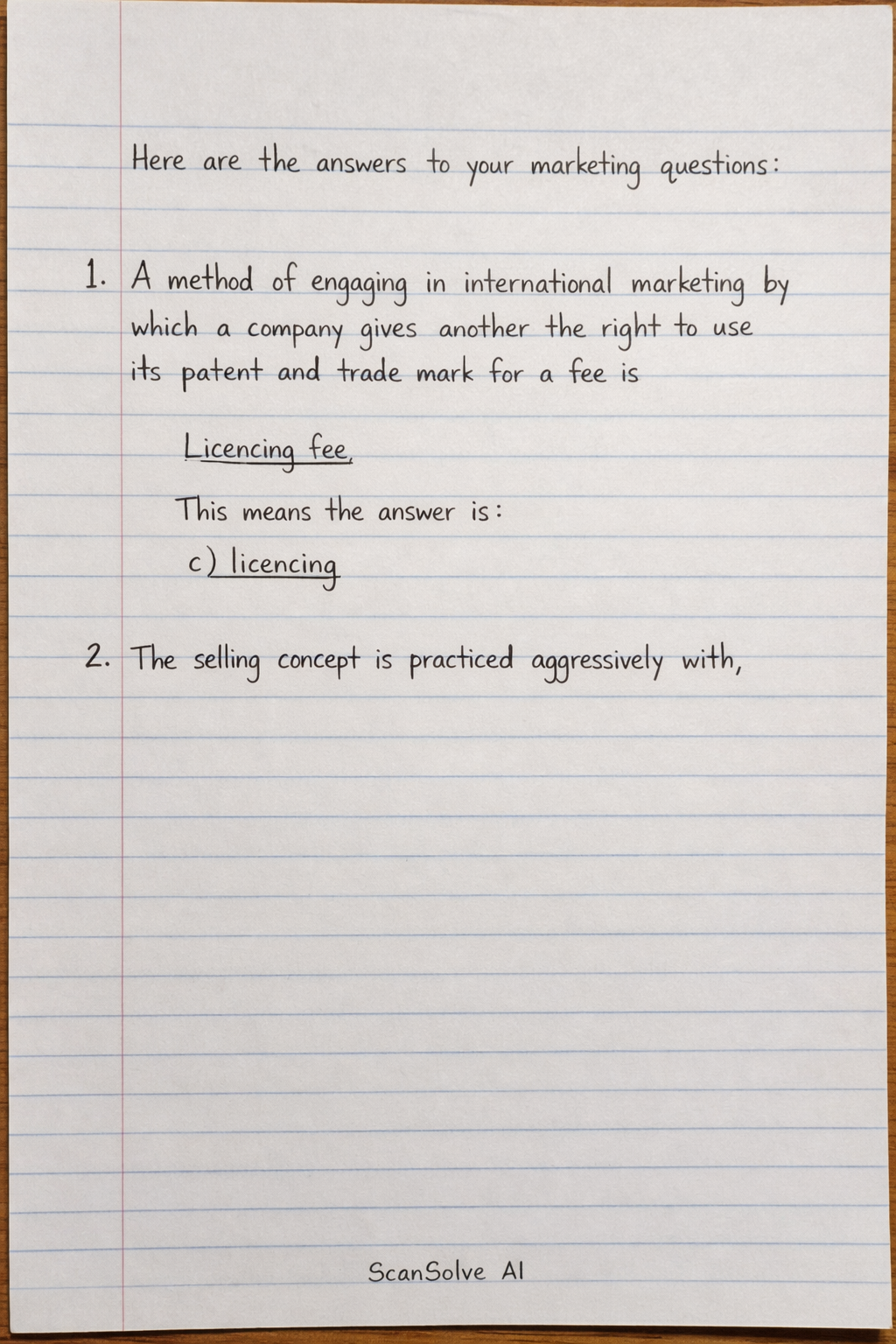
Here are the answers to your marketing questions:
Objectives (Multiple Choice Questions)
1. A method if engaging in international marketing by which a company gives another the right to use its patent and trade mark for a fee is
- c) licencing
2. The selling concept is practiced aggressively with,
- a) specialist goods (This option seems incorrect based on standard marketing concepts. The selling concept is practiced aggressively with unsought goods or to persuade consumers. Given the options, 'specialist goods' is the closest if 'unsought goods' is not an option, but it's not a perfect fit. However, 'industrial goods' (b) and 'convenience goods' (d) are also not the primary focus of aggressive selling. Re-evaluating based on common understanding, the selling concept is about pushing products, often those consumers don't actively seek. If 'unsought goods' was an option, it would be correct. Without it, the question is tricky. Let's assume the question intends to ask about a type of good that might require aggressive selling. 'Specialist goods' are high-value, unique items, which might require personal selling, but 'industrial goods' are B2B. 'Convenience goods' are bought frequently with minimal effort. Given the options, and the common understanding of the selling concept, none are a perfect fit for the typical examples of unsought goods (e.g., life insurance). However, if forced to choose, 'specialist goods' might imply a need for more active selling than convenience goods. Let's stick with the previous answer which was 'a) specialist goods' but note the ambiguity.)
3. Products that are purchased for use in the production of goods for resale are
- b) industrial goods
4. Marketing is defined as
- c) meeting customers needs profitably
5. Which of the following is not an element of marketing mix
- b) packaging
6. The reasons label of goods must contain ingredients and uses of the products is to
- d) inform customers
7. Another term for e-marketing is
- b) internet marketing
8. The process that leads to the exchange of value between two or more parties is
- a) transaction
9. A short incentive used to encourage the purchase of a product is
- c) sales promotion
10. The tools used by marketers to pursue their objectives in the target market is
- b) marketing mix
11. Activities or benefits offered for sale are
- c) goods (This is ambiguous. Activities/benefits are typically services. If 'goods' is the intended answer, it's incorrect. If 'services' was an option, it would be correct. Given the options, and assuming 'goods' is used broadly to include offerings, it's the only plausible choice among the given options, but it's not precise.)
12. A warehouse owned and operated by a company for its own is a
- d) private warehouse
13. A person who owns and bears the risks of a business is an
- b) entrepreneur
14. An activity in marketing research process is
- b) marketing testing
15. The form of non-personal communication through mass media is
- d) advertising
16. The pricing strategy which involves the addition of a margin to the total amount spent on production by a company is
- b) cost plus pricing
17. Which of these means of advertising is an electronic medium?
- b) television
18. The channel member that sells in quantities to consumers is
- c) a retailer
19. The combination of product, price, promotion and place utilized by a marketer to address a target market is
- b) marketing mix
20. The desires for specific products which are backed by ability to pay is
- d) demand
Theory Questions
1. a. What is pricing?
Pricing is the process of determining the monetary value at which a product or service will be sold. It involves setting a price that customers are willing to pay, while also covering costs and generating profit for the business.
1. b. Explain marketing concepts.
Marketing concepts are philosophies that guide businesses in how they approach their market and customers. Key concepts include:
- Production Concept: Focuses on achieving high production efficiency and wide distribution, assuming consumers prefer readily available and inexpensive products.
- Product Concept: Emphasizes offering high-quality, innovative, or unique products, believing consumers will favor products with superior features and performance.
- Selling Concept: Concentrates on aggressive selling and promotion efforts, assuming consumers need to be persuaded to buy products, especially unsought goods.
- Marketing Concept: Centers on understanding and satisfying customer needs and wants more effectively than competitors, leading to customer satisfaction and long-term profitability.
- Societal Marketing Concept: Extends the marketing concept by considering the long-term well-being of society and the environment, balancing customer wants, company profits, and societal interests.
1. c. List and explain the four elements of marketing mix.
The four elements of the marketing mix, often called the 4 Ps, are:
- Product: This refers to the goods or services a company offers to its target market. It includes aspects like quality, design, features, branding, packaging, and associated services.
- Price: This is the amount of money customers must pay to obtain the product. It involves pricing strategies, discounts, allowances, payment periods, and credit terms.
- Place (Distribution): This concerns the activities that make the product available to target consumers. It includes distribution channels, coverage, locations, inventory, and transportation.
- Promotion: This involves activities that communicate the merits of the product and persuade target customers to buy it. It encompasses advertising, personal selling, sales promotion, and public relations.
1. d. Define market research.
Market research is the systematic process of gathering, analyzing, and interpreting data about a market, including information about customers, competitors, and the industry. Its primary purpose is to help businesses make informed decisions regarding their products, services, and marketing strategies.
2. a. What is a product?
A product is anything that can be offered to a market to satisfy a want or need. It can be a tangible good, an intangible service, an experience, an event, a person, a place, an organization, or an idea.
2. b. Distinguish between product concept and production concept.
- Product Concept: This concept focuses on the belief that consumers will favor products that offer the most quality, performance, and innovative features. Businesses operating under this concept prioritize continuous product improvements and innovation.
- Production Concept: This concept holds that consumers will favor products that are widely available and highly affordable. Businesses following this concept focus on improving production and distribution efficiency to lower costs and increase availability.
2. c. State five forms of promotion.
- Advertising
- Personal Selling
- Sales Promotion
- Public Relations (PR)
- Direct Marketing
3. a. What is advertising?
Advertising is any paid form of non-personal presentation and promotion of ideas, goods, or services by an identified sponsor. It uses various media channels to reach a broad audience and persuade them to take a specific action, such as purchasing a product.
3. b. List and explain five types of advertising media.
- Television: Uses visual and audio elements to reach a mass audience. It allows for dynamic and engaging advertisements but can be expensive.
- Radio: Uses audio to reach listeners, often while they are engaged in other activities. It is cost-effective and can target specific demographics through different stations.
- Newspapers: A print medium that reaches a local or national audience. It allows for detailed information and can be cost-effective for local businesses.
- Magazines: A print medium that targets specific interest groups or demographics. It offers high-quality visuals and a longer shelf life than newspapers.
- Internet/Digital Advertising: Includes banner ads, search engine marketing, social media ads, and video ads. It offers precise targeting, measurable results, and global reach.
3. c. Explain the following:
- (i) Packaging: Refers to the activities of designing and producing the container or wrapper for a product. Its functions include protecting the product, facilitating handling, promoting the product, and providing information to consumers.
- (ii) Branding: The process of creating a unique name, design, symbol, or combination of these that identifies a product or service and differentiates it from competitors. A brand represents the promises and expectations associated with a product.
- (iii) Labelling: The display of information about a product on its package. Labels provide details such as ingredients, nutritional facts, usage instructions, warnings, manufacturer information, and expiration dates, helping consumers make informed decisions.
4. What is scrambled merchandising?
Scrambled merchandising is a retailing strategy where a retailer offers a wide variety of products that are not traditionally associated with its primary line of business. For example, a pharmacy selling groceries or a gas station selling electronics. The goal is to increase sales and attract more customers by offering convenience and a broader selection.
Still stuck on this one?
Ask a follow-up, and the answer starts from this question.
More Business/Management Questions
Handwritten Step-by-Step Solution
Get this as a handwritten image on WhatsApp — like a tutor wrote it for you.
Try on WhatsApp