
We read your photo as:
State seven consequences of denying employees rest. (7mks)
Business/Management
ScanSolve AI Answer
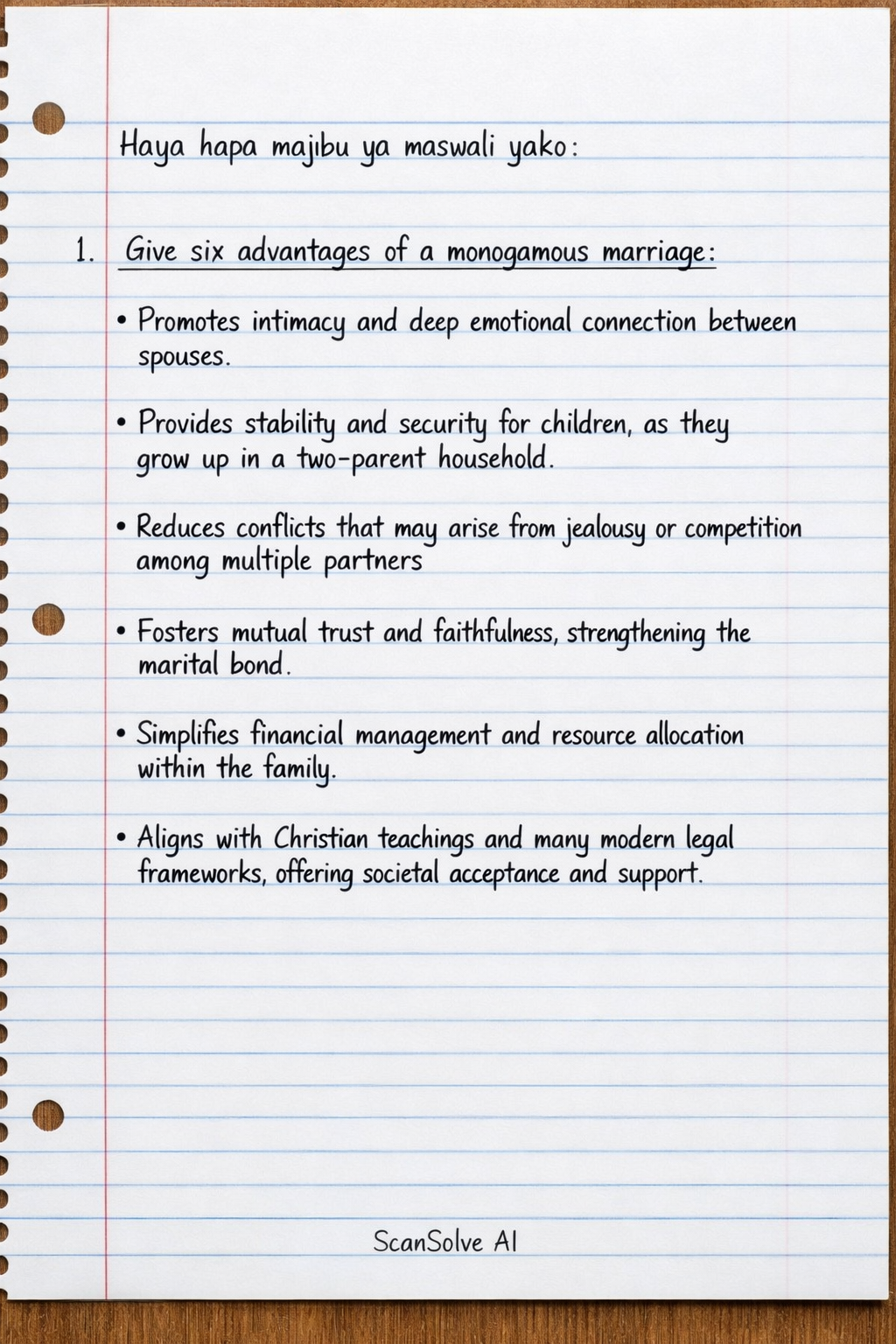
Haya hapa majibu ya maswali yako:
-
Give six advantages of a monogamous marriage.
- Promotes intimacy and deep emotional connection between spouses.
- Provides stability and security for children, as they grow up in a two-parent household.
- Reduces conflicts that may arise from jealousy or competition among multiple partners.
- Fosters mutual trust and faithfulness, strengthening the marital bond.
- Simplifies financial management and resource allocation within the family.
- Aligns with Christian teachings and many modern legal frameworks, offering societal acceptance and support.
-
State seven similarities in the Traditional African and Christian views on work.
- Work is a duty/responsibility: Both view work as an obligation for individuals to contribute to their families and communities.
- Work provides for basic needs: Both recognize work as essential for sustenance, food, shelter, and clothing.
- Work promotes dignity and self-worth: Engaging in productive labor gives individuals a sense of purpose and value.
- Work is a communal activity: Both emphasize the importance of working together for the common good of the family or community.
- Work is a blessing from God/ancestors: Both believe that the ability to work and the fruits of labor are gifts from a higher power.
- Work involves stewardship: Both encourage responsible use of resources and talents given to them.
- Work is not an end in itself: Both acknowledge that there is a time for rest and celebration, and work should not consume one's entire life.
-
State seven consequences of denying employees rest.
- Reduced productivity: Employees become fatigued, leading to decreased output and efficiency.
- Increased errors and accidents: Tired workers are more prone to making mistakes and causing workplace incidents.
- Poor decision-making: Lack of rest impairs cognitive functions, affecting judgment and problem-solving abilities.
- Health problems: Chronic fatigue can lead to stress, burnout, and various physical and mental health issues.
- Low morale and job dissatisfaction: Employees feel undervalued and overworked, leading to resentment and unhappiness.
- High employee turnover: Workers are more likely to leave jobs where they are denied adequate rest, increasing recruitment costs.
- Legal and ethical issues: Denying rest can violate labor laws and ethical employment practices, leading to penalties and reputational damage.
Was this helpful?
Still stuck on this one?
Ask a follow-up, and the answer starts from this question.
Got a different question?Ask your own question
More Business/Management Questions
QWrite down one reason why a business would lose money if it terminates an employee.QCan an employee refuse to work if they believe the conditions are unsafe?QBasic 7 Have work 1 to 8QIist and shed light on four consequences of disobeying traffic regulationsQProvide short notes on the following employment law concepts: a. Wrongful Dismissal, b. Testimonial…
Handwritten Step-by-Step Solution
Get this as a handwritten image on WhatsApp — like a tutor wrote it for you.
Try on WhatsApp