
We read your photo as:
According to Mintzberg, what are the three informational roles of managers, and what are three importance of planning to an organization? Also, list three reasons why managers do not delegate.
ScanSolve AI Answer
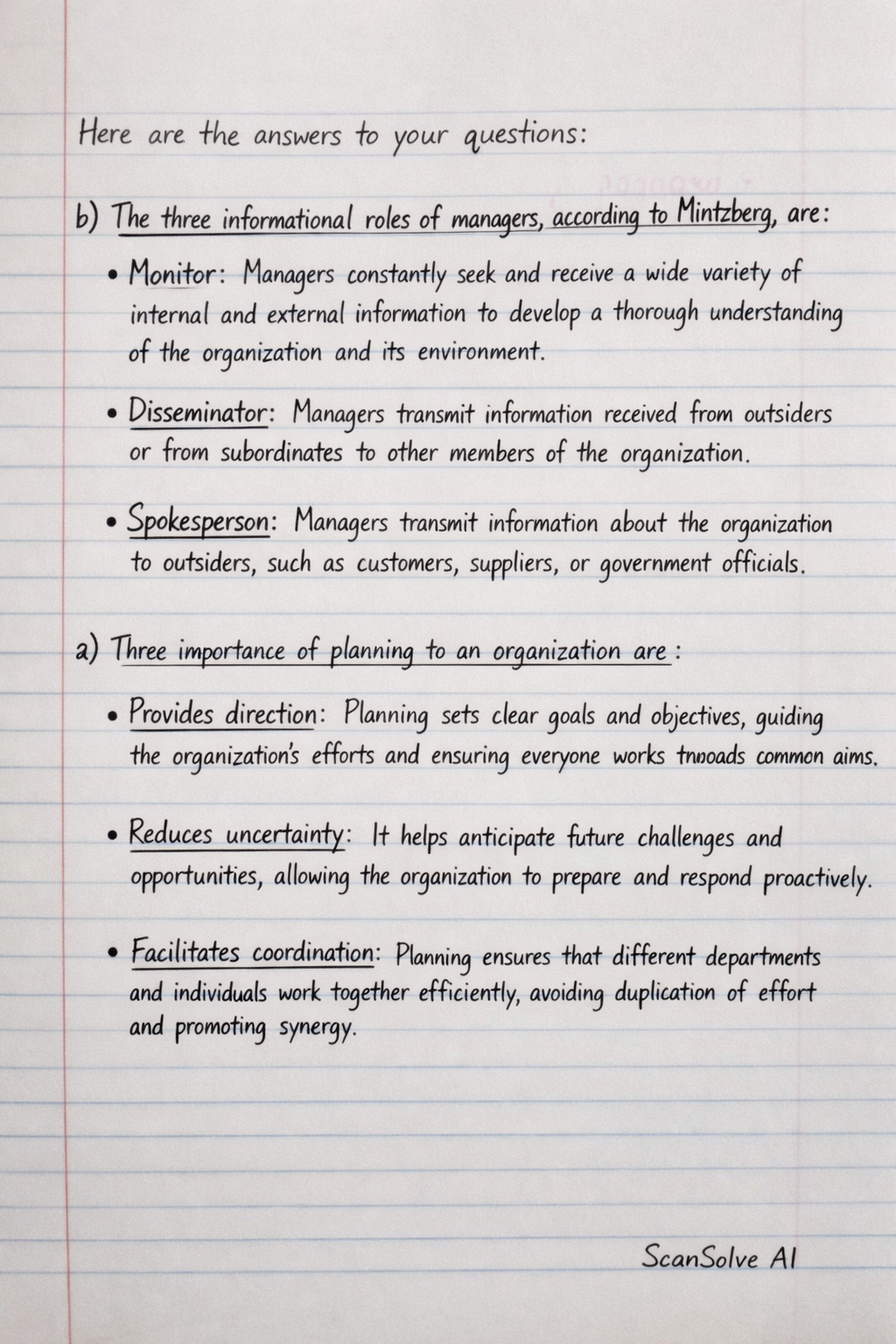
Here are the answers to your questions:
b) The three informational roles of managers, according to Mintzberg, are:
- Monitor: Managers constantly seek and receive a wide variety of internal and external information to develop a thorough understanding of the organization and its environment.
- Disseminator: Managers transmit information received from outsiders or from subordinates to other members of the organization.
- Spokesperson: Managers transmit information about the organization to outsiders, such as customers, suppliers, or government officials.
a) Three importance of planning to an organization are:
- Provides direction: Planning sets clear goals and objectives, guiding the organization's efforts and ensuring everyone works towards common aims.
- Reduces uncertainty: It helps anticipate future challenges and opportunities, allowing the organization to prepare and respond proactively.
- Facilitates coordination: Planning ensures that different departments and individuals work together efficiently, avoiding duplication of effort and promoting synergy.
b) Three reasons why managers do not delegate in an organization are:
- Fear of losing control: Managers may believe that delegating tasks will reduce their authority or control over the outcome, leading to a reluctance to hand over responsibilities.
- Lack of trust in subordinates: Managers might doubt the competence or reliability of their subordinates to perform tasks effectively, preferring to do the work themselves.
- Belief that they can do it better/faster: Some managers feel that it is quicker or more efficient to complete a task themselves rather than spending time explaining it or supervising someone else.
a) An agency is a legal relationship where one person, known as the agent, is authorized to act on behalf of another person, known as the principal, in dealings with third parties.
b) Ways of creating an agency:
i. Express agreement: This occurs when the principal and agent explicitly agree, either orally or in writing, to form an agency relationship. The terms and scope of the agent's authority are clearly stated and understood by both parties.
ii. Implication: This arises from the conduct, actions, or circumstances of the parties, even if there is no formal or explicit agreement. The actions of the principal suggest that an agency relationship exists, and the agent acts accordingly.
c) Three duties of an agent to his principals are:
- Duty to obey instructions: The agent must follow all lawful and reasonable instructions given by the principal.
- Duty of care and skill: The agent must exercise reasonable care and skill in performing their duties, similar to what a prudent person would do in similar circumstances.
- Duty of good faith: The agent must act honestly and in the best interests of the principal, avoiding conflicts of interest and not making secret profits.
Still stuck on this one?
Ask a follow-up, and the answer starts from this question.
More Business/Management Questions
Handwritten Step-by-Step Solution
Get this as a handwritten image on WhatsApp — like a tutor wrote it for you.
Try on WhatsApp