
We read your photo as:
Explain the advantages of email as an office communication channel and written communication over oral communication.
Business/Management
ScanSolve AI Answer
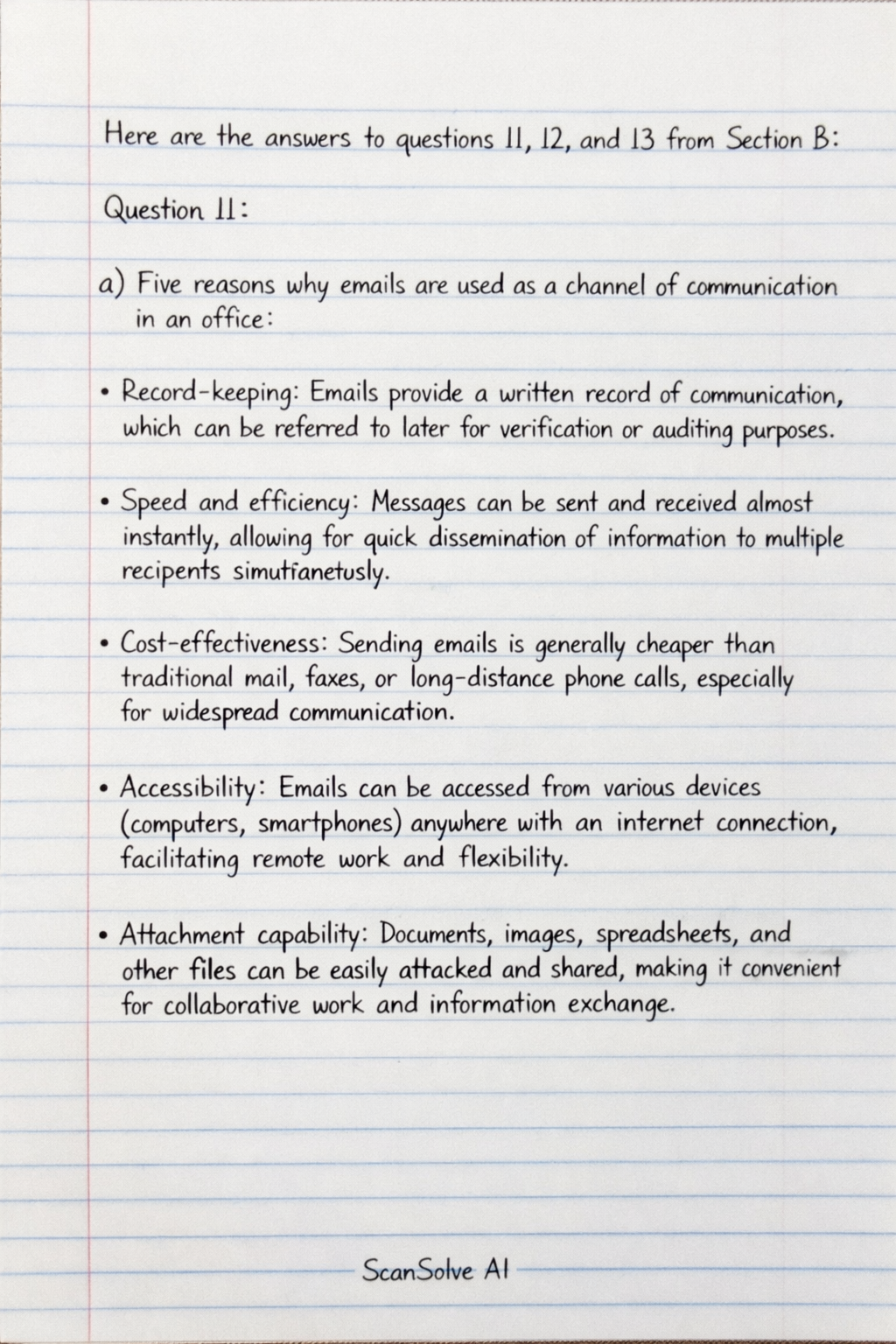
Here are the answers to questions 11, 12, and 13 from Section B:
Question 11:
a) Five reasons why emails are used as a channel of communication in an office:
- Record-keeping: Emails provide a written record of communication, which can be referred to later for verification or auditing purposes.
- Speed and efficiency: Messages can be sent and received almost instantly, allowing for quick dissemination of information to multiple recipients simultaneously.
- Cost-effectiveness: Sending emails is generally cheaper than traditional mail, faxes, or long-distance phone calls, especially for widespread communication.
- Accessibility: Emails can be accessed from various devices (computers, smartphones) anywhere with an internet connection, facilitating remote work and flexibility.
- Attachment capability: Documents, images, spreadsheets, and other files can be easily attached and shared, making it convenient for collaborative work and information exchange.
b) Five advantages of using written communication over oral communication:
- Provides a permanent record: Written communication serves as tangible evidence and can be stored for future reference, legal purposes, or historical records.
- Allows for careful consideration: Both the sender and receiver have time to draft, review, and process the message, reducing the chances of errors or misunderstandings.
- Ensures clarity and precision: Written messages can be carefully structured and edited to be clear, concise, and unambiguous, minimizing misinterpretation.
- Reaches a wider audience: A single written message can be distributed to numerous individuals or groups, regardless of their geographical location, ensuring consistent information delivery.
- Facilitates complex information: Detailed or technical information can be presented systematically in writing, allowing the receiver to study it at their own pace.
Question 12:
a) Significance of the following nonverbal cues in face-to-face communication:
- i. Facial expression: Conveys a wide range of emotions such as happiness, sadness, anger, surprise, and fear, providing immediate insight into a person's feelings and reactions.
- ii. Posture: Indicates a person's attitude, confidence, and engagement. An open posture might suggest receptiveness, while a closed posture could signal defensiveness or disinterest.
- iii. Eye contact: Demonstrates attention, interest, honesty, and respect. Sustained eye contact can build rapport, while avoiding it might suggest discomfort or dishonesty.
- iv. Distance (Proxemics): The physical space maintained between individuals indicates the nature of their relationship (e.g., intimate, personal, social, public) and cultural norms.
- v. Paralanguage: Refers to vocal cues like tone, pitch, volume, rate of speech, and pauses. It adds emotional context and emphasis to spoken words, influencing how the message is perceived.
b) Five importance of nonverbal communication:
- Complements verbal messages: Nonverbal cues often reinforce or elaborate on what is being said verbally, adding depth and clarity to the message.
- Contradicts verbal messages: Nonverbal signals can sometimes reveal a person's true feelings or intentions, even when their words say something different.
- Regulates interaction: Nonverbal cues, such as eye contact or gestures, help manage the flow of conversation, indicating when it's someone's turn to speak or listen.
- Substitutes for verbal messages: In certain situations, nonverbal communication can convey a complete message without the need for words (e.g., a nod for "yes" or a wave for "hello").
- Expresses emotions: Nonverbal cues are often more effective and immediate in conveying emotions than verbal language, allowing for a deeper understanding of feelings.
Question 13:
a) Five importance of effective communication in an organization:
- Improved decision-making: Clear and timely communication ensures that all relevant information is available, leading to more informed and better strategic decisions.
- Enhanced productivity: When employees understand their roles, tasks, and organizational goals, they can work more efficiently and effectively, reducing errors and rework.
- Stronger teamwork and collaboration: Effective communication fosters an environment where team members can share ideas, provide feedback, and work together cohesively towards common objectives.
- Better employee morale and engagement: Employees who feel heard and understood are more likely to be satisfied with their jobs, leading to higher motivation and reduced turnover.
- Efficient conflict resolution: Open and honest communication provides a channel for addressing disagreements, misunderstandings, and grievances constructively, preventing escalation.
b) Five principles of effective communication:
- Clarity: The message should be clear, simple, and easy for the receiver to understand, avoiding jargon or ambiguous language.
- Conciseness: The message should be brief and to the point, conveying necessary information without unnecessary words or details.
- Completeness: All essential information required by the receiver to understand and act upon the message should be included.
- Correctness: The message must be accurate in terms of facts, grammar, spelling, and punctuation to maintain credibility.
- Consideration: The sender should tailor the message to the receiver's background, knowledge, and emotional state, showing empathy and respect.
Was this helpful?
Still stuck on this one?
Ask a follow-up, and the answer starts from this question.
Got a different question?Ask your own question
More Business/Management Questions
QWhich of the following is NOT an advantage of written communication?QWhat are the disadvantages of written communication?QGive advantages of email and instant messagingQWhat are four disadvantages of written communication?QGive four reasons why one would prefer a letter to a telephone to send a message.
Handwritten Step-by-Step Solution
Get this as a handwritten image on WhatsApp — like a tutor wrote it for you.
Try on WhatsApp