
We read your photo as:
Advise the managing director as to whether the contract should be allowed to proceed, explaining the reasons for the treatment of each item. (Note: Ignore the time value of money.)
ScanSolve AI Answer
Step-by-step solution
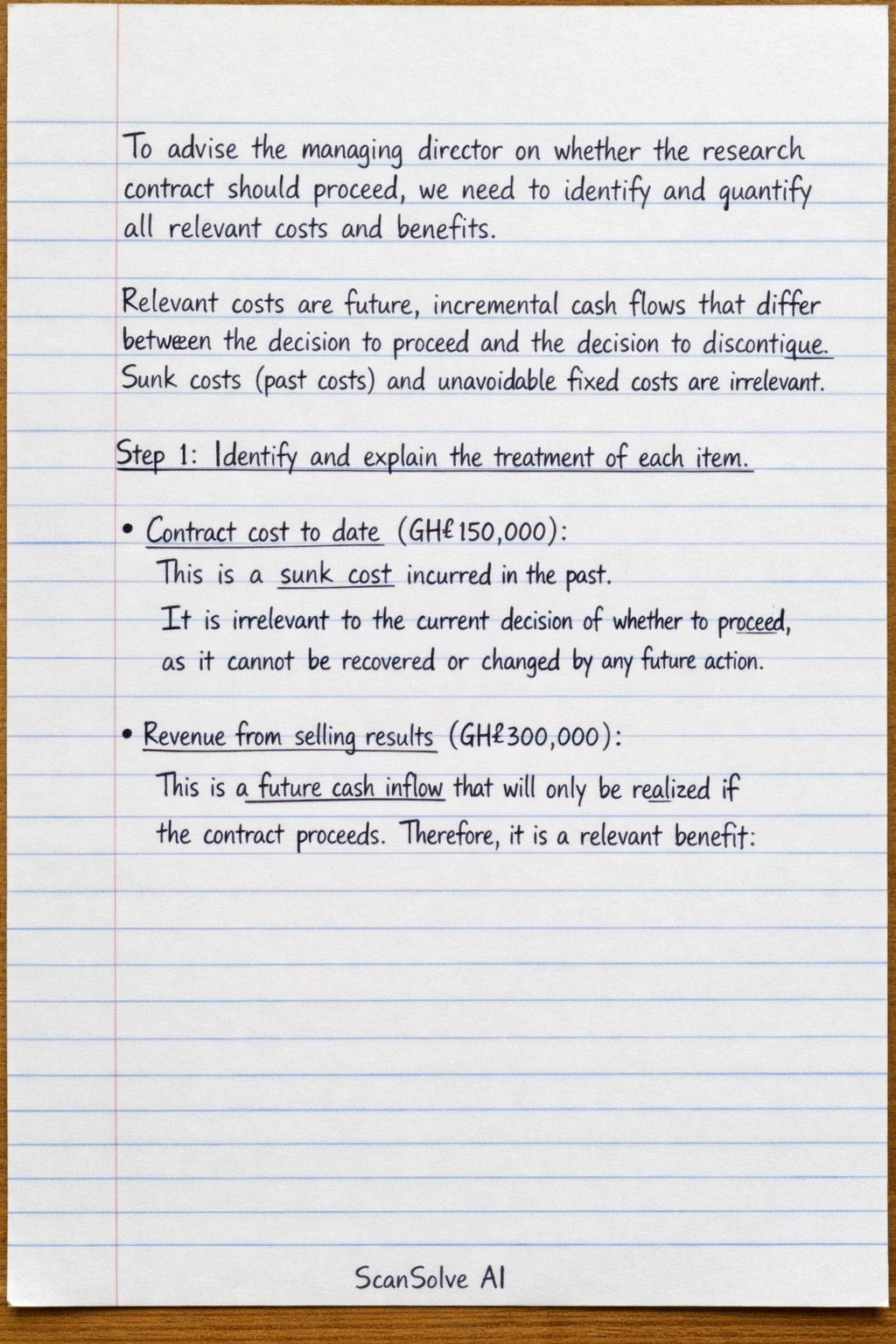
3 stepsTo advise the managing director on whether the research contract should proceed, we need to identify and quantify all relevant costs and benefits. Relevant costs are future, incremental cash flows that differ between the decision to proceed and the decision to discontinue. Sunk costs (past costs) and unavoidable fixed costs are irrelevant.
Identify and explain the treatment of each item.
-
Contract cost to date (GH¢150,000): This is a sunk cost incurred in the past. It is irrelevant to the current decision of whether to proceed, as it cannot be recovered or changed by any future action.
-
Revenue from selling results (GH¢300,000): This is a future cash inflow that will only be realized if the contract proceeds. Therefore, it is a relevant benefit.
-
Materials:
- Cost of material just purchased (GH¢60,000): This is a sunk cost as it has already been incurred. It is irrelevant to the decision.
- Disposal cost if not used (GH¢5,000): If the contract proceeds, the company avoids this GH¢5,000 disposal cost. Avoiding a cost is a benefit. Therefore, GH¢5,000 is a relevant benefit of proceeding.
-
Skilled labour:
- The workers, if returned to the production department, could generate sales of GH¢150,000 with a prime cost of GH¢100,000. The contribution foregone from this alternative work is GH¢150,000 (sales) - GH¢100,000 (prime cost) = GH¢50,000. This is an opportunity cost of using the skilled labour for the research contract.
- The overhead absorbed into this production (GH¢20,000) is likely a fixed overhead allocation and not an incremental cash outflow. Therefore, it is irrelevant.
- Relevant cost: GH¢50,000.
-
Research staff:
- Research wages for the year (GH¢60,000): This is a future cash outflow that will be incurred only if the contract proceeds for another year. Therefore, it is a relevant cost.
- Redundancy and severance pay:
- If the contract is discontinued now, the cost is GH¢15,000.
- If the contract proceeds for one year, the cost will be GH¢35,000.
- The incremental cost of redundancy if the contract proceeds is GH¢35,000 - GH¢15,000 = GH¢20,000. This is a relevant cost.
- Total relevant cost: GH¢60,000 + GH¢20,000 = GH¢80,000.
-
Equipment (Microscope):
- Original cost (GH¢18,000) and residual value in two years (GH¢3,000) are irrelevant (sunk cost and future value not directly impacted by this one-year decision).
- Current disposal value (GH¢8,000): This is the amount that could be received if the microscope is sold now.
- Disposal value in one year (GH¢6,000): This is the amount that could be received if the microscope is used for the contract and then sold.
- The opportunity cost of using the microscope for the contract is the reduction in its disposal value: GH¢8,000 (current sale) - GH¢6,000 (future sale) = GH¢2,000. This is a relevant cost.
-
Share of general building services:
- Charged GH¢35,000 pa: This is a fixed cost that will be incurred regardless of the decision to proceed or discontinue the contract. Therefore, it is irrelevant.
- Annual rental if space is sublet (GH¢7,000): If the contract proceeds, the company foregoes this potential rental income. This is an opportunity cost of proceeding.
- Relevant cost: GH¢7,000.
-
Calculate the net financial impact of proceeding with the contract.
Benefits of Proceeding:
- Revenue from selling results: GH¢300,000
- Avoided material disposal cost: GH¢5,000
- Total Benefits: GH¢305,000
Costs of Proceeding:
- Opportunity cost of skilled labour: GH¢50,000
- Research staff wages: GH¢60,000
- Incremental redundancy cost for research staff: GH¢20,000
- Opportunity cost of microscope: GH¢2,000
- Opportunity cost of building space: GH¢7,000
- Total Costs: GH¢139,000
Net Benefit of Proceeding = Total Benefits - Total Costs
Advise the managing director.
Since the net benefit of proceeding with the contract is positive (GH¢166,000), the managing director should allow the contract to proceed.
The final answer is
Still stuck on this one?
Ask a follow-up, and the answer starts from this question.
More Business/Management Questions
Handwritten Step-by-Step Solution
Get this as a handwritten image on WhatsApp — like a tutor wrote it for you.
Try on WhatsApp