
We read your photo as:
Okyena Nti University is trying to decide whether or not to advertise its new one-year MSC degree programme. The number of students starting the programme is dependent on economic conditions. Required: Demonstrate, using a decision tree, whether the programme should be advertised.
ScanSolve AI Answer
Step-by-step solution
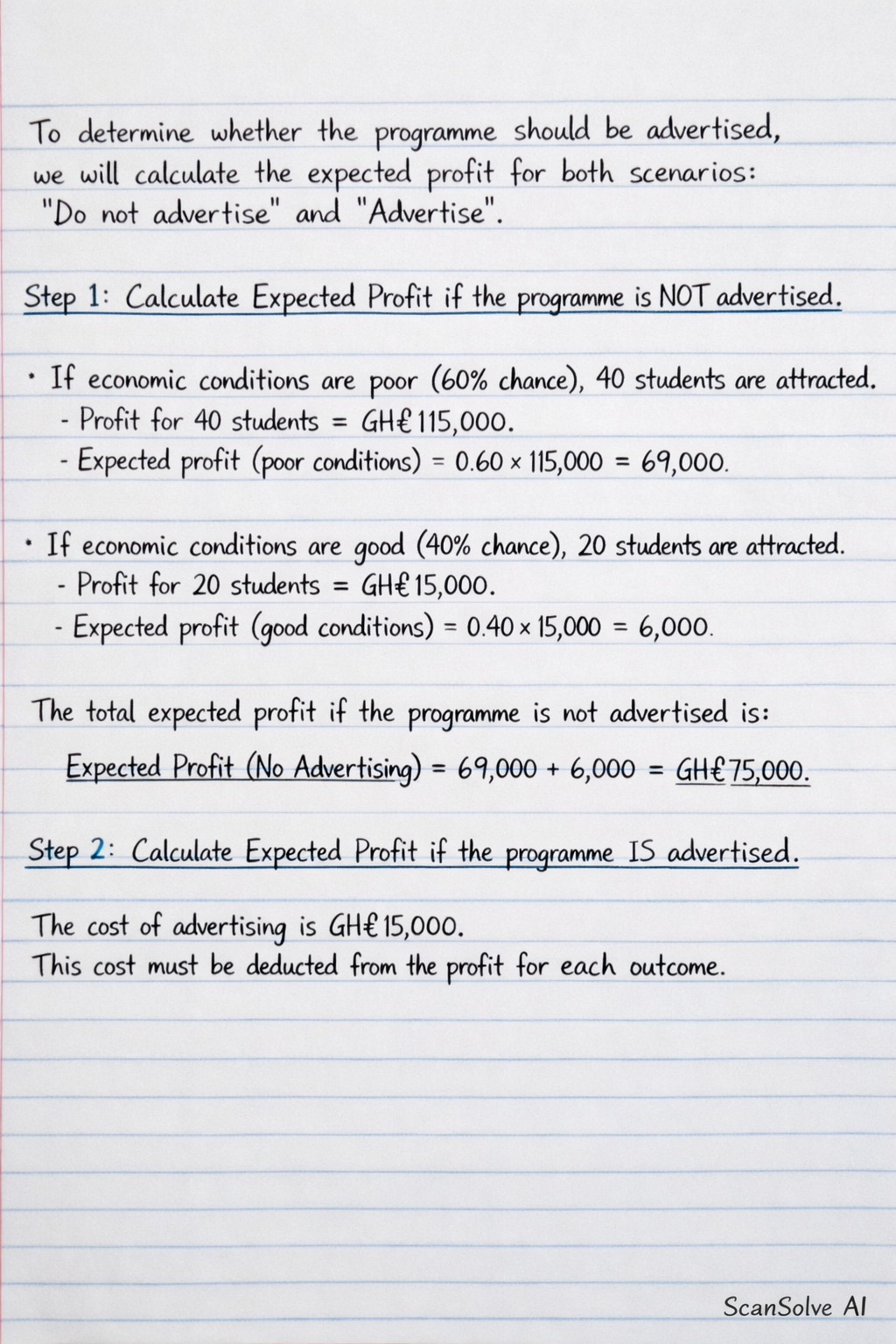
3 stepsTo determine whether the programme should be advertised, we will calculate the expected profit for both scenarios: "Do not advertise" and "Advertise".
Calculate Expected Profit if the programme is NOT advertised.
- If economic conditions are poor (60% chance), 40 students are attracted.
- Profit for 40 students = GH¢115,000.
- Expected profit (poor conditions) = .
- If economic conditions are good (40% chance), 20 students are attracted.
- Profit for 20 students = GH¢15,000.
- Expected profit (good conditions) = .
The total expected profit if the programme is not advertised is:
- If economic conditions are poor (60% chance), 40 students are attracted.
Calculate Expected Profit if the programme IS advertised.
The cost of advertising is GH¢15,000. This cost must be deducted from the profit for each outcome.
-
Scenario A: Economic conditions are poor (60% chance).
- There is a 65% chance advertising stimulates demand, increasing students to 50.
- Profit for 50 students = GH¢165,000.
- Net profit = .
- Probability = .
- Expected profit = .
- There is a 35% chance advertising does not stimulate demand, students remain at 40.
- Profit for 40 students = GH¢115,000.
- Net profit = .
- Probability = .
- Expected profit = .
- There is a 65% chance advertising stimulates demand, increasing students to 50.
-
Scenario B: Economic conditions are good (40% chance).
- There is a 25% chance advertising stimulates demand, increasing students to 25.
- Profit for 25 students = GH¢40,000.
- Net profit = .
- Probability = .
- Expected profit = .
- There is a 75% chance advertising does not stimulate demand, students remain at 20.
- Profit for 20 students = GH¢15,000.
- Net profit = .
- Probability = .
- Expected profit = .
- There is a 25% chance advertising stimulates demand, increasing students to 25.
The total expected profit if the programme is advertised is:
-
Compare the expected profits and make a decision.
- Expected Profit (No Advertising) = GH¢75,000
- Expected Profit (Advertising) = GH¢82,000
Since the expected profit from advertising (GH¢82,000) is higher than not advertising (GH¢75,000), the university should advertise the programme.
The final answer is
Still stuck on this one?
Ask a follow-up, and the answer starts from this question.
More Business/Management Questions
Handwritten Step-by-Step Solution
Get this as a handwritten image on WhatsApp — like a tutor wrote it for you.
Try on WhatsApp