
An object of mass 5kg moving with a velocity of 10m/s collides with a 25kg moving with a velocity of 30m/s, calculate the loss in kinetic energy if they coalesce on impact while traveling in the same direction
Business/Management
ScanSolve AI Answer
Answer
Step-by-step solution
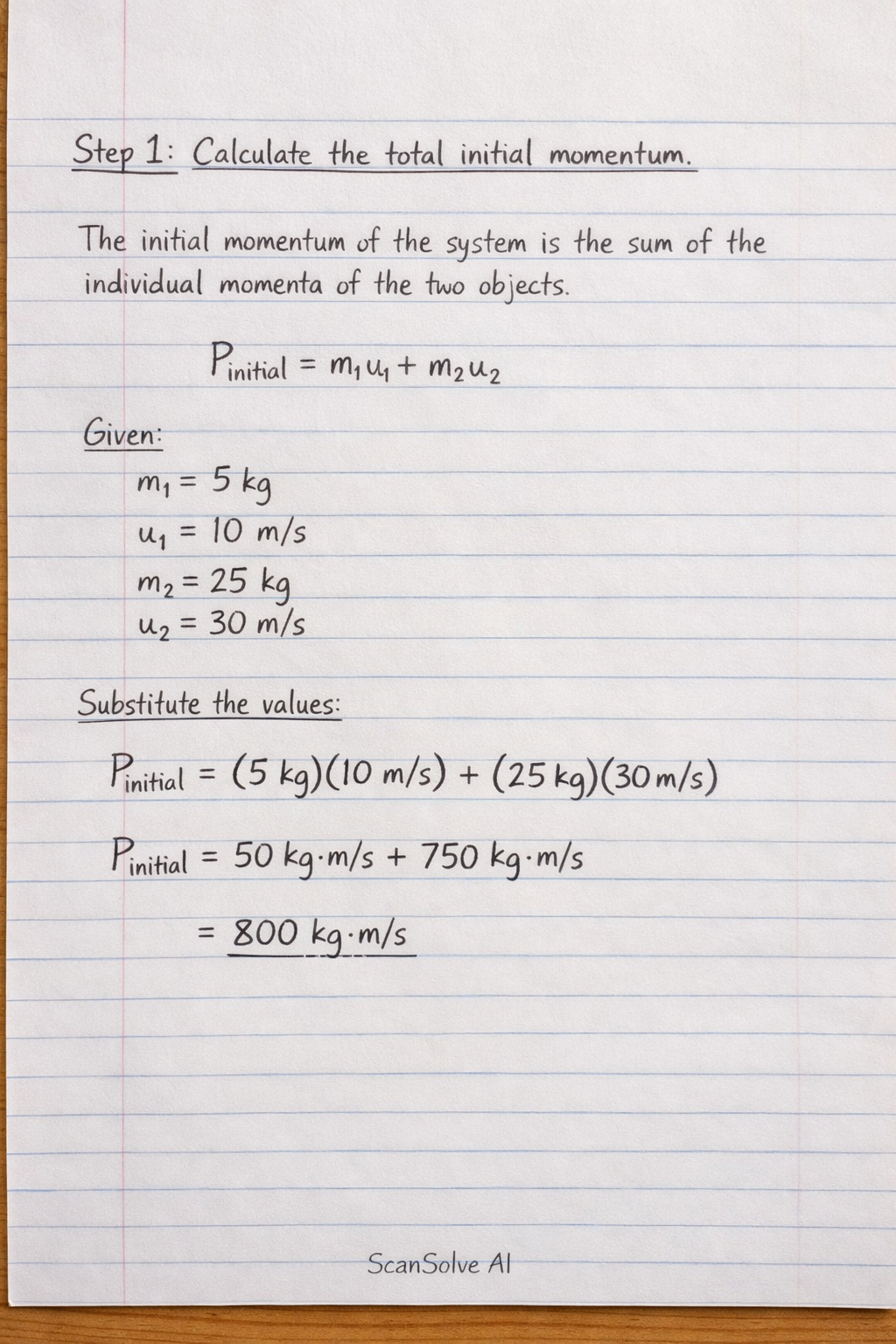
5 stepsCalculate the total initial momentum.
The initial momentum of the system is the sum of the individual momenta of the two objects.
Given:
Substitute the values:
Use the conservation of momentum to find the final velocity.
Since the objects coalesce, they move together as a single mass () with a common final velocity ().
By conservation of momentum, :
Solve for :
Calculate the total initial kinetic energy.
Calculate the total final kinetic energy.
Calculate the loss in kinetic energy.
Loss in kinetic energy =
The loss in kinetic energy is
Was this helpful?
Try one yourself
A new problem that tests the same skill.
Still stuck on this one?
Ask a follow-up, and the answer starts from this question.
Got a different question?Ask your own question
More Business/Management Questions
QA 5 kg mass moving with a velocity of 10 m/s collides with a 10 kg mass moving with a velocity of 4…QA car of mass 1600 kg traveling at 30 m/s collides with a minibus of mass 3000 kg traveling at 20…QTwo players, one with mass 75 kg moving at 6 m/s and another with mass 100 kg moving at 8 m/s…QTwo trolleys of mass 3 kg and 5 kg are moving toward each other at 4 m/s. They collide and stick…QA body of mass 100 g moving at 10 m/s collides and rebounds with a speed of 2 m/s. Calculate the…
Handwritten Step-by-Step Solution
Get this as a handwritten image on WhatsApp — like a tutor wrote it for you.
Try on WhatsApp