
We read your photo as:
Analyze and report on the inefficiencies of Greenfield High School's manual attendance system, focusing on time consumption and lack of real-time data.
ScanSolve AI Answer
Here's a report analyzing the attendance system at Greenfield High School, expanded to nine paragraphs:
Report on Greenfield High School's Attendance System
Greenfield High School, with its 800 students in Windhoek, currently relies on a manual, paper-based attendance system. This traditional method involves teachers physically marking attendance registers at the beginning of every class. While seemingly straightforward, this approach introduces a cascade of operational challenges that significantly hinder efficiency, data accuracy, and timely communication, impacting both administrative staff and student oversight.
One of the most immediate and pervasive problems is the sheer inefficiency and time consumption inherent in the manual process. Teachers dedicate valuable instructional time at the start of each lesson to record attendance, a repetitive task that accumulates across multiple classes daily. This not only reduces actual teaching time but also creates a bottleneck for administrative staff who must manually collect, collate, and process these paper registers, diverting their focus from more critical tasks.
A critical drawback is the absence of real-time data access and robust reporting capabilities. The administration frequently struggles to calculate overall attendance figures promptly, making it difficult to identify patterns of absenteeism or pinpoint students requiring intervention. Generating comprehensive and timely reports for parents, a crucial aspect of student welfare and accountability, becomes an arduous, time-consuming, and often delayed process due to the manual aggregation of scattered data.
The manual system is highly susceptible to human error. Teachers may inadvertently mark students present or absent incorrectly, leading to inaccurate records that can have serious implications for student academic standing or disciplinary actions. Furthermore, the reliance on physical paper records introduces significant risks of data loss or damage. Registers can be misplaced, damaged by spills, or destroyed in unforeseen incidents, compromising the integrity and completeness of historical attendance data.
Despite these glaring inefficiencies and risks, Greenfield High School continues to utilize the manual method primarily due to its perceived advantages of low cost and simplicity. The initial outlay for paper registers and pens is minimal compared to the investment required for new software, hardware, and network infrastructure. This financial barrier often makes the manual system appear more economically viable, especially for institutions with tight budgets.
Another significant factor contributing to the system's persistence is staff familiarity and an inherent resistance to change. Teachers and administrative personnel have grown accustomed to the paper-based process over many years, making them comfortable with its routines. The prospect of learning a new digital system, adapting to new workflows, and potentially facing technical glitches can be daunting, leading to a preference for the known, even if it is less efficient.
To address these challenges, a phased implementation of a digital attendance system is strongly recommended. This modern solution would empower teachers to mark attendance electronically via a secure web portal or a dedicated mobile application, directly updating a central, cloud-based database. This immediate data capture would eliminate manual collation, significantly reducing the time spent on administrative tasks and freeing up teachers for instructional duties.
The digital system would offer advanced features crucial for effective school management. It would enable automated attendance calculation, providing real-time insights into student presence and absence patterns. The system could be configured to generate customizable reports for administrators, highlighting students with chronic absenteeism, and automatically dispatch notifications to parents regarding their child's attendance status. This proactive communication would foster greater parental engagement and support student accountability.
In conclusion, transitioning from a manual to a digital attendance system at Greenfield High School would yield substantial benefits. It would dramatically improve operational efficiency, ensure data accuracy and integrity, and enhance communication between the school and parents. While requiring an initial investment and a period of adaptation, the long-term advantages of streamlined processes, better student oversight, and a more modern, responsive administrative framework would position Greenfield High School for greater success in student management and overall educational delivery.
Still stuck on this one?
Ask a follow-up, and the answer starts from this question.
More Business/Management Questions
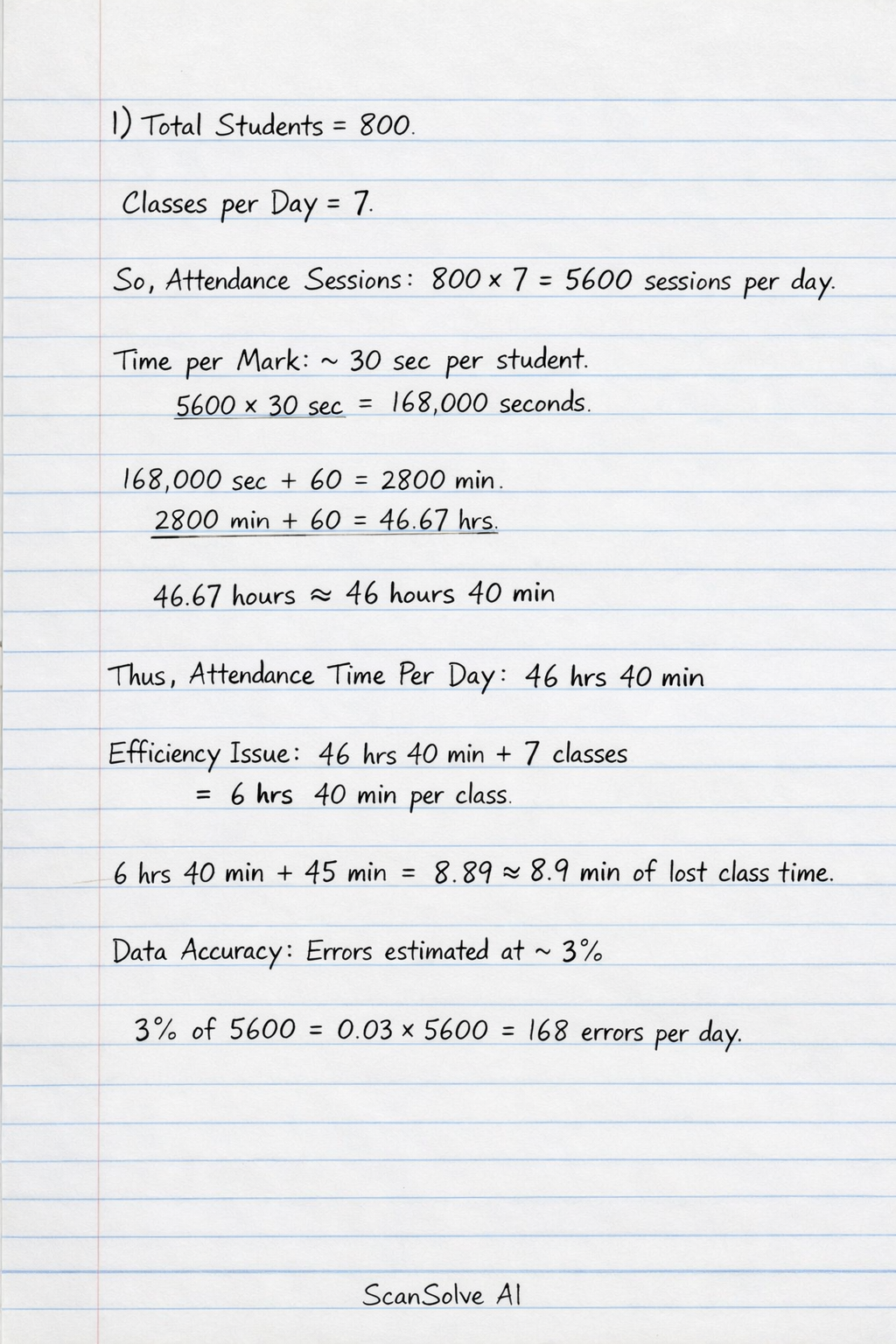
Handwritten Step-by-Step Solution
Get this as a handwritten image on WhatsApp — like a tutor wrote it for you.
Try on WhatsApp