
We read your photo as:
Analyze Scenario A regarding employee social media use, privacy, and termination, focusing on the right to use information and fault.
ScanSolve AI Answer
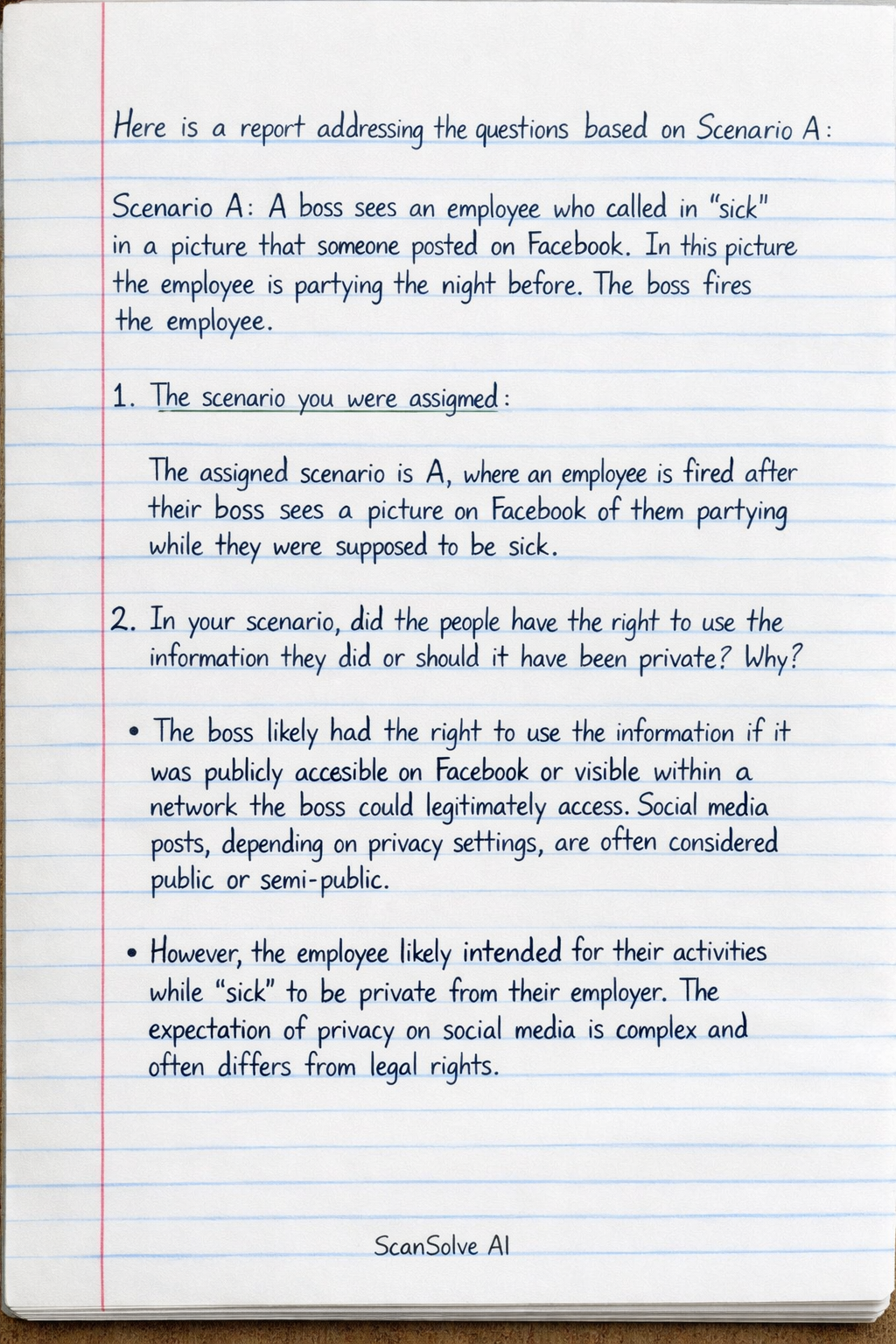
Here is a report addressing the questions based on Scenario A:
Scenario A: A boss sees an employee who called in "sick" in a picture that someone posted on Facebook. In this picture the employee is partying the night before. The boss fires the employee.
-
The scenario you were assigned:
- The assigned scenario is A, where an employee is fired after their boss sees a picture on Facebook of them partying while they were supposed to be sick.
-
In your scenario, did the people have the right to use the information they did or should it have been private? Why?
- The boss likely had the right to use the information if it was publicly accessible on Facebook or visible within a network the boss could legitimately access. Social media posts, depending on privacy settings, are often considered public or semi-public.
- However, the employee likely intended for their activities while "sick" to be private from their employer. The expectation of privacy on social media is complex and often differs from legal rights.
-
Are the people who were affected by the use of this information at fault? Why?
- Yes, the employee is partly at fault. They misrepresented their health to their employer and either posted the incriminating picture themselves or allowed a friend to post it without sufficient privacy controls, making it accessible to their employer. The friend who posted the picture without considering the employee's situation could also be considered at fault.
-
Give another example of something unexpected happening because of information shared at sites such as Facebook, Twitter, MySpace, blogs.
- An unexpected consequence could be a university rescinding an admission offer to a student after discovering old, offensive posts or comments on their social media profiles, even if those posts were made years ago and do not reflect the student's current character.
-
Think about what data you've made available in different places/spaces such as Facebook, Twitter, texting, email, at the grocery store, etc. What might other people think about who you are based on these data? Is it an accurate impression of who you are?
- Data made available includes social media posts, photos, location tags, purchase history, search queries, and communication content. Based on this, others might form an impression of my interests, political views, social life, or consumer habits. This impression is often not fully accurate because online data typically represents a curated or partial view of a person, lacking full context and nuance.
-
Consider each of the following broad categories of societal change: Privacy, Safety, Globalization, Connectivity (keeping in touch with people), Permanence of historical information. Discuss whether availability of data has had a positive or negative impact on each aspect of society and, if negative, how these consequences can be minimized.
-
Privacy:
- Impact: Largely negative. Increased data availability has led to reduced personal privacy, easier surveillance, and a higher risk of data breaches and identity theft.
- Minimization: Implementing stronger data protection laws (e.g., GDPR), educating users on managing privacy settings, promoting the use of encryption, and developing anonymization techniques for data.
-
Safety:
- Impact: Mixed. Positive for law enforcement and emergency services (e.g., tracking criminals, rapid response). Negative for individuals due to increased risks of cyberbullying, stalking, doxing, and online fraud.
- Minimization: Enhancing cybersecurity measures, establishing clear reporting mechanisms for online abuse, promoting digital literacy, and ensuring secure data storage practices.
-
Globalization:
- Impact: Largely positive. Data availability facilitates international communication, trade, cultural exchange, and collaborative efforts across borders, breaking down geographical barriers.
- Minimization (of negative aspects): Addressing the digital divide to ensure equitable access, promoting diverse content, and combating the spread of misinformation across cultures.
-
Connectivity (keeping in touch with people):
- Impact: Largely positive. Enables instant communication, helps maintain relationships over long distances, and fosters online communities based on shared interests.
- Minimization (of negative aspects): Encouraging healthy digital habits, addressing issues like social media addiction, and promoting critical thinking to avoid echo chambers.
-
Permanence of historical information:
- Impact: Mixed. Positive for historical record-keeping, research, and holding individuals/organizations accountable. Negative for individuals who may be judged by past mistakes, outdated opinions, or embarrassing content that is difficult to erase ("digital tattoos").
- Minimization: Implementing "right to be forgotten" laws, establishing clear data retention policies, encouraging careful consideration of what is shared online, and developing tools for managing one's digital legacy.
-
Still stuck on this one?
Ask a follow-up, and the answer starts from this question.
More Business/Management Questions
Handwritten Step-by-Step Solution
Get this as a handwritten image on WhatsApp — like a tutor wrote it for you.
Try on WhatsApp