
We read your photo as:
Analyze the situation and explain the two main areas of business ethics.
ScanSolve AI Answer
a) Analyze the situation and explain the two main areas of business ethics.
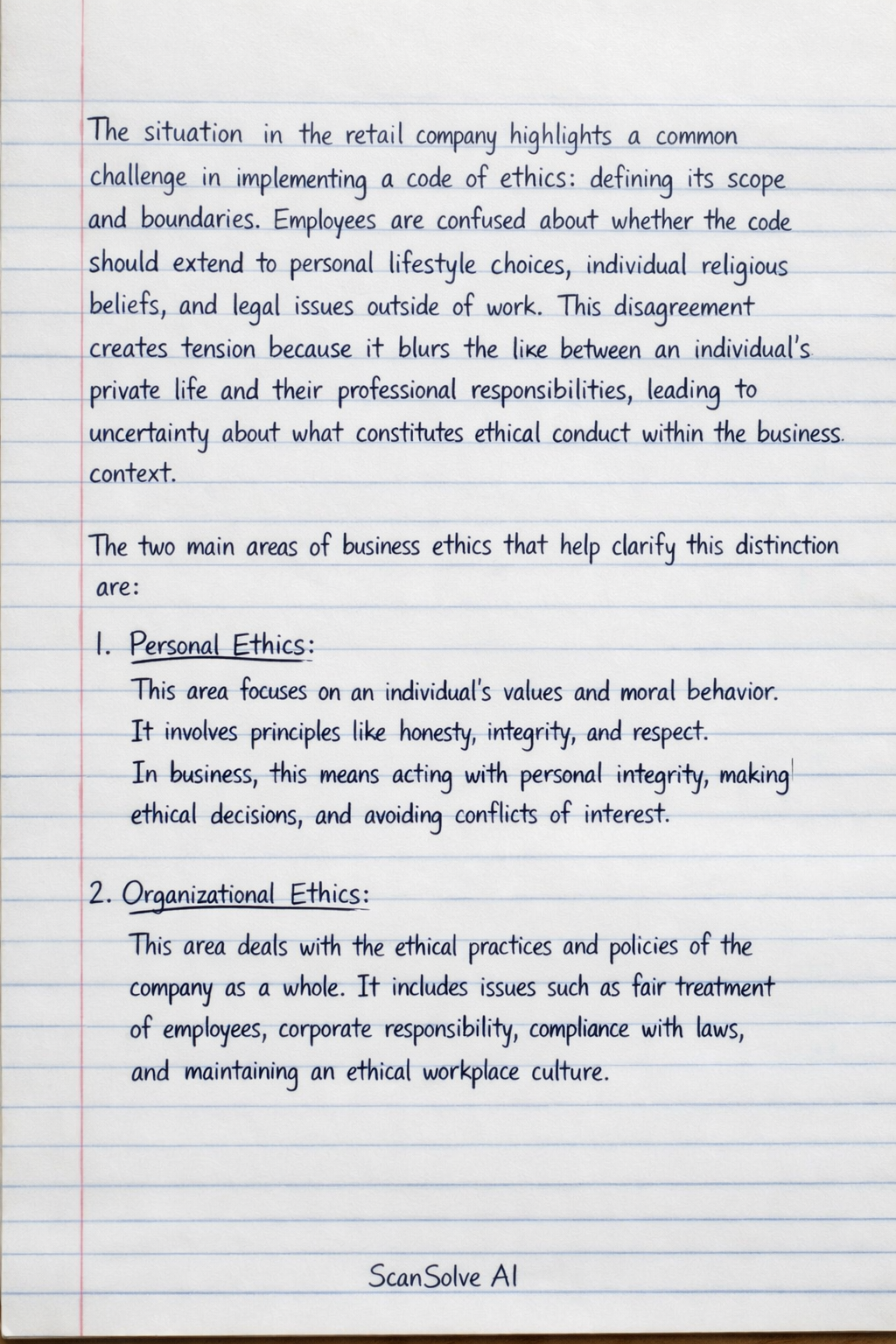
The situation in the retail company highlights a common challenge in implementing a code of ethics: defining its scope and boundaries. Employees are confused about whether the code should extend to personal lifestyle choices, individual religious beliefs, and legal issues outside of work. This disagreement creates tension because it blurs the line between an individual's private life and their professional responsibilities, leading to uncertainty about what constitutes ethical conduct within the business context.
The two main areas of business ethics that help clarify this distinction are:
-
Organizational Ethics: This area focuses on the ethical principles, policies, and practices that govern the business entity itself. It addresses how the company operates, its culture, its decision-making processes, and its impact on all stakeholders (employees, customers, suppliers, community, environment). This includes issues like fair labor practices, product quality, environmental responsibility, and corporate governance. The company's code of ethics primarily falls under this area, guiding collective behavior and corporate responsibility.
-
Individual Ethics (within a business context): This area deals with the ethical behavior and decisions of individual employees, managers, and leaders within their professional roles. It examines how personal values intersect with organizational values and professional duties. While it acknowledges an individual's personal moral compass, its scope is limited to actions that affect their job performance, their interactions with colleagues and customers, the company's reputation, or the use of company resources. It does not typically extend to purely private matters that have no bearing on the business.
b) Discuss four (4) types of issues that may not fall within the scope of business ethics.
While business ethics is broad, certain issues typically fall outside its direct scope, especially when they do not impact an employee's job performance, the company's operations, or its reputation. Four such types of issues are:
-
Purely Personal Lifestyle Choices: These are decisions an individual makes about their private life outside of work that do not affect their job performance, the company's resources, or its public image. Examples include an employee's dietary preferences, fashion choices outside of work attire, hobbies, or social activities that are not illegal or directly harmful to the company. The company's ethical code should not dictate these personal freedoms.
-
Private Religious or Spiritual Beliefs: An individual's personal faith, spiritual practices, or lack thereof are generally considered outside the scope of business ethics. While companies must accommodate religious practices where reasonable and avoid discrimination, the ethical code should not attempt to regulate or prescribe an employee's private beliefs, as long as these beliefs do not lead to discriminatory behavior, harassment, or conflict with essential job functions in the workplace.
-
Personal Legal Matters Unrelated to Employment: These are legal issues an employee faces in their private life that have no direct bearing on their professional conduct, the company's operations, or its reputation. For instance, an employee's personal civil dispute, a minor traffic violation outside of work hours, or family legal matters are typically not subject to the company's ethical code, unless they involve criminal activity that impacts their ability to perform their job or poses a direct risk to the company.
-
Purely Private Political Opinions: Employees have a right to their political views and affiliations. A company's ethical code should not regulate an individual's private political opinions or how they vote. This remains outside the scope of business ethics as long as these opinions are not expressed in a way that creates a hostile work environment, discriminates against others, or is publicly associated with the company in a damaging or unauthorized manner.
Still stuck on this one?
Ask a follow-up, and the answer starts from this question.
More Business/Management Questions
Handwritten Step-by-Step Solution
Get this as a handwritten image on WhatsApp — like a tutor wrote it for you.
Try on WhatsApp