

This business/management problem is solved step by step below, with detailed explanations to help you understand the method and arrive at the correct answer.
ScanSolve AI Answer
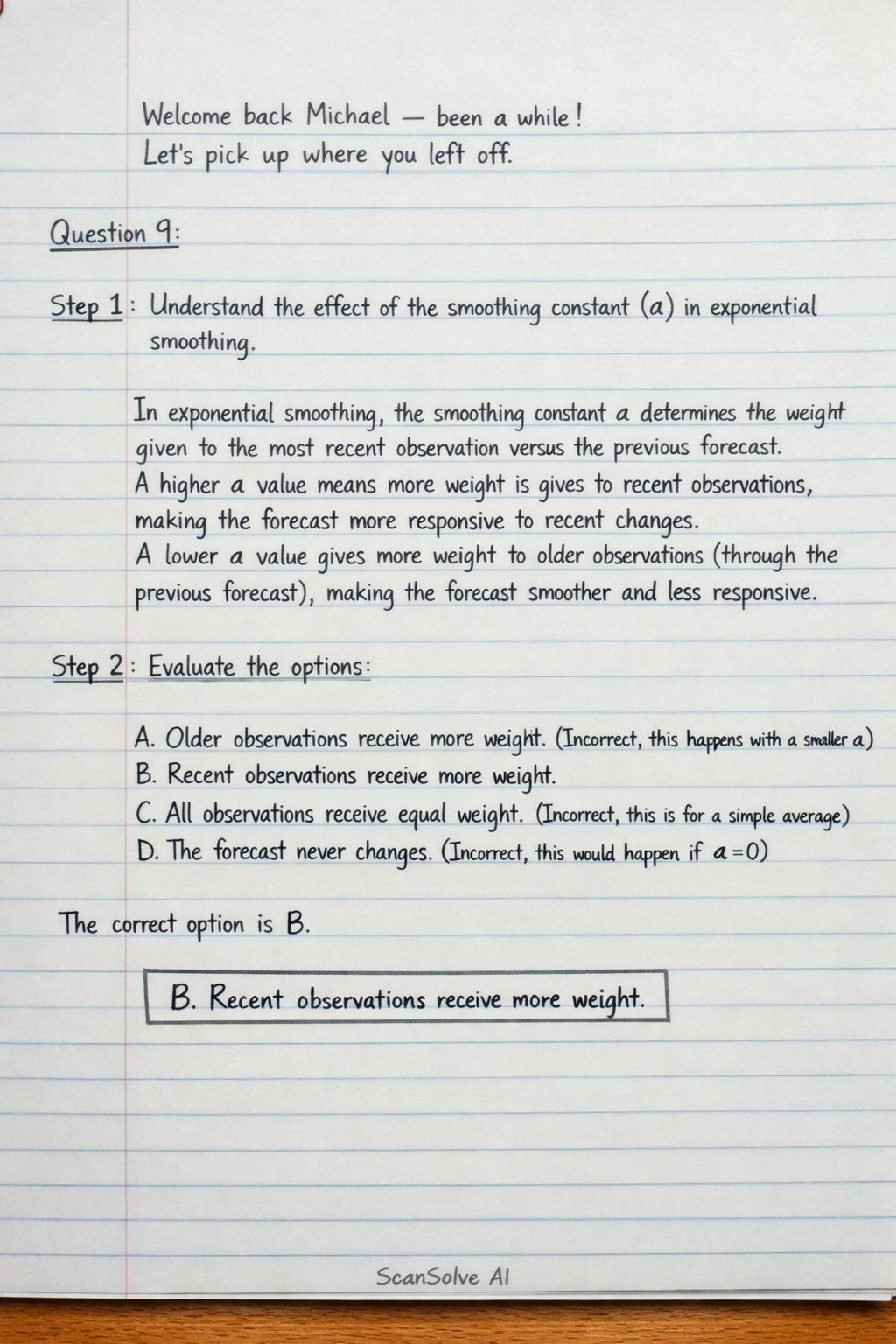
Question 9: Step 1: Understand the effect of the smoothing constant () in exponential smoothing. In exponential smoothing, the smoothing constant determines the weight given to the most recent observation versus the previous forecast. A higher value means more weight is given to recent observations, making the forecast more responsive to recent changes. A lower value gives more weight to older observations (through the previous forecast), making the forecast smoother and less responsive. Step 2: Evaluate the options. A. Older observations receive more weight. (Incorrect, this happens with a smaller ) B. Recent observations receive more weight. (Correct) C. All observations receive equal weight. (Incorrect, this is for a simple average) D. The forecast never changes. (Incorrect, this would happen if = 0) The correct option is B. B. Recent observations receive more weight. Question 10: Step 1: Analyze the problem statement. The company experiences highly unstable demand with many random fluctuations. This means the forecast needs to be very responsive to recent changes in demand, as past patterns might not hold due to the instability. Step 2: Determine the appropriate value. A larger in exponential smoothing gives more weight to the most recent actual demand and less weight to the older forecast. This makes the forecast more reactive to current conditions, which is suitable for highly unstable demand. A smaller would make the forecast smoother and less responsive, which is not ideal for fluctuating demand. The correct option is B. B. A larger Question 11: Step 1: Recall the definition of forecast error. Forecast error is the difference between what actually happened and what was forecasted. It is typically calculated as the actual value minus the forecasted value. Step 2: Evaluate the options. A. Forecast - Actual (Incorrect, this would give a negative error if actual demand was higher than forecast) B. Actual - Forecast (Correct) C. Actual × Forecast (Incorrect) D. Forecast ÷ Actual (Incorrect) The correct option is B. B. Actual - Forecast Question 12: Step 1: Identify the nature of the forecasting methods. The question asks for a method that relies primarily on opinions and experience of experts. This describes a qualitative forecasting approach. Moving average, Regression, and Time-series decomposition are quantitative forecasting methods that use historical data and mathematical models. Judgmental forecasting relies on human judgment, intuition, and expert opinions. Step 2: Evaluate the options. A. Moving average (Quantitative) B. Regression (Quantitative) C. Judgmental forecasting (Qualitative, relies on expert opinions) D. Time-series decomposition (Quantitative) The correct option is C. C. Judgmental forecasting Question 13: Step 1: Understand the approach described. A mobile phone retailer asks its sales representatives in different regions to estimate customer demand. This involves gathering forecasts from individuals or small groups at the "grassroots" level, who are closest to the customers. Step 2: Evaluate the options. A. Regression forecasting (A quantitative method using statistical relationships) B. Grassroots forecasting (A qualitative method that aggregates forecasts from individuals or units close to the market) C. Exponential smoothing (A quantitative time-series method) D. Weighted moving average (A quantitative time-series method) The correct option is B. B. Grassroots forecasting Question 14: Step 1: Understand the tracking signal. A tracking signal is a measure used to monitor the quality of a forecast. It indicates whether the forecast is biased (consistently too high or too low). It is typically calculated as the cumulative sum of forecast errors divided by the Mean Absolute Deviation (MAD). Step 2: Interpret a tracking signal of +2.5. A tracking signal within an acceptable range (often ± 4 or ± 6, depending on the organization's policy) suggests that the forecasting model is performing adequately and there is no significant bias. A value of +2.5 is generally within this acceptable range. A value outside this range would indicate a problem with the forecast. The correct option is A. A. The forecasting model is generally acceptable. Question 15: Step 1: Understand Mean Squared Error (MSE). MSE is a common measure of forecast accuracy. It calculates the average of the squared differences between actual and forecasted values. A lower MSE indicates a more accurate forecasting method. Step 2: Compare the MSE values for each method. Method A: MSE = 18.5 Method B: MSE = 9.4 Method C: MSE = 12.8 Step 3: Select the method with the lowest MSE. Method B has the lowest MSE (9.4), meaning it has the smallest average squared error and is therefore the most accurate among the three methods. The correct option is B. B. Method B Question 16: Step 1: Define capacity terms. Design capacity* is the maximum theoretical output rate of a system or process under ideal conditions. Effective capacity* is the capacity a firm expects to achieve given current operating constraints (e.g., maintenance, staffing, quality issues). It is less than design capacity. Actual output* is the actual production achieved, which is often less than effective capacity due to unforeseen issues. Utilization* is the ratio of actual output to design capacity or effective capacity. Step 2: Relate the definition to the problem. The problem states the company can produce a maximum of 80,000 bottles per day under ideal conditions. This perfectly matches the definition of design capacity. The correct option is C. C. Design capacity Question 17: Step 1: Define capacity terms (re-using definitions from Q16). Design capacity*: Maximum theoretical output under ideal conditions. Effective capacity*: Capacity expected given current operating constraints. Utilization*: Ratio of actual output to capacity. Step 2: Apply definitions to the hospital scenario. The hospital has 500 beds (its maximum theoretical capacity, or design capacity). However, it normally operates only 430 beds due to practical constraints like maintenance and staffing. This 430-bed figure represents the capacity that the hospital can realistically achieve under normal operating conditions, which is the definition of effective capacity. The correct option is B. B. Effective capacity Drop the next question! 📸