Calculate the optimal number Minimum and maximum stock level to maintain in the store

Business/Management

ScanSolve AI Answer

Step-by-step solution

4 steps

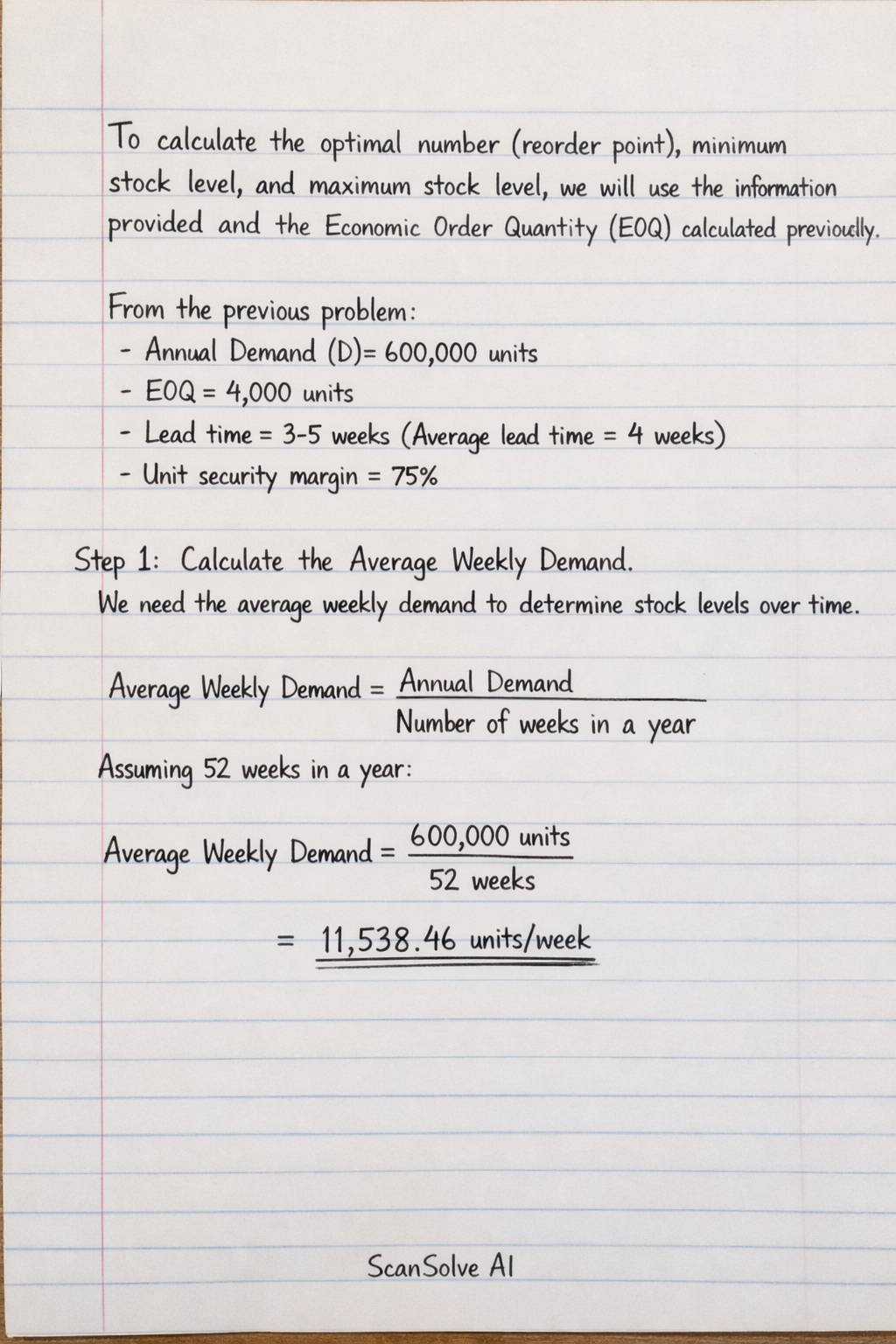
To calculate the optimal number (reorder point), minimum stock level, and maximum stock level, we will use the information provided and the Economic Order Quantity (EOQ) calculated previously.

From the previous problem:

  • Annual Demand (D) = 600,000 units
  • EOQ = 4,000 units
  • Lead time = 3-5 weeks (Average lead time = 4 weeks)
  • Unit security margin = 75%
  1. Calculate the Average Weekly Demand.

    We need the average weekly demand to determine stock levels over time.

    Average Weekly Demand=Annual DemandNumber of weeks in a year\text{Average Weekly Demand} = \frac{\text{Annual Demand}}{\text{Number of weeks in a year}}

    Assuming 52 weeks in a year:

    Average Weekly Demand=600 000 units52 weeks≈11 538.46 units/week\text{Average Weekly Demand} = \frac{600\,000 \text{ units}}{52 \text{ weeks}} \approx 11\,538.46 \text{ units/week}
  2. Calculate the Minimum Stock Level (Safety Stock).

    The "Unit security margin 75%" is interpreted as 75% of the average weekly demand, which serves as the safety stock to cover unexpected demand or delays.

    Safety Stock (SS)=0.75×Average Weekly Demand\text{Safety Stock (SS)} = 0.75 \times \text{Average Weekly Demand} SS=0.75×11 538.46 units≈8 653.85 units\text{SS} = 0.75 \times 11\,538.46 \text{ units} \approx 8\,653.85 \text{ units}

    Rounding to the nearest whole unit, the minimum stock level is 8,654 units.

  3. Calculate the Optimal Number (Reorder Point).

    The optimal number refers to the reorder point (ROP), which is the inventory level at which a new order should be placed.

    Reorder Point (ROP)=(Average Demand during Lead Time)+Safety Stock\text{Reorder Point (ROP)} = (\text{Average Demand during Lead Time}) + \text{Safety Stock}

    First, calculate the average lead time:

    Average Lead Time=3 weeks+5 weeks2=4 weeks\text{Average Lead Time} = \frac{3 \text{ weeks} + 5 \text{ weeks}}{2} = 4 \text{ weeks}

    Next, calculate the demand during the average lead time:

    Demand during Lead Time=Average Weekly Demand×Average Lead Time\text{Demand during Lead Time} = \text{Average Weekly Demand} \times \text{Average Lead Time} Demand during Lead Time=11 538.46 units/week×4 weeks≈46 153.84 units\text{Demand during Lead Time} = 11\,538.46 \text{ units/week} \times 4 \text{ weeks} \approx 46\,153.84 \text{ units}

    Now, calculate the Reorder Point:

    ROP=46 153.84 units+8 653.85 units≈54 807.69 units\text{ROP} = 46\,153.84 \text{ units} + 8\,653.85 \text{ units} \approx 54\,807.69 \text{ units}

    Rounding to the nearest whole unit, the optimal number (reorder point) is 54,808 units.

  4. Calculate the Maximum Stock Level.

    The maximum stock level is typically the safety stock plus the Economic Order Quantity (EOQ), assuming a new order arrives when the stock level has reached the safety stock.

    Maximum Stock Level=Safety Stock+EOQ\text{Maximum Stock Level} = \text{Safety Stock} + \text{EOQ} Maximum Stock Level=8 653.85 units+4 000 units≈12 653.85 units\text{Maximum Stock Level} = 8\,653.85 \text{ units} + 4\,000 \text{ units} \approx 12\,653.85 \text{ units}

    Rounding to the nearest whole unit, the maximum stock level is 12,654 units.

    • The optimal number (Reorder Point) is 54 808 units\boxed{54\,808 \text{ units}}.
    • The minimum stock level is 8 654 units\boxed{8\,654 \text{ units}}.
    • The maximum stock level is 12 654 units\boxed{12\,654 \text{ units}}.
Was this helpful?

Still stuck on this one?

Ask a follow-up, and the answer starts from this question.

Got a different question?Ask your own question
Handwritten step-by-step solution preview

Handwritten Step-by-Step Solution

Get this as a handwritten image on WhatsApp — like a tutor wrote it for you.

Try on WhatsApp