
We read your photo as:
From the following details given below, calculate: Re-ordering level (ii) Maximum level (iii) Minimum level (iv) Danger level Also what are the importance of determining maximum inventory level for a manufacturing company?
ScanSolve AI Answer
Step-by-step solution
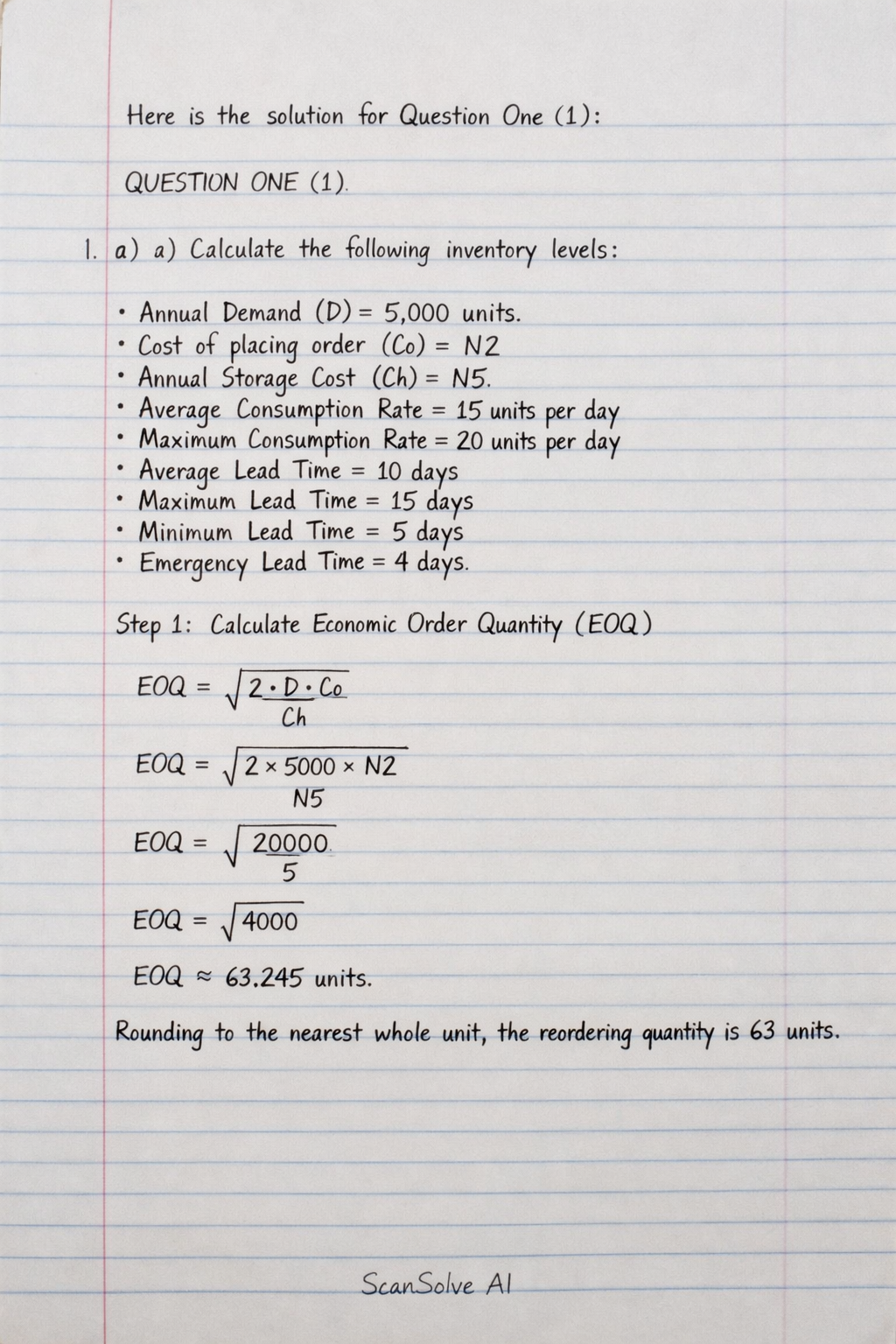
5 stepsHere is the solution for Question One (1):
QUESTION ONE (1)
1. a) Calculate the following inventory levels:
First, we need to calculate the Economic Order Quantity (EOQ) as the reordering quantity, based on the provided cost information.
- Annual Demand (D) = 5,000 units
- Cost of placing a purchase order (Co) = N2
- Annual cost of storage per unit (Ch) = N5
- Average Consumption Rate = 15 units per day
- Maximum Consumption Rate = 20 units per day
- Average Lead Time = 10 days
- Maximum Lead Time = 15 days
- Minimum Lead Time = 5 days
- Emergency Lead Time = 4 days
Calculate Economic Order Quantity (EOQ).
The EOQ is the optimal reordering quantity that minimizes total inventory costs.
Rounding to the nearest whole unit, the reordering quantity is 63 units.
Calculate Re-ordering Level (ROL).
The re-ordering level is the point at which a new order should be placed to avoid stockouts.
Calculate Minimum Level.
The minimum level is the lowest inventory level that should be maintained to cover unexpected delays or increased demand.
Calculate Maximum Level.
The maximum level is the highest inventory level that should be held at any time to avoid overstocking.
Assuming minimum consumption rate is the average consumption rate (15 units/day) as no specific minimum is given:
Calculate Danger Level.
The danger level is a critical point below the minimum level, indicating that emergency action is required to replenish stock.
1. b) What are the importance of determining maximum inventory level for a manufacturing company?
Determining the maximum inventory level is crucial for a manufacturing company to manage its resources effectively. It helps in cost control by preventing overstocking, which reduces carrying costs such as storage expenses, insurance, and the risk of obsolescence. It also optimizes working capital management by minimizing the amount of capital tied up in inventory, thereby freeing up funds for other operational needs.
Still stuck on this one?
Ask a follow-up, and the answer starts from this question.
More Accounting Questions
Handwritten Step-by-Step Solution
Get this as a handwritten image on WhatsApp — like a tutor wrote it for you.
Try on WhatsApp