We read your photo as:

Calculate the reorder level and minimum inventory level using the provided data.

Business/Management

ScanSolve AI Answer

Answers

5 parts
iv

7280 units\text{7280 units}

v

2680 units\text{2680 units}

vi

10880 units\text{10880 units}

c

N7\text{N}7

d

N12.77\text{N}12.77

Step-by-step solution

14 steps

Here are the calculations for the inventory levels and production costs:

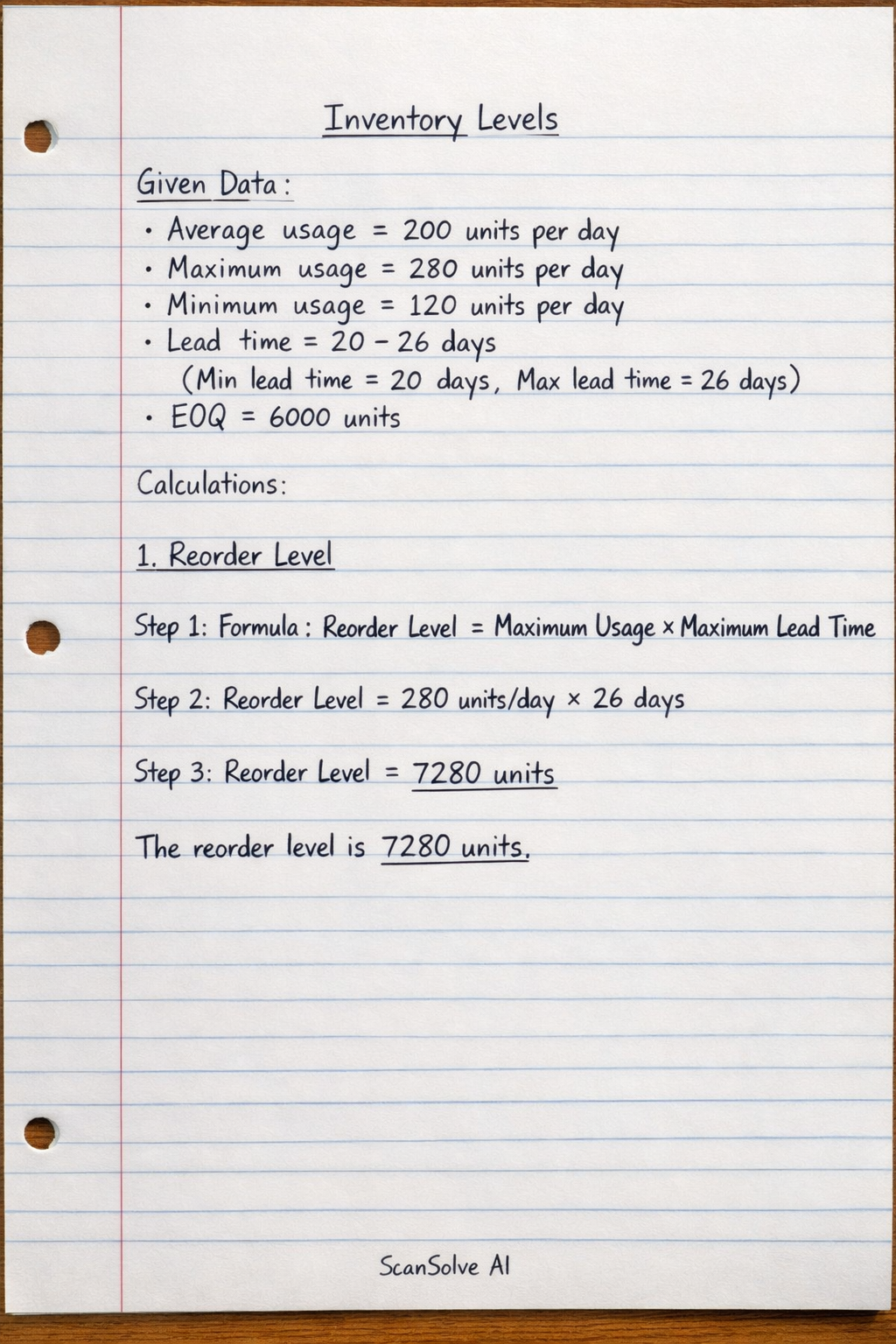
Inventory Levels

  • Given Data:

    • Average usage = 200 units per day
    • Maximum usage = 280 units per day
    • Minimum usage = 120 units per day
    • Lead time = 20 – 26 days (Minimum lead time = 20 days, Maximum lead time = 26 days)
    • EOQ = 6000 units
  • Calculations:

Part iv· 3 steps

Reorder level

  1. The formula for Reorder Level is Maximum Usage multiplied by Maximum Lead Time.

    Reorder Level=Maximum Usage×Maximum Lead Time\text{Reorder Level} = \text{Maximum Usage} \times \text{Maximum Lead Time}
  2. Substitute the given values into the formula.

    Reorder Level=280 units/day×26 days\text{Reorder Level} = 280 \text{ units/day} \times 26 \text{ days}
  3. Calculate the Reorder Level.

    Reorder Level=7280 units\text{Reorder Level} = 7280 \text{ units}

    The reorder level is 7280 units\boxed{\text{7280 units}}.

Part v

2680 units\text{2680 units}

Minimum level

  1. The formula for Minimum Level is Reorder Level minus (Average Usage multiplied by Average Lead Time).

    Minimum Level=Reorder Level−(Average Usage×Average Lead Time)\text{Minimum Level} = \text{Reorder Level} - (\text{Average Usage} \times \text{Average Lead Time})
  2. Calculate the Average Lead Time.

    Average Lead Time=20 days+26 days2=23 days\text{Average Lead Time} = \frac{20 \text{ days} + 26 \text{ days}}{2} = 23 \text{ days}
  3. Substitute the values into the Minimum Level formula.

    Minimum Level=7280 units−(200 units/day×23 days)\text{Minimum Level} = 7280 \text{ units} - (200 \text{ units/day} \times 23 \text{ days})
  4. Calculate the Minimum Level.

    Minimum Level=7280 units−4600 units\text{Minimum Level} = 7280 \text{ units} - 4600 \text{ units} Minimum Level=2680 units\text{Minimum Level} = 2680 \text{ units}

    The minimum level is 2680 units\boxed{\text{2680 units}}.

Part vi

10880 units\text{10880 units}

Maximum level

  1. The formula for Maximum Level is Reorder Level plus EOQ minus (Minimum Usage multiplied by Minimum Lead Time).

    Maximum Level=Reorder Level+EOQ−(Minimum Usage×Minimum Lead Time)\text{Maximum Level} = \text{Reorder Level} + \text{EOQ} - (\text{Minimum Usage} \times \text{Minimum Lead Time})
  2. Substitute the values into the Maximum Level formula.

    Maximum Level=7280 units+6000 units−(120 units/day×20 days)\text{Maximum Level} = 7280 \text{ units} + 6000 \text{ units} - (120 \text{ units/day} \times 20 \text{ days})
  3. Calculate the Maximum Level.

    Maximum Level=7280 units+6000 units−2400 units\text{Maximum Level} = 7280 \text{ units} + 6000 \text{ units} - 2400 \text{ units} Maximum Level=13280 units−2400 units\text{Maximum Level} = 13280 \text{ units} - 2400 \text{ units} Maximum Level=10880 units\text{Maximum Level} = 10880 \text{ units}

    The maximum level is 10880 units\boxed{\text{10880 units}}.


    Cost Calculations

    • Given Data:

      • Variable overhead = N8,000
      • Fixed overhead = N9,300
      • Direct materials cost = N12,000
      • Direct labour cost = N9,000
      • Output for the month = 3000 units
    • Calculations:

Part c

N7\text{N}7

Prime cost per unit

  1. Calculate the total Prime Cost.

    Prime Cost=Direct Materials Cost+Direct Labour Cost\text{Prime Cost} = \text{Direct Materials Cost} + \text{Direct Labour Cost} Prime Cost=N12,000+N9,000\text{Prime Cost} = \text{N}12,000 + \text{N}9,000 Prime Cost=N21,000\text{Prime Cost} = \text{N}21,000
  2. Calculate the Prime Cost per unit.

    Prime Cost per Unit=Prime CostOutput for the Month\text{Prime Cost per Unit} = \frac{\text{Prime Cost}}{\text{Output for the Month}} Prime Cost per Unit=N21,0003000 units\text{Prime Cost per Unit} = \frac{\text{N}21,000}{3000 \text{ units}} Prime Cost per Unit=N7 per unit\text{Prime Cost per Unit} = \text{N}7 \text{ per unit}

    The prime cost per unit is N7\boxed{\text{N}7}.

Part d

N12.77\text{N}12.77

The production cost per unit

  1. Calculate the total Production Cost.

    Production Cost=Prime Cost+Variable Overhead+Fixed Overhead\text{Production Cost} = \text{Prime Cost} + \text{Variable Overhead} + \text{Fixed Overhead} Production Cost=N21,000+N8,000+N9,300\text{Production Cost} = \text{N}21,000 + \text{N}8,000 + \text{N}9,300 Production Cost=N38,300\text{Production Cost} = \text{N}38,300
  2. Calculate the Production Cost per unit.

    Production Cost per Unit=Production CostOutput for the Month\text{Production Cost per Unit} = \frac{\text{Production Cost}}{\text{Output for the Month}} Production Cost per Unit=N38,3003000 units\text{Production Cost per Unit} = \frac{\text{N}38,300}{3000 \text{ units}} Production Cost per Unit≈N12.77 per unit\text{Production Cost per Unit} \approx \text{N}12.77 \text{ per unit}

    The production cost per unit is N12.77\boxed{\text{N}12.77}.

Was this helpful?

Try one yourself

A new problem that tests the same skill.

Still stuck on this one?

Ask a follow-up, and the answer starts from this question.

Got a different question?Ask your own question
Handwritten step-by-step solution preview

Handwritten Step-by-Step Solution

Get this as a handwritten image on WhatsApp — like a tutor wrote it for you.

Try on WhatsApp