
We read your photo as:
Module 1: Monitor and control quality control practices in a manufacturing/engineering environment, interpret statistical process control charts, and rectify production problems.
ScanSolve AI Answer
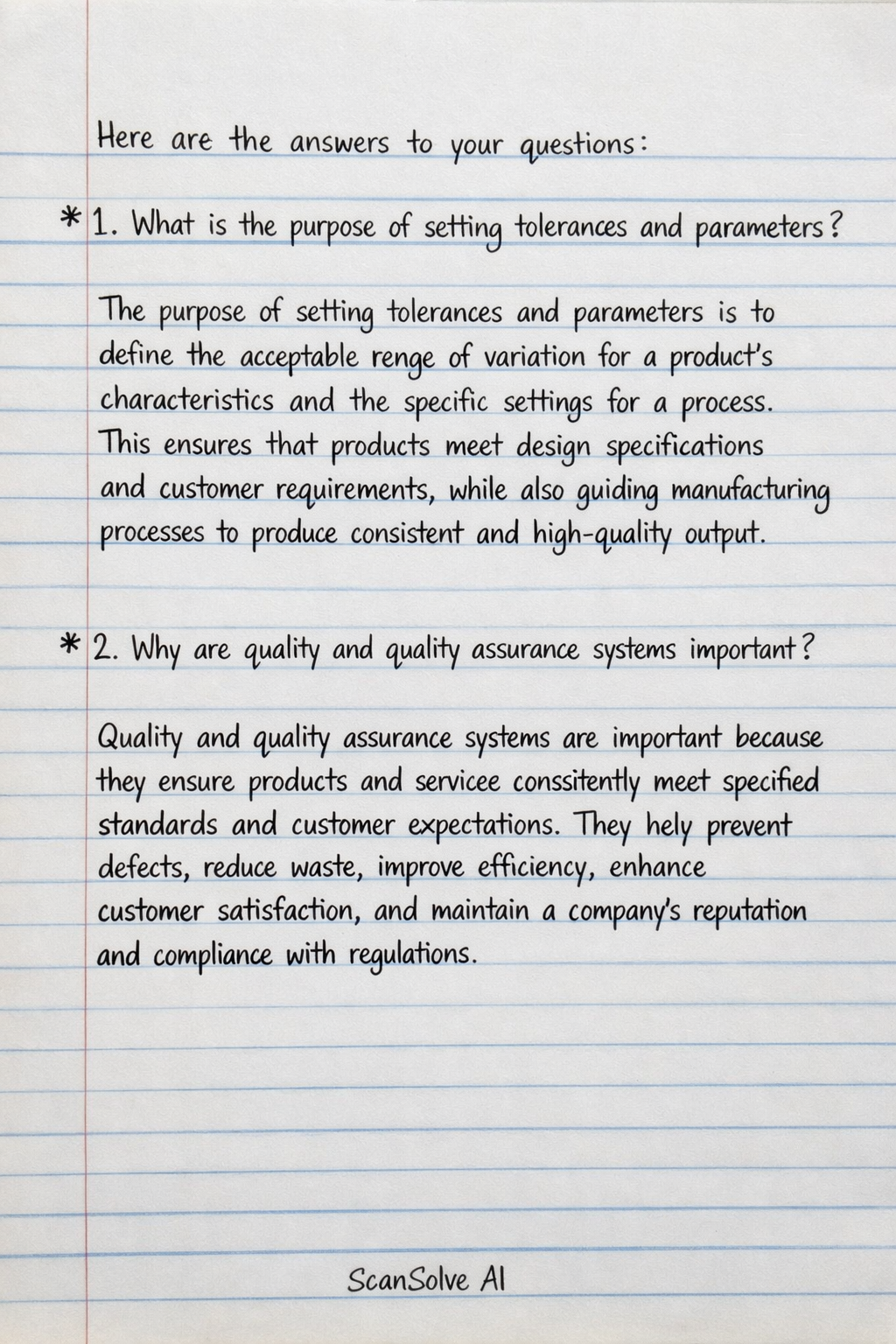
Here are the answers to your questions:
1. What is the purpose of setting tolerances and parameters?
The purpose of setting tolerances and parameters is to define the acceptable range of variation for a product's characteristics and the specific settings for a process. This ensures that products meet design specifications and customer requirements, while also guiding manufacturing processes to produce consistent and high-quality output.
2. Why are quality and quality assurance systems important?
Quality and quality assurance systems are important because they ensure products and services consistently meet specified standards and customer expectations. They help prevent defects, reduce waste, improve efficiency, enhance customer satisfaction, and maintain a company's reputation and compliance with regulations.
3. What is the purpose of work instructions or SOP's?
The purpose of work instructions or Standard Operating Procedures (SOPs) is to provide clear, step-by-step guidelines for performing tasks. They ensure consistency in operations, reduce errors, facilitate training, and help maintain safety and quality standards across all processes.
4. What is the purpose of control charts?
Control charts are statistical tools used to monitor a process over time to determine if it is in a state of statistical control. Their purpose is to distinguish between common cause variation (inherent to the process) and special cause variation (assignable factors), allowing for timely intervention to maintain process stability and predictability.
5. Is the tolerance of a product specification the same as a control limit?
No, the tolerance of a product specification is not the same as a control limit. Tolerance limits (or specification limits) define the acceptable range for a product's output based on customer requirements or design. Control limits, on the other hand, are derived from the process's own historical data and indicate the expected range of variation when the process is stable and in control.
6. When looking at control charts, which chart should be looked at first? Why?
When looking at control charts, the range (R) chart or standard deviation (S) chart should be looked at first. This is because these charts monitor the process variation. If the process variation is not in control, the control limits for the mean (X-bar) chart will be unreliable, making it impossible to accurately assess the process average.
Still stuck on this one?
Ask a follow-up, and the answer starts from this question.
More Business/Management Questions
Handwritten Step-by-Step Solution
Get this as a handwritten image on WhatsApp — like a tutor wrote it for you.
Try on WhatsApp