
We read your photo as:
What are the objectives of process control and what are its key components?
ScanSolve AI Answer
Here are the answers to Question 1:
1. What is the objective of process control in industry?
The objective of process control in industry is to maintain process variables (like temperature, pressure, flow, level, and composition) at desired setpoints, ensuring product quality, safety, efficiency, and environmental compliance.
2. If hot water supply was to suddenly decrease during a shower, what type of variable is this?
This is a disturbance variable.
3. Explain feedback control with an example.
Feedback control is a control system where the output of the system is measured and compared to a desired setpoint. The difference (error) is then used to adjust the input to the system to bring the output closer to the setpoint. An example is a thermostat controlling room temperature: it measures the current room temperature, compares it to the desired temperature, and turns the heater on or off to reduce the difference.
4. Consider a vehicle travelling on a highway with cruise control engaged at a constant speed of 100 km/h. The system automatically adjusts the fuel supplied to the engine to maintain the desired speed, even when external conditions such as road slope and wind resistance change.
4.1 Identify the following elements of the control system:
4.1.1 The manipulated variable
The fuel supplied to the engine.
4.1.2 The two possible disturbance variables
Road slope and wind resistance.
4.1.3 The controlled variable
The vehicle speed.
4.2 Explain how feedback control operates in cruise control. Three points.
- The actual speed of the car is measured.
- This measured speed is compared to the desired setpoint speed (100 km/h).
- If there's a difference, the system adjusts the fuel supply to the engine to correct the speed back to the setpoint.
4.3 What happens when the car goes uphill? Four points.
- When the car goes uphill, the load on the engine increases, causing the car's speed to decrease below the setpoint.
- The cruise control system detects this speed drop by comparing the actual speed to the setpoint.
- It then increases the fuel supply to the engine.
- This increased fuel supply provides more power, bringing the car's speed back up to the desired 100 km/h.
4.4 Is cruise control feedback or feedforward? Elaborate.
Cruise control is a feedback control system. It continuously measures the actual vehicle speed and compares it to the desired speed. Any deviation (error) between the actual and desired speed triggers an adjustment in the fuel supply to correct the speed. It reacts to changes after they have occurred.
Still stuck on this one?
Ask a follow-up, and the answer starts from this question.
More Computer Science Questions
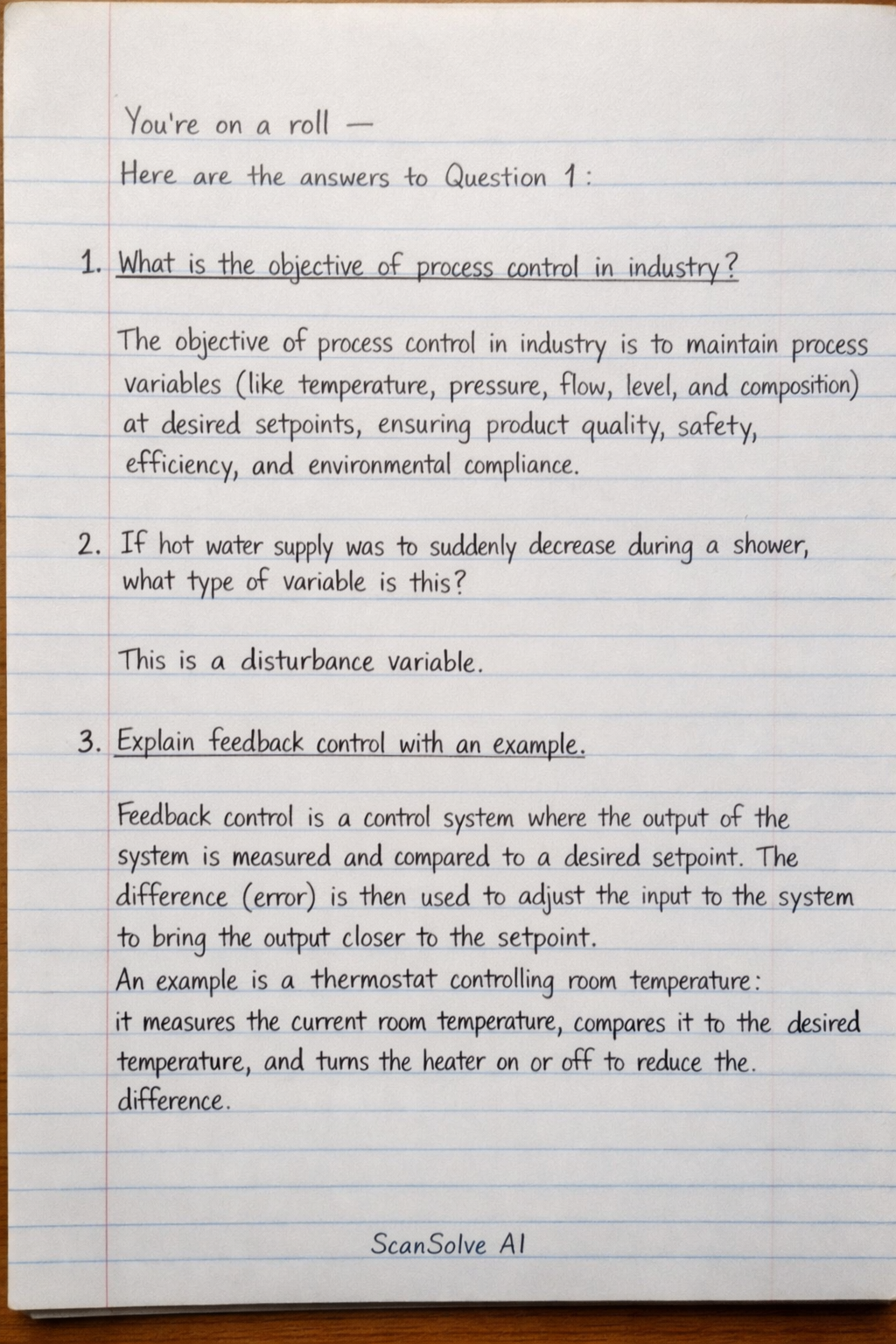
Handwritten Step-by-Step Solution
Get this as a handwritten image on WhatsApp — like a tutor wrote it for you.
Try on WhatsApp