
We read your photo as:
ANSWER ONLY TWO QUESTIONS Q1. a) Briefly explain the three major inventory control techniques: EOQ, JIT, and ABC Analysis. b) State four major challenges faced in inventory management
ScanSolve AI Answer
here are the answers to the remaining multiple-choice questions and two questions from Section B:
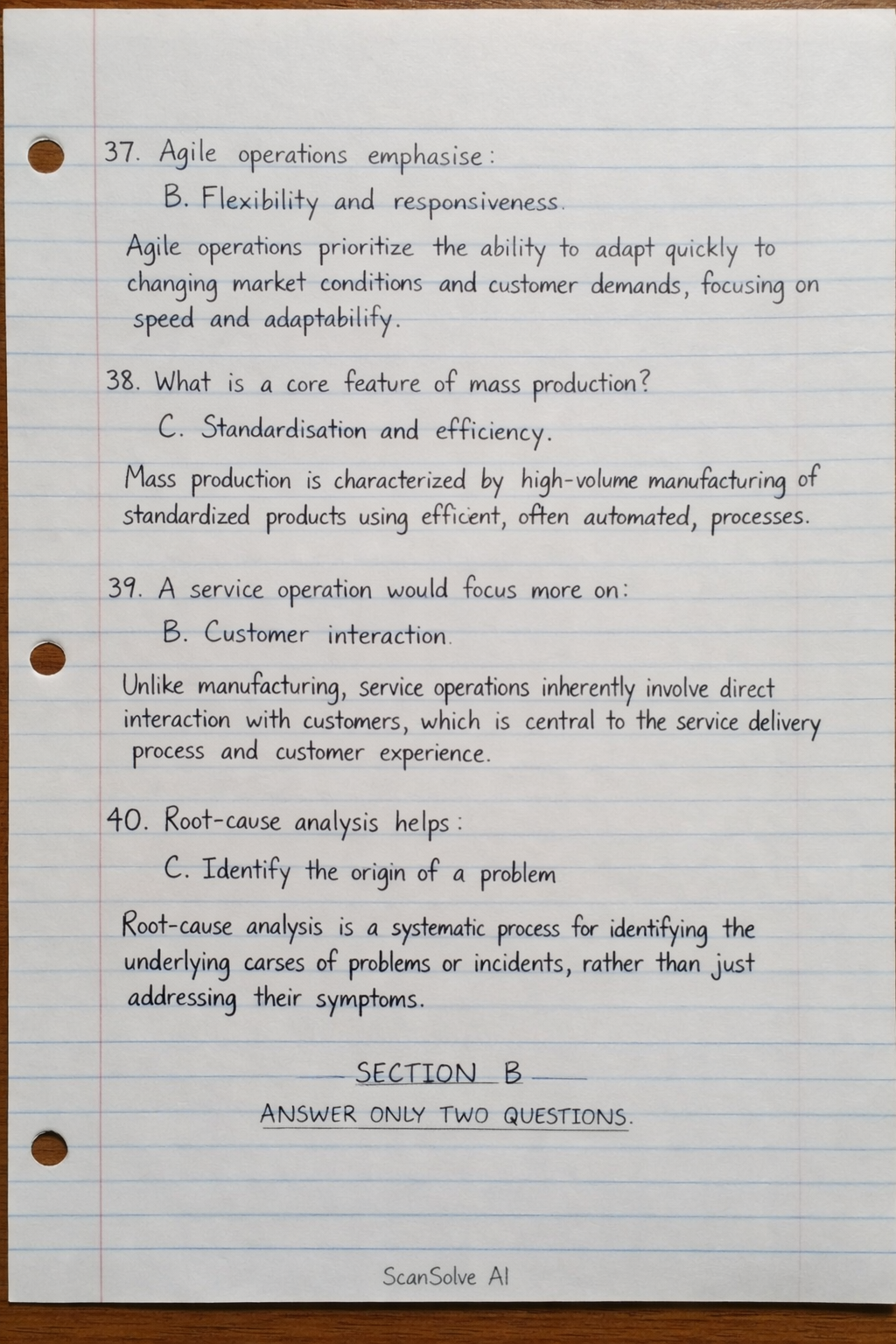
37. Agile operations emphasise:
B. Flexibility and responsiveness
Agile operations prioritize the ability to adapt quickly to changing market conditions and customer demands, focusing on speed and adaptability.
38. What is a core feature of mass production?
C. Standardisation and efficiency
Mass production is characterized by the high-volume manufacturing of standardized products using efficient, often automated, processes.
39. A service operation would focus more on:
B. Customer interaction
Unlike manufacturing, service operations inherently involve direct interaction with customers, which is central to the service delivery process and customer experience.
40. Root-cause analysis helps:
C. Identify the origin of a problem
Root-cause analysis is a systematic process for identifying the underlying causes of problems or incidents, rather than just addressing their symptoms.
SECTION B
ANSWER ONLY TWO QUESTIONS
Q1.
a) Briefly explain the three major inventory control techniques: EOQ, JIT, and ABC Analysis.
-
Economic Order Quantity (EOQ): This is a model used to calculate the optimal quantity of inventory to order at a time to minimize the total inventory costs, which include both holding costs (cost of storing inventory) and ordering costs (cost of placing an order). The formula for EOQ is:
where is annual demand, is ordering cost per order, and is holding cost per unit per year.
-
Just-in-Time (JIT): JIT is an inventory management philosophy that aims to minimize inventory levels by receiving goods and materials only when they are needed in the production process, rather than storing large quantities. Its goal is to reduce waste, improve efficiency, and lower inventory holding costs.
-
ABC Analysis: This is an inventory categorization technique that classifies inventory items into three categories (A, B, and C) based on their annual consumption value.
- A-items: High-value items that represent a small percentage of total inventory items but a large percentage of total inventory value (e.g., 10-20% of items account for 70-80% of value). These require tight control.
- B-items: Medium-value items, representing a moderate percentage of both items and value.
- C-items: Low-value items that represent a large percentage of total inventory items but a small percentage of total inventory value (e.g., 50-60% of items account for 5-10% of value). These require simpler control.
b) State four major challenges faced in inventory management
- Accurate Demand Forecasting: Predicting future customer demand precisely is difficult, leading to either overstocking (high holding costs, obsolescence) or understocking (lost sales, customer dissatisfaction).
- Balancing Costs: Managing the trade-off between inventory holding costs (storage, insurance, spoilage) and ordering/setup costs, as well as potential stockout costs.
- Lead Time Variability: Unpredictable variations in supplier delivery times can disrupt production schedules and lead to either excess inventory or shortages.
- Obsolescence and Spoilage: For certain products, the risk of becoming outdated, damaged, or expiring before being sold can lead to significant financial losses.
Q2.
Explain the five main types of processes used in operations. Include an example of each and highlight their differences.
The five main types of processes used in operations, often arranged on a spectrum from low volume/high variety to high volume/low variety, are:
-
Project Process:
- Characteristics: Unique, complex, one-off activities with a defined start and end. High customization, low volume. Resources are often brought to the product.
- Best-use scenario: When the product or service is unique and requires significant planning and coordination.
- Example: Building a custom house, developing a new software application, launching a new marketing campaign.
- Differences: Highly flexible, long duration, often involves a dedicated team, non-repetitive tasks.
-
Job Shop Process:
- Characteristics: Produces a wide variety of products or services in low volumes, each often requiring a different sequence of operations. High customization. General-purpose equipment and skilled labor are common.
- Best-use scenario: When customers require highly customized products or services, and demand is intermittent.
- Example: A custom furniture maker, a specialized machine shop producing unique parts, a bespoke tailor.
- Differences: Flexible equipment, skilled labor, high variety, low standardization, often uses a process layout.
-
Batch Process:
- Characteristics: Produces a medium variety of products or services in medium volumes. Products move through stages in batches, meaning a group of identical items is processed together before moving to the next stage.
- Best-use scenario: When there is moderate demand for a range of similar products, allowing for some standardization but still offering variety.
- Example: A bakery producing different types of bread in batches, a printing shop for custom orders, pharmaceutical production of different drug formulations.
- Differences: More standardized than job shop, less flexible than job shop but more than line, uses general-purpose equipment but with more dedicated setups.
-
Line Process (Repetitive Process):
- Characteristics: Produces a high volume of standardized products or services using a fixed sequence of operations. Low variety, high efficiency. Workstations are arranged in a linear flow.
- Best-use scenario: When there is high, stable demand for a standardized product or service.
- Example: Automobile assembly line, fast-food restaurants (e.g., McDonald's), appliance manufacturing.
- Differences: High efficiency, low unit cost, specialized equipment, low flexibility, often uses a product layout.
-
Continuous Process:
- Characteristics: Operates 24/7, producing extremely high volumes of highly standardized products. The output is continuous, not discrete units. Highly automated and capital-intensive.
- Best-use scenario: For products that are commodities and have extremely high, stable demand, where stopping the process is costly.
- Example: Oil refinery, chemical plant, electricity generation, steel production.
- Differences: Highly automated, very capital-intensive, extremely low flexibility, process cannot be easily stopped or changed, continuous flow of materials.
Still stuck on this one?
Ask a follow-up, and the answer starts from this question.
More Business/Management Questions
Handwritten Step-by-Step Solution
Get this as a handwritten image on WhatsApp — like a tutor wrote it for you.
Try on WhatsApp