
Here is a clear, high-yield summary of the section on pharmaceutical warehouse management (pests, storage, performance, and key inventory concepts): Managing Pests in Warehouses Pest control is essential to protect medicines from contamination and damage. Objectives Prevention of pest entry Elimination of existing pests Complete eradication Key Activities Good hygiene and sanitation Proper housekeeping (clean environment) Avoiding congestion/overcrowding of stock Trapping pests Fumigation when necessary Warehouse Operations Effective warehouse operations rely on: Clear procedures and instructions Guidelines and feedback systems Continuous monitoring Staff training General Storage Guidelines for Health Commodities Good storage ensures safety, quality, and efficiency: Clean store daily and remove dust Inspect regularly for pests Ensure ventilation and protect from direct sunlight Keep temperature appropriate (including cold chain products) Restrict access and secure controlled drugs Store items properly stacked (10 cm off floor, 30 cm from walls) Ensure labels, expiry dates, and manufacturing dates are visible Apply FEFO (First Expiry First Out) Store hazardous materials separately Separate usable and non-usable (damaged/expired) stock Performance Indicators in Warehouse Management Key measures of efficiency include: Service level: Should be close to 100% Inventory turnover: > 6 is desirable Inventory shrinkage: 0% ideal Space utilisation: 100% optimal use Holding cost: 30–40% of inventory value Purchase accuracy: Actual vs projected = 1 (ideal) Cost efficiency: Holding costs vs procurement costs = 1 Warehouse Equipment Common tools include: Ladders, pallets, shelves, tables, seats Calculators, torches Locks and keys Fans and housekeeping tools Pallet A platform used for lifting and moving goods using forklifts or pallet jacks. Types of Storage Cold storage: For heat-sensitive (thermolabile) medicines Dry storage: For non-refrigerated items Stock Rotation and Inventory Control FIFO (First In First Out): Old stock used first (preferred method) LIFO: New stock used first (rare in practice) Obsolete stock: Items with no movement for long periods (dead stock) Key Inventory Cost Concepts Carrying (holding) cost: Cost of storing inventory (rent, security, lighting, staff, etc.) Order cost: Cost of placing and processing orders (admin, inspection, payment, etc.) Order cycle: Time between placing orders Lead time: Time from ordering to availability for use Inventory Control Terms Quantity on hand: Actual physical stock available Reorder point: Stock level that triggers reordering Quantity on order: Stock already ordered but not received In transit: Stock shipped but not yet received SKU: Specific stock item identification Unit of measure (U/M): How stock is counted (each, box, case, etc.) Unit conversion: Converting between units (e.g., cases to eaches) Conclusion Stock is equivalent to cash and must be protected Proper systems ensure safety, efficiency, and accountability Good warehouse management prevents losses, expiry, and misuse If you want, I can �combine everything you sent into a complete exam revision sheet or �possible exam questions with answers. Summarize the above
ScanSolve AI Answer
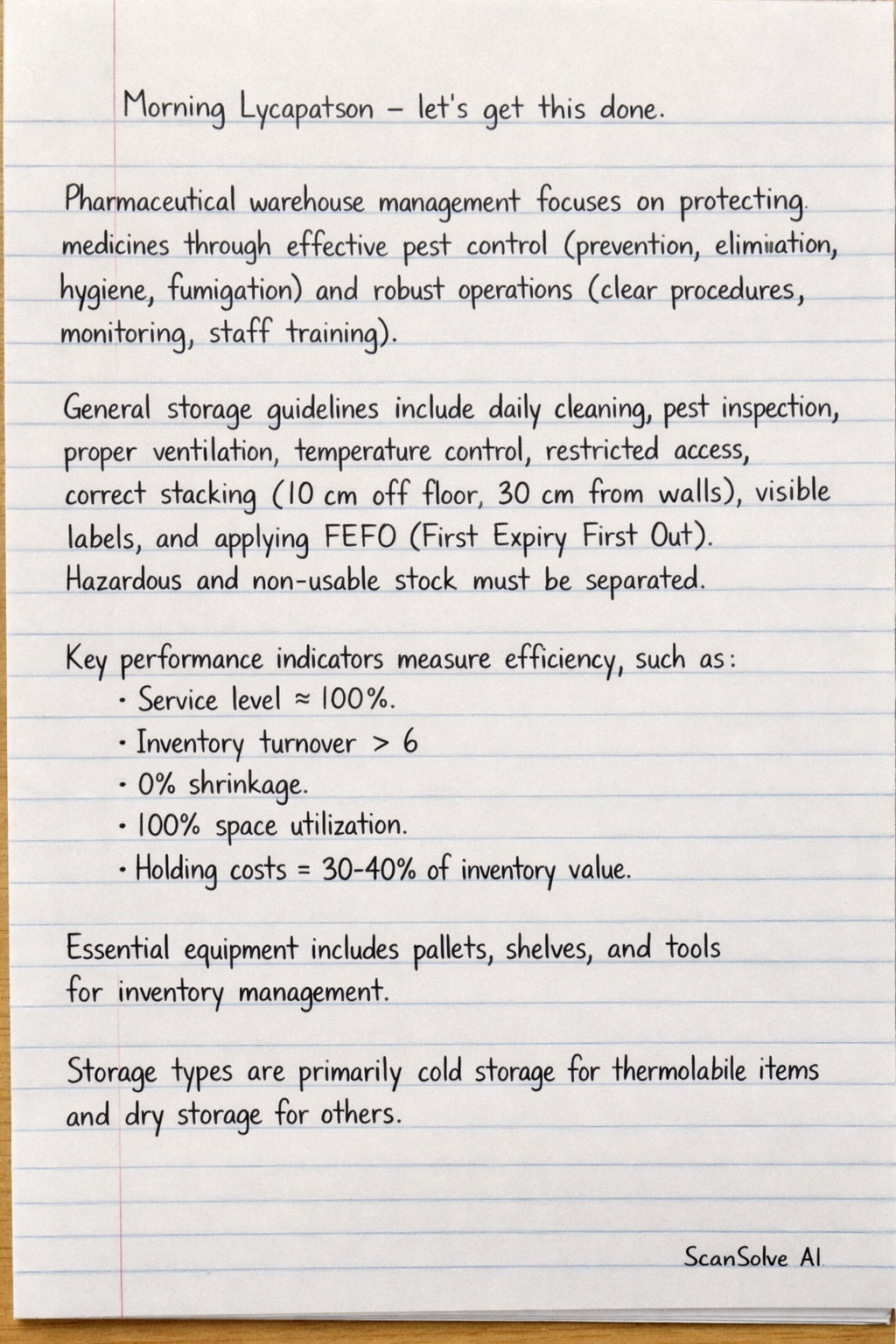
Pharmaceutical warehouse management focuses on protecting medicines through effective pest control (prevention, elimination, hygiene, fumigation) and robust operations (clear procedures, monitoring, staff training). General storage guidelines include daily cleaning, pest inspection, proper ventilation, temperature control, restricted access, correct stacking (10 cm off floor, 30 cm from walls), visible labels, and applying FEFO (First Expiry First Out). Hazardous and non-usable stock must be separated.
Key performance indicators measure efficiency, such as service level (near 100%), inventory turnover (>6), 0% shrinkage, 100% space utilization, and controlled holding costs (30-40% of inventory value). Essential equipment includes pallets, shelves, and tools for inventory management. Storage types are primarily cold storage for thermolabile items and dry storage for others.
Inventory control involves FIFO (First In First Out) for stock rotation, managing obsolete stock, and understanding cost concepts like carrying (holding) cost and order cost. Key terms include quantity on hand, reorder point, quantity on order, in transit, SKU, and unit of measure. Ultimately, good warehouse management treats stock as cash, ensuring safety, efficiency, and accountability to prevent losses.
Still stuck on this one?
Ask a follow-up, and the answer starts from this question.
More Business/Management Questions
Handwritten Step-by-Step Solution
Get this as a handwritten image on WhatsApp — like a tutor wrote it for you.
Try on WhatsApp