
We read your photo as:
Identify and explain the following terms: cost, variable cost, prime cost, inventory control, goods received note, and economic order quantity.
ScanSolve AI Answer
Step-by-step solution
6 stepshere are the answers to these questions:
6. The amount used up to provide a service is
- A. cost.
- Explanation: The cost represents the monetary value of resources consumed or sacrificed to provide a service or produce a good.
7. Cost that changes with the volume of production is
- C. variable cost.
- Explanation: Variable costs fluctuate in direct proportion to changes in the level of production or activity.
8. Direct wages are charged to a product as part of
- B. prime cost.
- Explanation: Prime cost is the sum of direct materials and direct labour (direct wages), which are directly traceable to the production of a product.
9. The process of keeping stores at their optimal level is
- D. inventory control.
- Explanation: Inventory control involves managing the stock levels to ensure that the right quantity of goods is available at the right time, at the minimum possible cost.
10. The use of goods received note is to
- B. check the goods sent by the supplier.
- Explanation: A goods received note (GRN) is a document prepared upon the receipt of goods to confirm that the items and quantities match the purchase order and supplier's delivery note.
11. The most cost effective quantity of goods to order at a time is
- D. economic order quantity.
- Explanation: The Economic Order Quantity (EOQ) is the optimal order size that minimizes the total inventory costs, including ordering costs and holding costs.
12. The document that records the result of continuous stocktaking is
- B. stock verification sheet.
- Explanation: A stock verification sheet or stock card is used to record the results of physical counts and reconcile them with inventory records during continuous stocktaking.
Use the following information to answer questions 13 to 15.
- July 1: Stock balance = 200 units @ D 2.50
- July 5: Receipt = 400 units @ D 3.00
- July 10: Issues = 400 units (The D 5.00 is irrelevant for FIFO pricing of issues.)
13. Calculate the closing stock using the FIFO method of pricing issues.
Determine the total stock available before issues.
- Opening stock: 200 units @ D 2.50 = D 500
- Receipt: 400 units @ D 3.00 = D 1,200
- Total units available = 200 + 400 = 600 units
Calculate the cost of issues using FIFO (First-In, First-Out).
- The first 200 units issued are from the July 1 stock:
- The remaining units to be issued are units. These are taken from the July 5 receipt:
- Total cost of issues = D 500 + D 600 = D 1,100
Calculate the closing stock.
- The July 1 stock is fully issued.
- From the July 5 receipt (400 units), 200 units were issued.
- Remaining units from July 5 receipt = units.
- Value of closing stock =
The closing stock is D 600.
- B. D 600
14. What is the cost of issues using FIFO method of pricing issues?
Identify the units issued from the earliest stock.
- From July 1 stock: 200 units @ D 2.50
Identify the remaining units issued from the next earliest stock.
- Total units issued = 400 units.
- Remaining units to be issued = units.
- These 200 units are from the July 5 receipt @ D 3.00.
Calculate the total cost of issues.
- Cost of issues =
- Cost of issues = D 500 + D 600
- Cost of issues = D 1,100
The cost of issues is D 1,100.
- C. D 1,100
Still stuck on this one?
Ask a follow-up, and the answer starts from this question.
More Accounting Questions
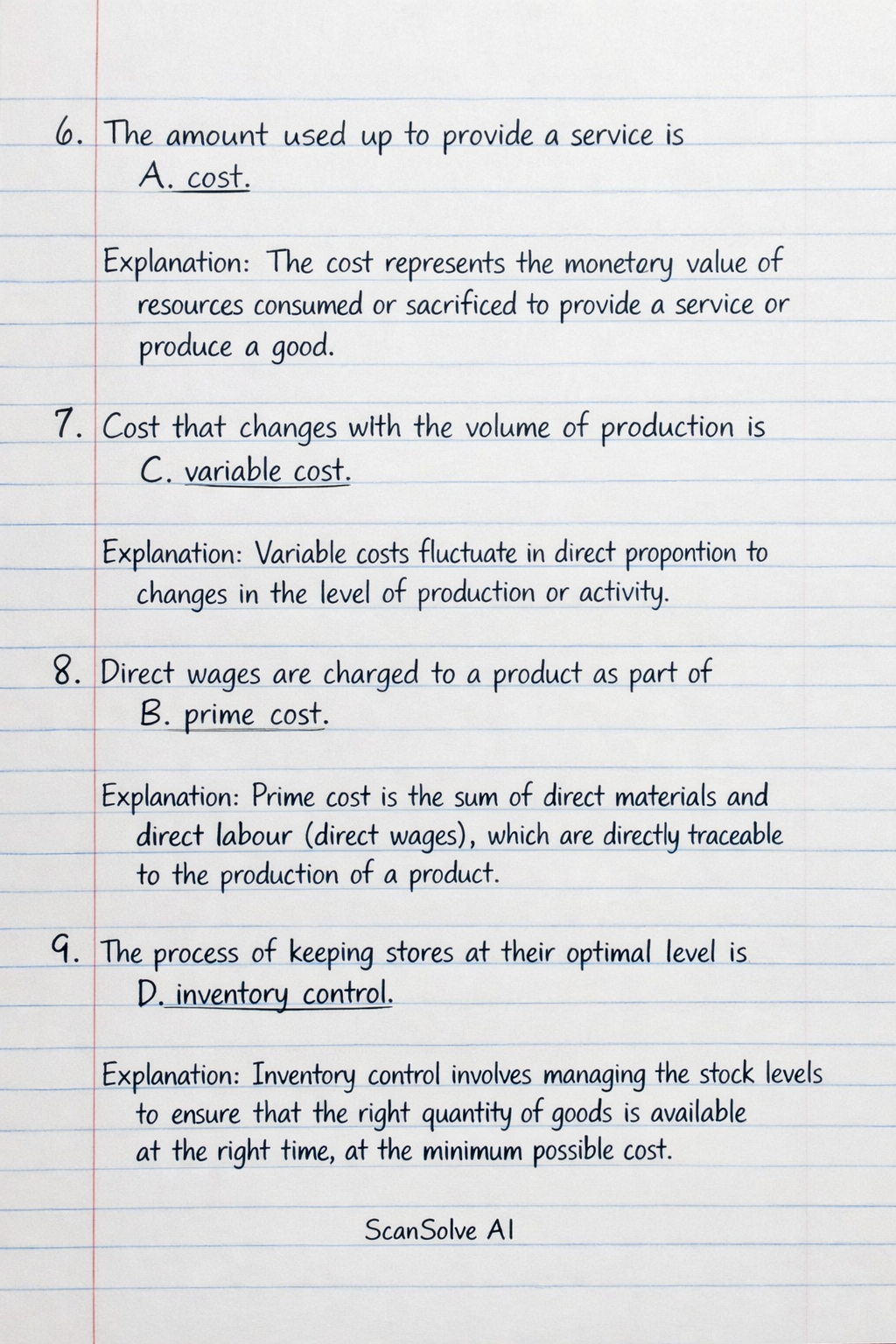
Handwritten Step-by-Step Solution
Get this as a handwritten image on WhatsApp — like a tutor wrote it for you.
Try on WhatsApp